Learn From the Bern

Second post in the series: How Do We Organize A Hundred Million?

th-19

 Learn from the Bern: Learn the Inside/Outside Strategy

The inside/outside strategy is a way to learn as events unfold. It is important that we learn from, work with, and leverage positions we do not entirely agree with.1 Otherwise we are assuming we have already arrived at the “Truth,” when the state of the world — and the state of the movement — strongly suggests otherwise.

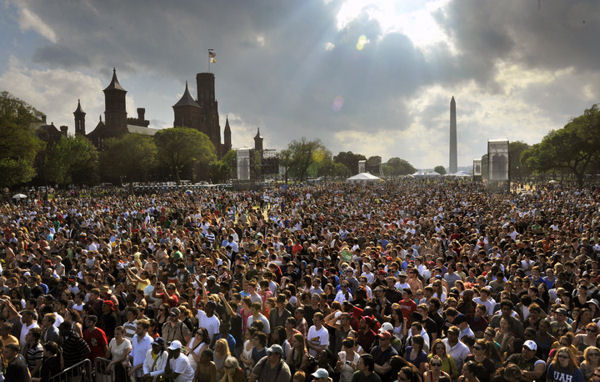
The most important political consideration is this: millions of Americans are learning the power of the people. We are learning that engagement, activism, participation and contest produces power, not silent consent or the passive consumption of  whatever the machines offer.  The people can make history.  The Sanders campaign is a school and it needs to remain in session.

The inside/outside strategy recommends diversity in organizing methods and approaches. So let’s try to learn the inside/outside strategy from the historically unprecedented presidential campaign of Bernie Sanders.

Sanders starts from a position outside of, or on the very margins of, the Democratic Party. Without his decades as an independent and social democrat, Sanders would not have the capacity to give voice to long-standing grievances or propose policy solutions. That independence is the ultimate source of his appeal. Sanders independence from the big money and the big machine won the hearts and minds of millions by proving it was possible to be an honest leader with a positive view of the future. Yes, he ran as a Democrat, and we do risk him bringing some of his supporters back into line. But it is also his best first path to the presidency. It’s a gamble we will have to take and an offer we cannot refuse.

While we cannot predict the future, contingency planning is essential.

As of May 2016, victory is still possible and appears more probable. It is vitally important that Sanders activists push hard to win the nomination.  In addition to the mountain of evidence that Clinton’s politics will keep us on the path to disaster,  Clinton is looking more and more the loser against Trump.   The email scandal, election fraud, and  a pattern of deception and lies in the face of the State Department report; the Clinton machine seems hell-bent on self-destruction.

The inside/outside strategy is demanding. The Sanders surge must pull out all stops on the remaining primaries, court the super-delegates with promises and threats, step up political criticism of the Clinton machine, build for massive protests in Philadelphia, while simultaneously exploring the possibility of a Sanders/Stein ticket. We could, after all, also win with a Green Sanders.

The question is not whether we need a new political system: the question is what is the path forward.

The Bernie or Bust Pledge, over 100,000 strong, is pushing for Sanders or Green Party in case he does not win the Democratic nomination. Bernie or Bust is a leading example of strategic intervention aimed right at the nub of conflicting possibilities.  Socialist Alternative is also sponsoring a petition to encourage Sanders to run as independent or Green.

Still, without the Democratic label the already stunting media blackout and bias would have been total censorship. Organizers and activists would still be searching for the millions of people Sanders has led in a revealing and educational electoral struggle.

And who can deny the fact that the Sanders campaign has made democracy, corporate influence, socialism or the crisis of the two-party system itself a greater subject of public discourse than any movement since Occupy at least and perhaps since the Sixties?

Without the Democratic run the Sanders surge would have faltered on the single quality most lacking the Greens and the social movements generally: a path to power that people can imagine as possible.   Starting with an independent campaign, as many radicals called for, would have presented nearly insurmountable obstacles in reaching the public.  Even as a Democrat, electability was the single greatest objection everyday people raised against Sanders.

Electability/viability/inevitability are central narratives for the corporate media for a reason: “inevitability” is a social control discourse limiting the expression of alternatives and the building of social movements alive with purpose and confidence.

In overcoming, or at least weakening, the electability discourse by expanding the horizon of what is possible, the Sanders campaign has paved the way for other challengers.  The Green Party, better positioned for growth than ever before, can win the 5% necessary for federal funding. 5% is a stepping stone to becoming a truly national party if the Green Party can learn to leverage the Sanders surge; regardless of outcome. The Sanders surge is an unmistakable sign that millions of Americans, the young most of all, agree with Green Party values and ideals.

But, how could Sanders, or we, make the most of this campaign without trying our best to win the Democratic nomination? It is by pushing on to victory — or the bitter end — that millions of people will learn through their own experience the depths of corporate control and corruption of the electoral process.

The now likely contested convention is also fraught with risks and possibilities, but the massive demonstrations already planned for Philly are the most productive movement response.  Afterwards, we can update strategy based on the new facts on the ground.

Revolutionary strategy demands that we embrace Sanders’ contradictory role and make the most of it. It is precisely because Sanders gives expression to contradictory impulses and trends that millions of people can see him as a heroic figure. That makes Sanders the most important political leader in the US, win, lose or draw.

It is up to the social movements to strengthen the “outside” with vigorous resistance movements, civil disobedience and constructive alternatives. It is not a coincidence that the Communication Workers of America, had the vision to both wage and win a historic strike and to support Bernie Sanders when many unions caved into the Clinton machine and lowered expectations to incremental change.  How can we fight for $15 without fighting the machine?

Every twist and every turn holds an organizing opportunity if we can clear our minds  from the straight and narrow. The challenging part for organizers is to not give into the comfort of ideological clarity, easy answers, or machine politics. Stay in the discomfort zone. That is where strategy is discovered because contradictoriness is the actual condition of all social movements. And strategy must emerge from the material conditions at hand.

Can we can see beyond black and white, in or out, good and evil? Static binaries, like “either/or” will not serve us well. Can we master the demanding “both/and” approach of the inside/outside strategy as well as Bernie has?

Is Sanders a transformative leader or a “sheepdog” propping up the Democratic Party? The answer to that is not just Sanders to make. It’s what we do that matters.  If we “learn from the Bern” we should learn that political judgements are best made in the thick of it. The revolutionary organizer is simultaneously insider and outsider.

The inside/outside strategy values organizing and experimentation over the perfect but sparsely populated landscapes of the mind. If not ideological measures or machine politics, what concepts might help us to frame the way forward? Universal values.


1.The inside/outside strategy is a dialectical approach to action. Opposition and multiple viewpoints gives us a lot to learn from.  And learn we must, because strategic organizing is the most challenging form of thought-in-action and the most needed.

Next: Universal Values
Posted in Electoral Strategy for 2016, Movement Culture, Organizing Method, Organizing Strategy, revolutionary strategy, Strategy, Uncategorized | Tagged , , , , | Leave a comment

How Do We Organize A Hundred Million?

First in a series: How Do We Organize a Hundred Million?

Earth-Day

How Do We Organize a Hundred Million?

The strategic considerations discussed in this series of posts assumes that it will take a hundred million activist in the US and many hundreds of millions more worldwide to make revolution. Real politics begin where there are millions, many millions.

We will need millions to overwhelm, undermine and dismantle the machine. And we will need millions to create viable alternatives by building communities with independent control over their water, food, energy and incomes. There is just so much to be done.

The corporate power, military-industrial complex, corporate media, mass surveillance, seventeen secret police forces, global empire, and the vast militarized penal system — all coordinated, regulated and managed by the two-party system — is perhaps the most deeply entrenched power structure in world history.

The consequences of this power: the collapse of democracy, environmental catastrophe, endless war and untold suffering. If current trends continue, the established order is likely to be an existential threat to every county, culture and life-form.  Oh yes, we need millions to change the world.

But this power structure is a product of our history. It is not immortal or monolithic. The internal division exposed by the election of loose cannon and demagogue Trump and the bankruptcy of the corporate Democrats is on full display for any with clear eyes to see.

When in US history have secret police forces openly chosen sides in a US election? The point of the deep state is that it governs us out of sight and out of mind. When a trusted guardian of the establishment, such as Chuck Schumer, reveals on prime-time TV that the so-called intelligence community has the capacity to retaliate against Trump then the curtain is truly torn. Either the internal divisions are terribly desperate or Schumer feels that people are so profoundly ignorant of the fundamentals of democracy that the illusion is no longer worth maintaining. Or both.

Not since the confusion and disarray caused by the Tet Offensive during the Vietnam War has a division within the ruling class been so open. How permanent these divisions are remains to be seen but one things is sure: no matter how bankrupt, criminal, or dangerous the US government has become, that alone will not guarantee the resurgence of pro-democracy movements.

The Democrats for example are struggling to gain control over the movement against Trump and reconstitute themselves on the old basis of corporate power.

While it is important to point out how deep the crisis goes, objective conditions alone will not create the next American revolution.

Ideas and ideologies do matter, but if we are to contest power then we need to go beyond ideological rigor and moral positions. We need a strategy the can help us build movements large and visionary enough to disrupt the inner workings of the corporate and imperial machines driving us so relentlessly toward social and environmental disaster.

The unspoken assumption of the US left is that the right analysis, correct ideology, precise political definitions, or righteous moral positions on the issues will somehow translate into power. We have devoted enormous energy to all those things for decades yet somehow they are not enough.

Instead, we need to complement our ideological and utopian visions with a more strategic sensibility based on the existing conditions and existing social movements. We should look not just at the goal or ideal we desire but study the movement itself. How and why do people move? How is consciousness raised? It takes more than winning a debate or being right. When we move to contest space and contest power then we contest ideas in ways far more meaningful than by discourse alone.

When we move to contest space and contest power then we contest ideas in ways far more meaningful than by discourse alone. The new civil rights movement, Standing Rock and the environmental movement it is leading, and a reemerging movement of soldiers and veterans are good indicators, among others, that the contest over power and space has begun. The point is not what ideas constitute the right analysis, the point is what strategy will get millions of people to take action. When the multitudes move then school is really in session.

A useful strategy can help us learn from — and guide us through — what will undoubted be a time of immense volatility, fluidity and creativity. We are already seeing natural, political and cultural upheaval and disruption and the trends promise more, much more.

With that in mind, a provisional strategy could begin with the inside/outside strategy as a framework for organizing; universal values as destiny and primary rhetorical strategy; and transformation/reconstruction as the historical measure and most likely mode of revolutionary change.

A working theory of revolution must take into account the deep contradictoriness and abiding contingency that is the hallmark of revolution. It is doubtful whether strict ideological standards, moral striving, or machine politics can produce the kinds of creative strategy and tactics necessary to navigate rapidly shifting circumstances. It is unlikely that the revolution will proceed according to our expectations. We must learn to navigate stormy seas or drown.

Next: Learning From the Bern

Posted in American Culture, Cooperation, electoral strategy, History, Labor Movement, Movement Culture, Organizing Method, Organizing Strategy, revolutionary strategy, Uncategorized, union organzing, unions | Tagged , , , | Leave a comment

Why Bernie Should Stay in the Race — And How He Can Win

Some serious food for thought from Kevin Zeese from Popular Resistance and Patrick Walker from Revolt Against Plutocracy.  Published in Truthdig.

The nation, the people and the planet need Bernie to win. And we have to do everything we can to make the happen. So phonebank and send money.

We cannot predict the future but in the eventually that the Democrats make the biggest blunder in recent history and nominate Clinton, there is another path forward and another way to beat Trump. Bernie can run for President with the Green Party and he can win!

In the long run we need an viable opposition party and this kind of contingency planning is part of helping the Green Party grow. In the long run we need to put the Democrats on notice that they cannot take our votes for granted and we will no longer swallow “the lesser of two evils.”

This is a very well researched and well argued article.

http://www.truthdig.com/report/item/why_bernie_sanders_should_stay_in_the_race_–_and_how_he_can_win_20160513


Posted in Uncategorized | Leave a comment

Conclusion to the Series “On Organizing:” Evolution to Revolution

20110224_wi_2

Last in the series: On Organizing

History Has Not Come To An End

The series “On Organzing” aims to help us learn from the challenging and confusing dialectical tension that is every organizers terrain and trouble.  Among the most productive problems we face can be understood as those between change and continuity, the personal and the political, ideals and interests, planning and opportunity, and the transitions from evolutionary to revolutionary  forms of unionism.

Evolutionary Change

While these different versions of unionism discuss in “On Organizing” are not necessarily higher and lower stages of development it is difficult to envision how unions could aspire to social movement unionism without a history of solid service to its members, a strong ethical foundation and the kinds of experience that comes from struggling over the defense of the public interest.

Once we reconceptualize unionism in this way two approaches recommend themselves for resolving the tension between service and organizing and social moment unionism. First we should attempt to latch on to service functions and improve them by finding the organizing potential within them. That means that organizers must develop synergistic programs between organizing and legislative, grievance work, or negotiations. Usually grievance officers and lobbyists prefer casework or palace politics but that is the challenge. But by encouraging the participation of members, the organizer can avoid the zero-sum struggles for union resources and reconnect the lost link between organizing and the representative functions that were created by member activism decades ago.

Many unions already practice synergy by emphasizing community outreach by members during electoral campaigns, direct member interaction with legislators, member engagement with negotiations thought advisory committees, or face to face organizing teams that poll and educate members, or by entrusting union work, including grievances, to a shop steward type system. At first this may be more work for staff and leaders but in the long run could mobilize members and prove that organizing is not just about getting more members.

Organizing for Transformative Change

For us to go beyond just building an organization and to organize movements for fundamental social change we will need passage beyond the ancient theological model of either/or choices and static binaries so deeply embedded in convention radical thinking.

The inside/outside strategy depends on the creation of organizational centers outside the organziation that work in conjunction with clusters of interest and support inside. The “outside” organization becomes a safe home for activists and supporters to exchange information, develop strategy, publicize their agenda and make their case free from internal union pressures or organizational rivalries. The insider supporters funnel resources to the independent organization, legitimize its work, and bring its views into union discourse and practice.

It is the “outside” with its pressure politics and disruptions that we so lack today.

The key is to coordinate the efforts of people and organizations along a range of political and institutional positions. This tactical diversity and flexibility aims to create a push/pull dynamic edging the union toward more desirable activity.

In transformative organzing, the IOS also depends on the ability to travel between opposing, or what seem to be opposing ideas. Beyond either/or patterns of rejection or acceptance to learn from and include different political concepts and positions.

The ability to work within the multiple oppositional tensions I have described requires a certain degree of balance and calls on the organizer to master dialectical relationships through the art of dialogue, connection, and commensurability. Organizers are liminal figures that straddle political thresholds and borderlines: the “inside outsider,” the person with one foot in the community and one foot out, the “other” within.

The political passage, betwixt and between, is trod as the organizer helps a community live up to ideals agreed to in principle but unrealized in practice by struggling to do the same.

In “On Organizing” I have argued that organizers work in a world of contradiction. It is our goal to place these seemingly static oppositions in flux. To see the present in the light of the past, to find our personal lives embedded in the political world, to discover the connections between our particular interests and universal values; to both prefigure a better world and protest the existing one. This is how we reorganize the mind. Then maybe, fate will favor the prepared and social movements will build  the capacity to reach the many millions it takes to approach the threshold of revolutionary change.

Remember that history has not come to an end. It’s just that we cannot know its pace or foresee its twists and turns. Despite the triumphant claims of global elites that there is no alternative to the present regime, this, too, shall pass. If history is a credible guide, new possibilities may grow right out of the heart of corporate and imperial dominion.


Posted in American Culture, Corporate Power, Labor Movement, Movement Culture, organizing, Organizing Strategy, revolutionary strategy, Strategy, Uncategorized, union organzing, unions, Working Class | Tagged , , | Leave a comment

Social Movement Unionism: Right Here! Right Now!

th-22

Dedicated to the Chicago Teachers Union and teacher activists everywhere.

Seventh in the Series: On Organizing.  See What is Social Movement Unionism? for the first part of this post including the Battle for Seattle, Occupy and the Great American Boycott.

Right Here! Right Now! Continued….

“We are now faced with the fact that tomorrow is today. We are confronted with the fierce urgency of now.”   Martin Luther King

Black Lives Matter and Ferguson

In 2012, after the shooting of Trayvon Martin and the acquittal of his murderer, Black Lives Matter organized to rebuild the moment for black liberation, this time fully affirming the lives and leadership of people from all along the spectrum of gender, sexual, and able identities.1  Here is something for labor organizers to learn: social movement unionism embraces and expresses the full range of alternative political identities and consciousness aiming toward the realization of democracy.

In August 2014, thanks to the people of Ferguson, the long-simmering civil right movement was refounded as a dynamic national movement. Again, it was grassroots activism that created the possibilities for social movement unionism.  And, it was activists,  particularly black and low wage workers that brought #blacklivesmatters into union work.  AFL-CIO President Trumka did make a clarion call to consciousness, even recognizing labor’s racist past. But, much of the organizing came from workers centers, domestic workers and other groups along the dynamic edge of the working-class movement.

Stephanie Luce, writing for Public Seminar, outlines the potent, if rocky, relationships  between labor and the new civil rights movement.

Alicia Garza, one of the founders of Black Lives Matter, is also on staff with the National Domestic Workers Alliance, highlighting the ways in which activists are linking economic and racial justice (including with immigrant rights issues).

In many ways, the alliance is an obvious one. Black workers comprise a disproportionate share of low-wage workers; they also have higher unionization rates than non-Black workers. The movements for economic justice and racial justice have intersected throughout history — from the movement to abolish slavery to the collaboration between civil rights groups and public sector unions in the 1960s. Yet that does not mean the alliance is a natural or easy one. Labor unions have an unflattering history of racial exclusion, and while an increasing share of union members are black, the leadership is still overwhelmingly white. And many civil rights organizations, including churches have tried to avoid confrontational class-based politics for fear it could be divisive within the black community, or due to relations with the Democratic Party and elected officials.

The greatest potential for social movement unionism lies in bottom up coalitional work between labors’ activist edge and the array of new organizing projects leading the new civil rights movement. And yes, we are still hobbled because of racism within unions and because labor, civil right groups and churches accept the limits dictated by the Democratic Party.

But like the movements of the late 60s and early 70’s Ferguson moves beyond the liberal consensus of conservative unions and the Democratic machine . In a recent forum by Viewpoint the new civil rights movement proves itself rich with potential for new strategic alliances. Viewpoint’s editors introduce “Strategy After Ferguson:”

The eleven groups featured below constitute part of what may be an emerging radical pole in the struggle for black liberation. Even in their analytical divergence and organizational heterogeneity, they yield the outlines of a revolutionary unity, opposed to separatism, whose ambitions exceed that of the misleadership both new and old.

The political vision of those eleven organizations offer far more than hope. Historically grounded, politically astute and strategically savvy; they represent a movement with which alliances are possible and synergies abound.

It’s worth remembering the 1968 Poor Peoples Campaign.  Although ill-fated, it pointed the way toward an interracial movement that aimed at the core power structure of the day: the evil triplets of militarism, racism and economic exploitation.   A  New Poor Peoples Campaign For Today aims to pick up on that power.  When movements for racial justice, peace and economic democracy merge that is social movement unionism.

The Sanders Surge is a Social Movement.

For the first time in living memory a presidential campaign has unleashed revolutionary spirits.  Against all odds — and against expectations of the left, right and center — Sander’s call for a political revolution is moving millions.  And, we must admit that serious politics starts where there are millions of people.  We need not see Sanders as some perfect hero to learn how to leverage the Sanders surge.  But we do need to move toward a transformative electoral strategy. 

The mass demonstrations, protest marches, and record-setting meetings are raising  consciousness.  Sanders has already made history by running a major presidential campaign funded by everyday Americans.  Only the Green Party aspires to do the same.

It’s hard to understate the importance of restoring class politics to the electoral arena.  It’s about more than just issues.  A major political realignment seems possible.  The much maligned but potentially powerful white-working class is moving decisively in the direction of the social movements.  The multi-racial protests against Trump may not be formally part of the Sanders campaign, but they are part of how this election is taking on the transformative possibilities of a social movement by extending the horizon of the  possible.

It is time for organizing and movement building.  And it is time to disrupt.

There is a power shift underway.  The Sanders surge is disrupting the ruling strategy of triangulation and subverting its social control narratives: fear and fatalism, lesser of two evils, electability, inevitability, “there is no alternative” and the spoiler. It is the organizers task to show how those narratives no longer describe the new realities even though the corporate media and the machines repeat them a thousand times.

Yes, a new world is possible.

Much to labor’s discredit, the invitations to social movement unionism have almost all come from the social movements and an exceptional electoral campaign.  It is up to us to accept the invitation by encouraging rank and file activism and popular dissent.

Social movement unionism will reach the revolutionary threshold when the fusion of class race, gender, anti-imperial, environmental, youth and sexual consciousness finds simultaneous and equivalent expression in mass movements that incorporate all of the different trends yet is greater than the sum of its parts.  Well, easier said than done. But, who supposes that social transformation will be easy?

Here, then, are the major social upheavals of our time:  the 1999 Battle for Seattle, the 2003 global resistance against war and empire, the Great American Boycott of 2006, Wisconsin and Occupy in 2011,  Black Lives Matter 2012, the Ferguson rebellions of 2014, and the Sanders surge of 2016.   This is evidence; potent and unmistakable. It is possible to create a revolutionary movement and a revolutionary strategy.

Look at America.  We are ready to begin anew.


  1. For a new and insightful interpretation of BlackLivesMatter, See Keeanga-Yamahatta Taylor, From #BlackLivesMatter to Black Liberation
Posted in American Culture, Corporate Power, Electoral Strategy for 2016, History, Labor Movement, Martin Luther King, Movement Culture, organizing, Organizing Method, Organizing Strategy, revolutionary strategy, Strategy, Uncategorized, union organzing, unions | Tagged , , , , , | Leave a comment

The March 15 Primaries and St.Patricks Day?

I usually avoid doing news commentary because I am not good at it. But, here are some quick and dirty observations on the March 15 primaries.

In all cases but one Sanders outperformed the polls. The delegate split was not what we wanted but not an overwhelming defeat by any means.

The defeat in Ohio was awful but some unknown number of Democrats crossed over to the Republican side to vote against Trump. Switching is allowed under Ohio law. This demonstrates the weakness of both the “lesser of two evils” and the politics of fear.

Sanders loses in Chicago despite the recent powerful and important movement against Trump. Chicago is famous for electoral corruption. Major Emanuel’s machine and the conservative unions (AFT,NEA,SEIU, AFSME) are heirs to a well-established vote producing apparatus.  They have power, patronage and jobs to dispense.

The rural and southern part of the state, historically more “southern” in culture nonetheless votes for Sanders. He is reaching voters not connected to the status-quo machines.

Western North Carolina is the Appalachian region. Generally whiter and poorer that the rest of North Carolina and it was Sander’s only stronghold in the state. It shows that the white working-class, far from the conservative machines, will vote for a real reformer rather than a fascist. Cheers! We have been waiting for the white working-class to wake up and this is a very good thing.

Also worth noting that Swain county, also in the same pro-Sanders Appalachian region, includes the Cherokee reservation, one of the most populous native reservation east of the Mississippi.

In Florida some 3.2 million independence are shut out of the closed primary system and independents tend toward Sanders. Sanders only wins counties in the panhandle, another good inroad into Trump and Clinton territory and indication that working-class people are waking up.

And Keep in mind the Florida has one of the most corrupt histories in the country when it comes to elections. Remember when Jeb stole the 2000 election? Ex -felons are barred from voting for life in Florida for example, the only state to do so.

And Missouri, one of the more culturally “southern” and culturally conservative of the “northern” states is a dead heat. Again showing the potential reach of the message of  that the economy and political system are rigged regardless about our assumptions about demographics.

The lesson here is that its not just about some demographic, about how white workers or black voters or anybody is supposed to behave.  Its about changing the world by being engaged and organized. If the conservative machines can produce votes for the weaker candidate we can get organized to produce votes for the stronger candidate.

We know the Clinton machine is one of the most deeply entrenched political organizations in the world. They have the status quo, power, jobs and patronage.  Changing this will not be easy.

As St. Patrick Day approaches my thought run to Irish history.

The Wild Irish lived “Beyond the Pale.” Outside of the control of the British Imperial system.

Sinn Féin, the name of leading party for independence is translated as “we ourselves.”

“Tiocfaidh ár lá” a legendary Irish saying is  “our time will come.”

We have each other and our ideals and maybe, just maybe, our time has come.

The Great Only Appear Great Because We Are On Our Knees: Let Us Rise! — James Connolly.

images-12

Posted in Uncategorized | 1 Comment

What is Social Movement Unionism?

th-22

Sixth in the series: On Organizing

What is Social Movment Unionism?

The rarest and most politically charged form of unionism, social movement unionism is also the most difficult form of working-class rebellion to define or realize. When the borderlines between working class struggles and movements centered on race, gender, sexuality, age, and empire merge into a movement of movements — then political innovations and revolutionary changes are afoot.

Revolutions defy easy description, and we have yet to articulate a working theory.  But, if we look carefully at social movement unionism  we might begin to see the political attitudes and alliances that can help us envision what transformative change looks like in our time. The evolution of union activity: from conventional unionism, to professional unionism to public interest unionism takes us to the revolutionary threshold of social movement unionism. 

As we approach that threshold, members, leaders and staff consciously belong to a larger national and international effort dedicated to the creation of freedom and democracy in the union, workplace, and in society. The sense of community extends to the furthest horizon as unions claim to represent the interest of all the people. Social movement unionists often adopt the language and agenda of citizenship movements by working to exercise and extend basic human and civil rights into the workplace. We lay claims to democratic political traditions.

Social movement unionists aim beyond the workplace because they believe that workplace democracy will not likely be achieved outside of a broad popular movement that can alter the structures of law and political power.

For this reason, social movement unionists act in concert with other social movements and organizing and community building are given primacy. They value coalition work and for inspiration on vision and tactics, they look to the civil rights and other racial liberation movements, community organzing, feminism, and gay liberation.  Unions closely associated with social movements (such as the early United Farm Workers), and the rank and file rebellions of the pre-1940’s labor movement also provide good examples.

Social movement unionism embraces and expresses the full spectrum of alternative political identities and consciousness aiming toward the realization of democracy. And,  has emerged most frequently as local community struggles, often those of poor and immigrant workers.1

Perhaps most important, social movement unionism can only be created by rank and file activism — be that inside or outside of formal union structures. Workers who live at the intersection of multiple freedom movements are well suited to lead the way. Both labor and civil rights, and/or peace, and/or immigration,  and/or women’s rights, and/or environmentalism and/or gay liberation and so on and on.

Social Movement Unionism: Right Here, Right Now!

“Our challenge,” Martin Luther King said, “is to organize the power we already have in our midst.”

Social movement unionism is not distant utopia.  It is both means and ends, path and destination. From King’s perspective, all the deep cultural resources and  political ideals we need for social transformation already exist.  Take a good look, there is an American revolutionary tradition.  Now, we need the political skill and organizing savvy to make it real again.  Consider the following. We the people are ready.

“The Battle for Seattle”

The complex international constellation of social movements, ideas, discussions and organizing that lead up to and were a consequence of the 1999 “Battle for Seattle” offer us a glimpse of what social movement unionism might look like today on a grand scale.  The civil disobedience and protest that shook Seattle had a distinctly northwestern flair as local activists and labor and populist traditions set the stage for a gathering of international justice groups from the global North and South, as well as unions, women’s and environmental organizations.

The coalition of “Teamsters and Turtles” proved fragile but Seattle remains a powerful  example of what might be. Seattle remains one of America’s most organized and active cities.

Against War and Empire

While 9/11 and the so-called war on terror profoundly interrupted the course of social movement activism and international solidarity, the international coalitions that protested against the War in Iraq produced the largest global demonstrations in world history. On Feb. 15, 2003, a truly uncountable number — estimates range from 15 to 36 million — took to the streets to stop what we now know to be one of the greatest blunders in the blunderous history of the American Empire.

Today veterans of Iraq and Afghanistan are the working-class voice for veteran rights and against war and islamophobia. The Iraq Veterans Against the War,and Veterans for Peace continue the traditions of soldier and veteran resistance to war that go back to Vietnam Vets Agains the War.  VoteVets seeks restraint in US military policies, support for the veteran community and endorses veterans running for federal office.

Look at grassroots leadership and there you will find veterans. Listen to them.

The Great American Boycott

On Mayday 2006 approximately one million people in 50 US cities avoided work, school and shopping to march in one of the largest days of protest in American history.  Inspired by the farmworker movements of the 20th Century, Mexican-Americans and other Latinos played crucial leadership roles and filled the streets. The AFL-CIO and Change to Win endorsed the event, in part, because tens of thousand of new union members were immigrants. The Great American Boycott focused on immigration reform at a time when many unions were changing their attitudes and policies toward immigrants. Solidarity was recast in broader, multi-racial and multinational terms, then US labor had previously been willing to do. That is a serious breakthrough.

The movement continues and organizations, such as the FAIR coalition, continues to make connections between economic justice, immigration, racism and the record deportations under the Obama administration.

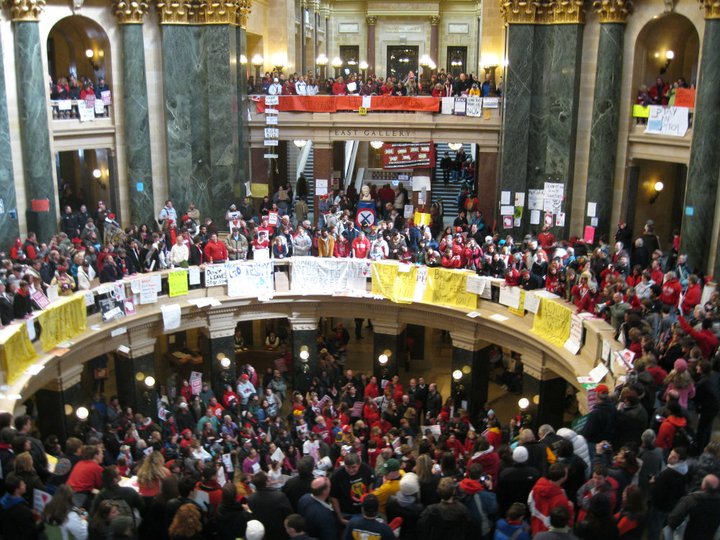
Wisconsin and Occupy

In 2011, the people of Wisconsin, led by a union of teaching assistants long steeped in the social movement style, kicked off the first massive anti-austerity demonstrations since Seattle.  Later that year, the Occupy movement sparked a tsunami of international resistance against austerity and the corporate power. The 99% resonated with millions of people and gave new life to class consciousness and class solidarity — reinvesting “class” with its broadest possible meaning.  In a burst of revolutionary creativity, the working-class and “We the People,” merged into the 99%.

Economic democracy became a mass aspiration.  In contesting public space, the occupations became a living embodiment of the 99% in hundred of cities and towns much as the Flint Sit-down strikes had triggered similar occupations and similar demands for economic democracy during the Great Depression. At countless meetings, people experienced direct local democracy often for the first time.

Occupy redirected feelings of  resentment against public employees — or just the person working down the hall or living next door — by focusing on the 1%.  Occupy made the corporate power visible again. At first, some in the union movement picked up on fresh faces and new messages that occupy created.  But, as Occupy waned, labor officials returned to the muddled discourse about the “middle class” and business-as-usual machine politics.  Occupy faded but never disappeared as many groups continue activism around the country. Revolutionary outlooks and energies may have submerged but still ran deep among the union rank-and-file and the 99%.


Next: Right Here, Right Now! Continued…..


  1. Vanessa Tait, Poor Workers Unions. Emmanuel Ness, Immigrants, Unions, and the New U.S. Labor Market.
Posted in American Culture, Cooperation, Corporate Power, History, Labor Movement, Martin Luther King, Movement Culture, Organizing Method, Organizing Strategy, revolutionary strategy, Strategy, Uncategorized, unions, Working Class | Tagged , , , , | 1 Comment

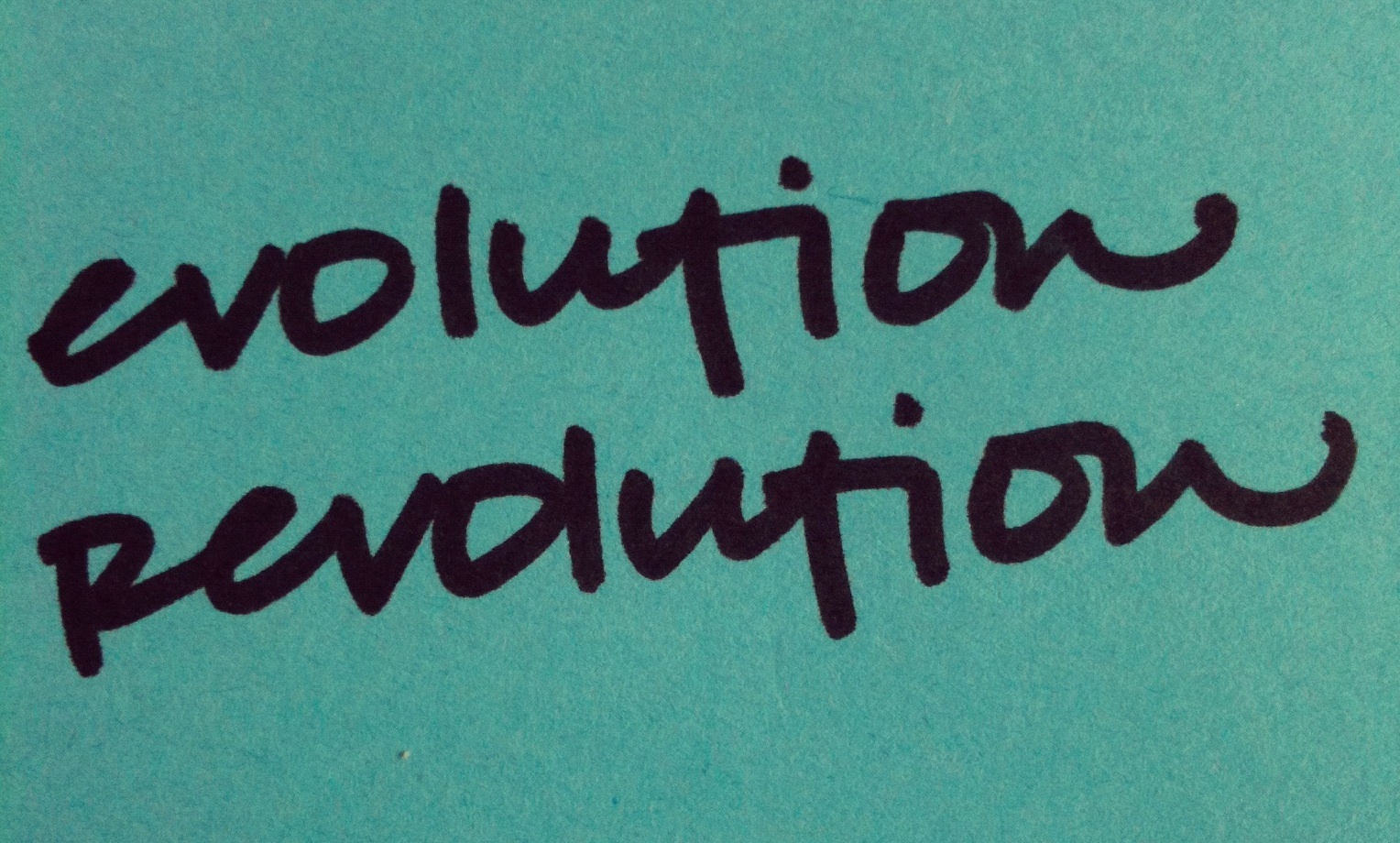
Evolution to Revolution: Rethinking the Organizing Model

evolution-revolution

Fifth in the series: On Organizing

The Revolution for US labor is Social Movement Unionism.

The strategic question, as always: how do we get there?

Organizers may detest service unionism but that is the world we are in. Can we organize our way out of the service model?

First, we need to recognize that the social contract culture created over half a century ago is deeply embedded in the minds and methods of many union officials.  The inertia and resistance to change is remarkable given the fact that the corporate and political bosses have given up their end of the bargain long ago and turned instead into labor’s worst enemy.

Despite decades of retreat some of the potentially most powerful unions in the US continue to squander their resources and undermined both their reputation and bargaining power by propping up the political machines of yesteryear.

While meaningful change often occurs gradually it is usually the product of visionary and revolutionary efforts.  Rising expectations shake the status quo, broaden the horizon of the possible and clear the way for fundamental change.  Yet we begin with the sobering reality that our strategy must start where we currently stand.  We should accept good service and efficient bureaucracy as necessary to effective unionism and organizing while we struggle against the political inertia and machine politics that have weakened unions and hurt workers.

Rethinking the Service Unionism/Organizing Model Debate

Rather than replicate the service/organizing duality that has both structured and limited the debate for the last decade perhaps an evolutionary model would allow a better passage toward a more effective union model.

An evolutionary approach, in which characteristics of earlier forms are necessary to and embedded in later forms and serve as references and resources, could move us away from an “Either/Or” choice to entertain the possibility of “Both/And.”  A good union model includes the positive components of all the major species of unions created by the labor movement.

Using the academic labor movement as an example, let me argue that four types of organization: conventional trade unionism, professional unionism, public interest unionism and social movement unionism represent a continuum of union models we can learn from, draw on, and aspire to.

The “Business as Usual” Baseline.

At one end is conventional trade unionism with a social contract culture. The focus is staff delivered service and members are largely consumers or called on during mobilizations that ask them to take fairly easy actions on behalf of decisions made by union officials.  The focus is on the specific workplace and the immediate and material self-interest of existing members. Organizing is devalued and the advice of experts, lobbyists and lawyers holds sway.

Conventional union officials rarely make principled opposition to management and instead seeks “fine-tuning.” They seek “a little more” for workers within the system of managerial power and zero-sum parameters imposed by bosses.  Conventional officials accept tuition increases — as if the students were their only possible source of income.  If pushed by the student movement these “realistic” leaders compromise with the token of “affordability.” Something lost long ago.

The massive ranks of low wage and contingent faculty are also viewed as an inevitable part of the funding formula for top-tier faculty. Once the low wage/high tuition model is accepted, “business as usual” becomes beating an orderly retreat with an eye toward maintaining dues income and budget surpluses for the organization.  If confronted with adjunct activism the conventional response is token leaders and token pay increases.

Much maligned, and often for good reason, the service model was nonetheless proficient at delivering the services and basic representation without which unions would not exist. The creation of professional bureaucratic staff was necessary for the survival of unions in the modern society and professional staff will continue to be indispensable given the size of both unions and corporations. Convention unionism often included a spirited defense of teachers as a special interest group. Many higher education locals go beyond convention unionism and act as professional unions as well.

Professional Unions Professional Ethics

Professional unions have similar characteristics to conventional ones but also act as professional associations that enlarge their purview to include all members of the profession nationally and internationally. Professional unions go beyond narrow self-interest and specific worksites to develop ethical codes and professional standards for the benefit of the whole profession.

Professional unionism includes an educational function that schools it members and does not simply reflect or represent members opinion. Members are expected to live up to ethical codes of conduct.  The leaders of profession unions act like teachers with their own moral compass, not their finger in the wind.

The exploitation of students and low wage faculty and staff can at least be viewed as unethical if not an urgent matter for practical politics.

Professional unionism in higher education is limited however by a belief that academic freedom and shared governance–that is freedom and democracy in the workplace–are unique privileges appropriate only to those that teach and research rather than a standard all working people should aspire to. In the current climate, the exclusivity typical of professional unionism tends to undercut working conditions because its special privileges become easy targets for  “reformers,” corporate-style managers and resentful workers deprived of basic job security or a living wage. Still, the ethical codes of professional unionism are important because they provide a passage beyond narrow self-interest toward issues concerning the common good.

Unions In the Public Interest

There are times when professional unionism shades over into public-interest unionism. Public-interest unionism requires a dramatic enlargement of the discursive and political terrain on which a union is willing to engage. The community being organized extends far beyond a single campus or system.  Arguments about quality teaching and research connect to the interests of students and the larger body politic.

The teachers’ working conditions are recognized as the students’ learning conditions.

Public interest unionism embodies enlightened self-interest and social solidarity and argues that education is essential to well being of the public at large and to democracy.

While not a union itself, the Coalition of Contingent Academic Labor (COCAL) led the way with grassroots resistance against the corporate model of education, linking student welfare to the fate of the faculty. New Faculty Majority and an array of new organizations and organizing drives are moving toward public interest unionism. 

Another  leading example of public-interest unionism is the innovative and important work done by the Campaign for the Future of Higher Education (CFHE).  CFHE bring together leading locals from all unions and provides visionary leadership pulling and pushing more conventional unions in the right direction.

Public interest unionism may begin by highlighting higher educations role in economic development but also introduces ideals such as citizenship into the public debate. Public interest unionism demands a much deeper participation by members who must tap personal contacts and professional expertise. Mobilization efforts are common and involve a high level of activism. Political action goes beyond professional lobbyists to mass lobbying and coalition work with students, alumni, parents, and other unions.

The goal of public interest unionism is to intervene in the public discourse and change public policy. Its success ultimately depends on the creation of a culture of organizing with growing numbers of members involved in direct personal contact with others members and other political actors.

Because Public-interest unionism initiates principled political challenges to management it may move seasoned and committed unions to cross the threshold to social movement unionism and embark on the revolution US labor so badly needs.


Next: Social Movement Unionism


Posted in Movement Culture, Organizing Method, Organizing Strategy, revolutionary strategy, Strategy, Uncategorized | Tagged , , | 1 Comment

Planning and Opportunity

th-13

Forth in the series: On Organizing


Planning and Opportunity

The vast majority of movement work today is reactive. In part that is a result of the defensive posture of the labor and social movements but it is also a reflection of the political culture of our organizations.

Many unions especially treat the historic decline in membership as a succession of surprises: one dissatisfied member, decertification campaign, runaway shop, or lost election at a time.  Yet when each crisis calls forth the most expedient, narrow, legalistic, managerial and apolitical response possible we can only blame ourselves.  Conventional union politics has failed us.  We need bold conscious plans.

Without action plans and intentional campaigns union officers and staff avoid accountability, play house politics, and settle into business as usual.

Effective organizers on the other hand “plan the work and work the plan.” While we can never predict the future — and trying to is an all-too-common waste of time — contingency planning is essential.  Create a scenario based on your best guess and another one based on your second best guess.  Avoid the rigid certainty of the soothsayer or ideologue.  Embrace the tactical flexibility of the revolutionary.

You can never, nor should you, avoid reacting to events or seizing opportunities, but working according to plan allows for better preparation and encourages organizations to envision a means of anticipating political problems with political solutions.

That does not mean rigid adherence to past decision but it does mean that you have a text to revise, a yardstick to measure your progress, a way of learning from mistakes, and a hypothesis that can actually promote and guide experimentation.

Planning does not prevent mistakes or bad luck; in fact they will be your constant companion. Instead, get to know them well; one day they may introduce you to success and good fortune.

Good action plans are not produced solely by the work of a few leaders and staff. Strategic planning is an excellent opportunity to practice union democracy and convene a union-wide discussion on the union’s future. Open ended discussion is necessary to discover new ideas and enlist the members in making the plan work.

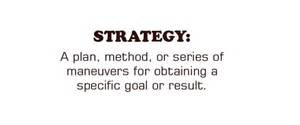
Good action plans are also not scholarly reports or policy recommendations or wish lists. A lot of precious time and energy have been wasted on formulating pious wishes and lofty desires. Strategic thinking may involve history, analysis of current conditions, or statements of desired goals but strategy is primarily characterized by a proposed course of action.

Strategic questions ask: “how do we win?” How do we create the transition between what is and what ought to be?

An effective strategy proposes how existing consciousness, resources, and capacities can be marshaled to achieve a range of political ends. Strategic plans try to answer the hardest questions of all—what to do next and how to do it.

Start with an inventory of your resources, match them to goals, plan the next step and you will be on the way to reenergizing your organization.

Posted in Electoral Strategy for 2016, Movement Culture, Organizing Method, Organizing Strategy, revolutionary strategy, Uncategorized | Tagged , , , | Leave a comment

Reframing: From “Electability” to Organizing Encounter

th-10


First post in a series on Election Talk

Making history is far better than predicting it.

Let’s practice turning speculation into an organizing opportunity.

Perhaps the most common remark I hear when taking to people about the Sanders campaign — even more so when promoting the Green Party — is “electability.” I always hear: “Can they win?”

Electability is a social-control discourse that we need to counter.

First, know that questions produce answers.

Electability questions rely on untestable assumptions that tend to produce the sought-after answer. Namely, that there is no alternative to the status quo.

Electability arguments draw on the “horserace” or sports framing that corporate media uses to explain elections to its consumers. And, to limit the range of opinion and readily available questions and answers.

“Can Sanders win?” “Can the Green Party win national office?” Such questions are invitation to predict the future, are they not?

Such predictions require speculation and cannot be based on facts alone. These seemingly rational political discussions devolve into statements of incontestable opinion if not outright meaningless soothsaying.  Electability drains political discourse of real content.

Counter-factual discourse is useful however to the organizer in that it exposes the underlying assumptions of the speaker since the facts cannot get in the way.

When confronted with the electability argument I respond:

“Yes, of course Sanders can win. Yes, the Green Party can become a viable opposition party.”

“But, its much better to ask a different question.”

“Can we win? Can the American people win?”

“Which candidate or candidates are most effective, right now, based on their record, for helping to promote the sweeping social movements that will be necessary to bring real change to the US.”

By the answer given, you will learn right away about the political consciousness of the person you are talking with. And that, for organizers and activists, is the first step toward meaningful engagement with that person.

“Can we win?” shifts the terrain to what we can do. Yes, you will hear fear and yes, you will hear fatalism, distracting and denial. But at least you can assess the discussion and invite them to make history rather than passively predict it.  Or not — but at least you will know its time to move on.

That is, after all, what’s important, isn’t it? Where would President Sanders be without a strong poly-centered social movements to support change? Congress is still controlled by the Corporate Power and even a landslide victory is not going to completely change that.

Sanders has repeated said he cannot make the political revolution without a broader political revolution and the Green Party has long been the electoral wing of the social movements.

Its what we do that matters. We the people. Its in our hands.

So let’s reframe. Let’s challenge the soothsayers and move toward political dialogue about activism, organizing, and a vision for revolutionary change.

Posted in Electoral Strategy for 2016, Movement Culture, Organizing Method, Organizing Strategy, revolutionary strategy, Uncategorized | Tagged , , , , | 4 Comments