Mamdani and the United Front We Need

What should we make of Mamdani’s stunning victory? Much of the commentary —regardless of vantage point— is grandiose, highly speculative, and without context. So let’s ground ourselves in the broader politics, available evidence, and, above all, history.  Then maybe we can figure out what to do.

To The Organizers Go The Victories

Mamdani won the NYC primary because his campaign put together an impressive ground game. This is the first, most important takeaway.  The credit goes to the DSA, Working Families Party, and many others who knocked on doors and lit up the phone lines. There are no victories of any kind — electoral or movement-building — without basic organizing. 

The ground game was all the more important because unions — who have run and staffed the Democrats’ GOTV operation for decades — split between Cuomo and Mamdani, but gave the lion’s share of support to Cuomo.  

UAW Region 9A and IATSE Local 161 ranked Mamdani No. 1. District Council 37, Unite HERE Local 100, and Teamster 804 ranked him No. 2. The influential Professional Staff Congress made the kind of endorsements only possible through Ranked Choice Voting (RCV). They advised their members to rank Mamdani as 1, 2, or 3 alongside Landers and Adrienne Adams as they saw fit. They understood that their members would benefit from economic reforms and recognized how RCV was altering the political landscape.

Among the unions for Cuomo were: 32BJ SEIU, 1199 SEIU United Healthcare Workers East, Teamsters Local 237, IBEW Local 3, NYC Deputy Sheriffs’ Association, NYC Coalition of the International Union of the Operating Engineers, FDNY EMS Local 2507 and Uniformed EMS Officers Union Local 3621, NYS Iron Workers District Council, Teamsters Joint Council 16, Uniformed Firefighters Association, Uniformed Firefighters Officers Association, Uniformed Fire Alarm Dispatchers Benevolent Association, the Building and Construction Trades Council of Greater New York. 

Mamdani’s working-class-oriented “affordability” platform certainly won many votes. Why wasn’t it enough to win the unions? 32BJ SEIU has already moved to Mamdani. Will the rest follow?

Ranked Choice Voting Makes A Difference.

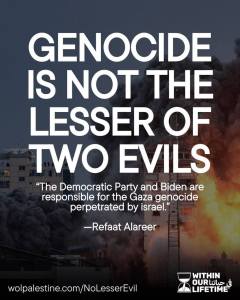
RCV allowed a different electoral landscape to emerge, where candidates more easily formed alliances. “Cross endorsement” cannot exist under the dominant winner-takes-all, plurality system. Yes, Brad Lander was a real mensch to cross-endorse Mamdani, but that would have been impossible without electoral reform. RCV allowed voters to act more in accordance with their values by undermining the lesser evil voting strategy.

Mamdani achieved a historic majority as the RCV count continued. This is due to his platform, but RCV is designed to replace plurality rules with majority rules. Now, will the Mamdani campaign or DSA advocate for RCV or other reforms, such as proportional representation, in every election?

The Peace Movement Prepared The Way For Mamdani

Mamdani did not win the election despite being Muslim and pro-Palestine, but because of it. Public attitudes have shifted. Zionism and the Democratic machine are on the wrong side of history.

While Jewish Voice for Peace endorsed Mamdani, the influence of the peace movement ran much deeper. With an urgency and militancy far exceeding the glacial pace of electoral compromise, peace activists plowed the field that Mamdani harvested.  

All those students and protesters who were arrested, surveilled, beaten, punished, even kidnapped, changed the climate of opinion and cleared the way for voting against genocide. Their “outside” position made this “inside’ victory possible. 

Consider this perceptive appeal by Miriam Markowitz:

“To all the people who are anti-genocide but remain too afraid to say it: Signaling support for the Democratic nominee for mayor of New York City, even if you don’t live there, is a good way to pop into the conversation without having to say the word “Gaza” or issue a mea culpa….[T]his is your very easy onboarding to the ethical issue of our time as well as the locus of the fight for democracy, such that it exists.”

Risky activism for some made “easy onboarding” for others. It’s ok: welcome aboard! In organizing, we look for an easy first step. 

The question is: what is the next step? Palestinian solidarity cannot afford to wait for elections, because the answer can only be found somewhere in the wild weeds of anti-imperialist and anti-colonial resistance, in the building of mass movements, and in forcing actual constraints — political and material — on the war machine. 

Mamdani and the Burden of History

He ain’t the mayor yet. The hits are already coming on hot and heavy from both ruling parties. They are about to prove again that the top priority for ruling parties is to maintain control here on the home front. The Democrats specialize in stopping threats from the left, but this time they will get plenty of help from the Republicans. Mamdani’s economic proposals are seen as a challenge to Big Money.

Consider what happened when India Walton, a Black working-class socialist, won the 2021 Democratic mayoral nomination in Buffalo. The city’s Democrats and Republicans joined forces against her. India’s defeat in the general is a cautionary tale that the ruling class doesn’t just roll over and play dead.

Even if Mamdani prevails, he will still face an ambush not unlike the one Sanders might have faced in 2016 and 2020 had he won. Sanders dared not defy the big guns of empire, capital, and the Democratic machine. He chose surrender and appeasement.

The machine will do everything to box Mamdani in. Will he disappoint the soaring expectations of the “hot takes?” Can he resist the forces of assimilation that drew in Sanders and the Squad? Tlaib remains an outlier on Palestine; maybe Mamdani will be one too. Time will tell. 

History offers us a real solution to Mamdani’s power paradox, but we have yet to build it.

Mayor La Guardia and the New Deal

Mayor Fiorello La Guardia (1934-1946) could well be seen as a forerunner to Mamdani, but the history of his reign contains the seeds of either victory or defeat.

La Guardia was a product of the New Deal, which was driven by the activism of millions of workers, farmers, and Blacks, often led by socialists and communists. Third parties held seats in Congress, and populists found a broad audience. Without similar deep roots and varied branches, Mamdani is, and will remain, out on a limb. Evidence? Mamdani’s weak showing among sectors of Black voters and the poorest New Yorkers shows that, without a powerful opposition movement, the Democratic machine is able to dominate politics just as it did with many labor unions.

His maverick campaign benefited from an electoral reform called “fusion,” which allowed candidates to run on multiple party tickets. We don’t hear much about fusion today; the Democrats largely dismantled it. La Guardia took refuge from the Democratic machine in the Republican Party, but he was a New Deal Republican.

The beating heart of the New Deal was the “United Front.” Even though La Guardia ultimately betrayed the United Front, he could never have come to power without it; with it, Mamdani has a chance at greatness.

The Rise and Fall of the New Deal: From United Front to Popular Front 

The New Deal rose and fell in stages. The “United Front” strategy of the early years showed us the way forward, while the later “Popular Front” led to defeat. The final deathblow was delivered by Cold War/Anticommunism, through purges within and beyond the labor movement. The defeat was codified in law and still sets limits on our “common sense” of what is politically possible.[1 ]

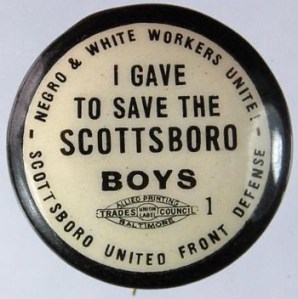
But, for a time, militant class and racial struggles, political independence, the emergence of third parties, union organizing, and efforts among the unemployed made the United Front a force to be reckoned with. Issues of race were inseparable from class. Support for the Scottsboro Boys was a pivotal move in the making of the United Front.[2]


The United Front is one of the most underappreciated developments in 20th-century US history — everyday people actually built an effective opposition of mass movements and revolutionary political parties. Hundreds of thousands came to see their self-interest and class interests as contrary to those of the bosses and bankers. United Front leadership was a quarrelsome but functioning counter-hegemonic bloc of radicals, anarchists, unionists, activists, and socialists, with the Communist Party its largest and most coherent force.

The United Front is a historical example that proves the oppositional politics we so desperately need today are possible.

But, the “United Front” was abandoned for the “Popular Front” in the late 1930s and 1940s. The Communists made a pragmatic alliance with the US ruling class in the hopes of defending the Soviet Union and defeating Fascism.

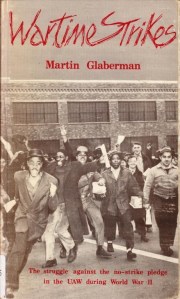
Crucially, the Communist Party, politicians, and union leaders sought to maintain the class peace they thought necessary for the war by enforcing a deeply divisive “no-strike pledge.”[3]

They sacrificed hard-won solidarity with the workers who were the grassroots leaders of the United Front — just as workers were leading a historic strike wave. La Guardia, it must be remembered, joined with the Communist Party and union officials in punishing and smearing striking workers.

As John Munro summarized it:  “The Popular Front…meant quieting critiques of state repression, capitalist exploitation, and racial oppression.”[4]  

The no-strike pledge was one-sided political surrender. 

As World War II quickly morphed into the Cold War, the Communist Party, like the Soviet Union, became the new existential threat. Big money, anticommunist unions, and the ruling parties turned against their now-weakened former allies. They were purged from labor and smeared as political pariahs. Unions were also punished — despite their enforcement of the no-strike pledge — with the passage of the Taft-Hartley Act, which has hobbled unions ever since.

The Popular Front was a disaster that the working class and the left have never recovered from.

So forgotten is this history that what is often presented as a united front against fascism or Trump is little more than “fall in line” behind the Democrats and a return to the failed Popular Front of the 1940s.

Social Movements Save The Day

But all is not lost. The brightest lights found a way forward out of the dark days of Cold War. The social movements led by the Civil Rights and Black Power struggles reclaimed and legitimized dissent after the purges. The Peace movement, Women’s movement, Environmental Movement, LGBT movement, Community Organizing, rank-and-file union caucuses, and all their many descendants continue to be the “left” we actually have and the one that matters most.

The Burden of History We All Bear

Most of the self-described left still hold the position bequeathed to them by the Cold War. When they support Democrats based on “pragmatism” or “reality,” the Popular Front is the reality they have internalized and repeat.  

The DSA has engaged in a lengthy debate about whether to break with the Democrats. The debate remains unresolved, and it’s too early to tell how Mamdani’s victory will impact it. On the other hand, the oppositional left is showing signs of revival, but remains small and scattered, without a significant national role in the unions or the community. But, no part of the left — or even the sum of all its parts — has roots in the working class anywhere near the scale of the United Front of the 30’s.

Mamdani and the DSA have the potential to start building a united front, and we desperately need that.

History is a guide, but current models do exist. Kshama Sawant and Workers Strike Back’s campaign for Congress — with its fusion of electoral and social movement activism, political independence, opposition to genocide, as well as its crystal-clear socialist politics — is the best example that truly aligns with the history of the United Front.

We lack massive movements, but the day will surely come when many millions take to the streets again, as they did during Occupy or the George Floyd protests. Right now, the present-day civil rights movement confronting ICE and the burgeoning police state, and today’s peace movement in solidarity with Palestine, are the best steps forward. Any party or political formation that can join them, serve them, lead them, become their architect, or electoral wing, will be well-positioned to help us — Mamdani and all — shoulder the burdens of history and build the United Front we need.

====================================

1. In his article “The Popular Front Didn’t Work” Charlie Post sets out the history of the United Front and Popular Front with far more detail than my short summary. It’s an indispensable read.

2. In his insightful new book, Class War in America, Jon Jeter demonstrates how the campaign to free the Scottsboro Boys served as a catalyst for working-class resistance.

3. See Martin Glaberman, “Wartime strikes: The struggle against the no-strike pledge in the UAW during World War II.”

4. John Munro, ” A Tool for Our Times: Legacies of Black Radicalism and Communism” in Black Perspectives.

Posted in Capitalism, Corporate Power, electoral strategy, History, Labor Movement, Movement Culture, organizing, Organizing Strategy, police state, Racism, Red Scare, revolutionary strategy, Strategy, unions, Working Class | 1 Comment

A Tale of Two Maydays

Mayday is a holiday dedicated to international working-class solidarity.

Born in the United States on May 1, 1886, during a time of intense class conflict, Mayday became the recognized labor holiday worldwide. However, it has rarely been celebrated in the US since the beginning of the first Cold War. The largest Maydays in recent history were organized not by unions but by the peace movement in 1971, by immigrant workers in 2006, and the Occupy movement in 2012.

The original May Day was created by a huge mass movement and coordinated strike wave aimed at winning the eight-hour day — at a time when 60- to 80-hour workweeks were both common and deadly. Over 300,000 went on strike across the country. In Chicago, the center of the movement, anarchists, socialists, and union activists organized more than 40,000 to strike. Albert and Lucy Parsons led the Knights of Labor and 100,000 in a peaceful parade marking the first Mayday march. 

A few days later, on May 4, a much smaller rally was organized to protest police violence. As the cops rushed the stage, a bomb exploded. Those responsible for the blast have never been identified. The best-known leaders were rounded up, and four, including Albert Parsons, were hanged for a crime they did not commit. The anarchists were murdered for their ideas and leadership. 

During the late 19th Century, big ideas were widely discussed among everyday people. The biggest question they raised: Was capitalism the best system for running society, or was the new idea of socialism or anarchism a better alternative?

This is the tradition of Mayday, and it’s worth defending.

Mayday and the Movement

2025 was the largest Mayday in my lifetime, and the people prevailed, making it the best as well. Thousands of marchers remained true to its traditions as an international day of labor solidarity. The peace movement and calls to end the genocide in Palestine easily outnumbered the pro-war forces, which were quite visible in earlier “Hands Off” marches. ICE and its police state infrastructure were roundly condemned. The Vermont AFL-CIO urged labor to become “Strike Ready” to resist fascism. The rank-and-file raised positive issues — health care being the most popular. The opposition was there. The rank-and-file marchers made it a Mayday to be proud of.

Most importantly, immigrant workers played a leading role in the streets. The last time Mayday was really big was in 2006, when Latino immigrants led a one-day general strike called the  “Great American Boycott.” Approximately one million people in 50 US cities participated in one of the largest days of protest in American history. The voices of that Mayday are still heard today.

Mayday and the Machine

Mayday was so large, in part, because it was sanctioned by the Democrats through their loyal organizations. This carefully permitted event was without a disruptive police presence, let alone the kind of brutality student protesters faced on Mayday 2024. Perhaps that allowed people to feel safe and was part of the reason the people, including the most vulnerable, showed up in such large numbers.

The size of the protest is all the more remarkable because most US unions rarely celebrated Mayday, sticking instead to the parades and picnics of Labor Day in September. To point to Trump’s very real threat against workers is obvious, true, and certainly speaks to the motivation of the rank and file. But does this embrace of Mayday mean a new, more class-conscious labor movement is being born? Time will tell, but the long, steady love affair between most labor officials and the Democrats casts that into serious doubt. This would hardly be the first time that the rank and file have run ahead of the official leaders.

The Democratic Party’s support for Mayday is truly unprecedented. Does it mean that the day to celebrate international working-class solidarity was actually organized by a political party dominated by big-money oligarchs and guilty of an ongoing genocide? Are we to believe that something historic is afoot, or is this a replay of the Democrats’ embrace of MLK Day — while undermining everything King ever stood for? Are the Democrats really going for the billionaires’ throat, or is this just get-out-the-vote?

Mayday 2025 was partly the work of loyal Democratic groups such as 50501 and Indivisible. Maybe that is why some of the Mayday events seemed to vary little from the early Hands-Off rallies—all anti-Trump without a systematic critique or a positive program, but with a leadership hiding Palestine and supporting NATO and the war machine. 

The Democratic Party’s version of Mayday was most famously represented by its evangelist extraordinaire: Senator Sanders. His ongoing attempts to redeem the Democrats are a self-described move to “strengthen American Democracy where faith in both the Democratic and Republican Parties is extremely low.” Now, would a leader true to the tradition of Mayday make it a day to challenge the system or prop it up?

All Sanders has to do to reclaim Mayday is say the following words: “The Israeli genocide against the Palestinian people could not have happened without the support and consent of the US government. I urge you to do everything you can to bring an end to genocide.” And, “We will never have leverage against the Democrats or Republicans until we create a real opposition with a credible threat of exit. I urge you to support and join the third party of your choice.”

The redemption of the party of war, genocide, and austerity is not a price we have to pay for resisting Trump’s fascism. Genocide is fascism at its most evil. Redeeming the Democrats is just pushing lesser evil thinking to its final, lowest possible point — the lesser of two evil fascisms. Has it really come to that? Not if the tradition of Mayday holds.

What Are Workers To Make Of Dual Maydays?

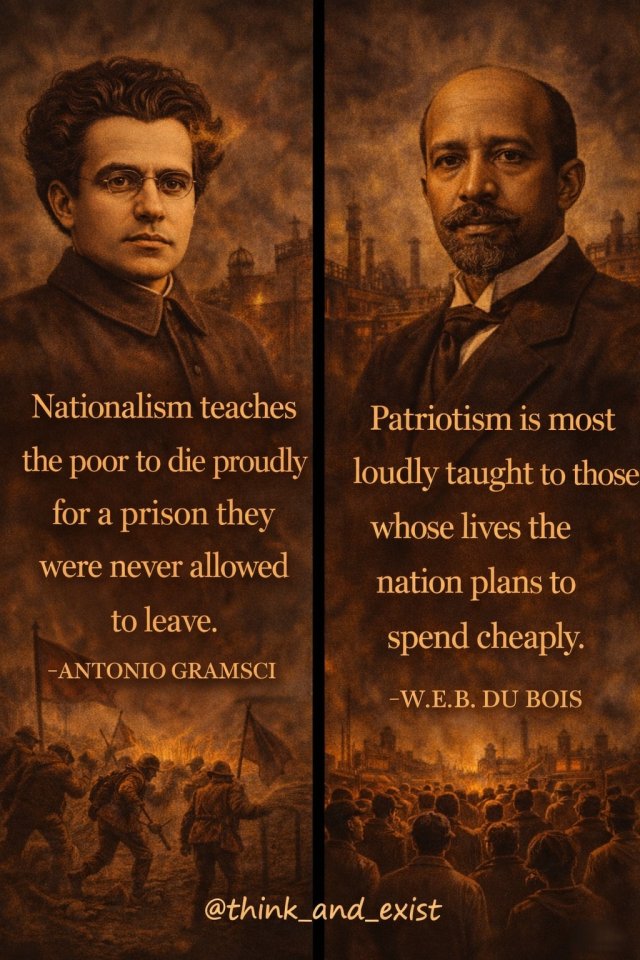
The great Black intellectual W.E.B. Du Bois and Italian Communist Antonio Gramsci helped us to unlock the secrets of our collective mind with the concept of dual consciousness. We all have to contend with a volatile blend of ruling-class and oppositional ideas that make up what we believe to be “reality,” “common sense,” and even our sense of ourselves.

“It is a peculiar sensation, this double consciousness, this sense of always looking at one’s self through the eyes of others, of measuring one’s soul by the tape of the world that looks on in amused contempt and pity.” Dubois, The Souls of Black Folks

This contradictory common sense allows for, and sometimes even encourages our resistance — just so long as we understand ourselves “through the eyes of others,” just so long as we accommodate ourselves to the established order in the end. 

The trap is set, and it will lure us in as long as Marx’s observation remains true: “The ideas of the ruling class are in every epoch the ruling ideas.” The idea that the problem is far greater than Trump—that a system of corporate power and empire, managed by both ruling parties, produced him and his fascism—bursts the bounds of ruling class thinking. 

The loyal left serves the existing order by diluting working-class consciousness with partisan loyalty, disciplining the movement to the machine. More than that, the loyalists who tried to steer Mayday into safe channels had one overriding effect: to make independent action by the working class seem inconceivable. But is it?

The Mayday marchers might just be harbingers of a real opposition. They hinted at what we should all know deep in our bones: the ruling class is neither pre-ordained nor eternal. Their rule is historical, and history is far from over. As we build a genuine opposition, our goal is to learn to think and act for ourselves. Mayday was a success not because of the intention of its leaders but because it may have helped unleash the forces of change. I double-dog dare the same leaders to call a general strike.

On Mayday, we recognize ourselves as a class of the vast majority who, through our labors, produce all wealth. We are aligned against Capital in whatever form big money takes. In our time, corporations and their merger with the state is the nursery for all oligarchs and all forms of fascism. Only by our actions can we legitimately claim to represent the aspirations of all people for a better life, from the concrete demands of daily life to the lofty goal of liberation.

Posted in American Culture, Capitalism, Corporate Power, Green Party, History, Labor Movement, organizing, Organizing Strategy, revolutionary strategy, Socialism, union organzing, unions, War, Working Class | Tagged , , , , , , , | Leave a comment

Tips for Organizing at the Big Rally

Here are some organizing rules of thumb. They may be useful in many circumstances, but in this article, I will focus on multi-issue or Democratic Party-led protests. The “Hands-Off” protest or the Sanders/AOC revival meetings are so useful to the Democrats that they are not about to go away.

No matter our focus, our strategic goal should be to build opposition movements. These methods and rules of thumb will help us engage a larger audience regardless of the setting.

Two considerations at the outset: Organizers often work at cross purposes to official leadership. What follows is an exercise in the “workaround.” I know from my own experience that workarounds become necessary when the “leaders” are beyond repair and most successful when we have a base we can relate to.  The second is this: never underestimate the power of the Democrats and their array of loyal institutions to absorb and divert dissenting activity into safe channels that perpetuate the system.

That said, here are some organizing methods that can help you stay on the straight and narrow path to building a true opposition movement.

Plan the Work and Work the Plan 

An action plan must link goals to resources and capacity. If you do not do this, your strategy will be nothing more than a “wish list. This is where most strategic planning fails. Make-believe is very big right now with loyalists, but we cannot afford to be driven by the desire for redemption or other warm feelings. If you don’t have adequate resources, then your plan should be to get them. 

Know yourself and your organization/team, and don’t bite off more than you can chew. Focus. There will be well-meaning people among us who want to lash out in ten directions at once or push today’s hot button. This may work for short-term agitation, but it will not necessarily lead to long-term organizing. Avoid the tendency to be strictly reactive.

Initial plans almost never survive contact with the millions (or the enemy), so you must have a high tolerance for failure and frustration. Sorry, but we call it the struggle for good reason. But, planning the work and working the plan starts you from the best possible position.

Both/And not Either/Or

Tactics and strategies do change, sometimes quickly. I generally use a “both/and” rather than an “either/or” approach to tactics, otherwise known as tactical diversity. If you don’t want to touch demonstrations like Hands Off, I can’t say as I blame you. There are plenty of other opportunities — just dig in somewhere else. Join the ICE resistance, mutual aid,  rank and file caucuses in your union, Stop Cop City, or military counter-recruitment with the kids — just to mention a few. 

What does an opposition movement do when faced with an irredeemably corrupt electoral system? Boycott or engage? Both/And. Hands-off, and the Sanders revival are GOTV operations designed, like the electoral system itself, to redirect dissent into harmless partisan channels. Still, we should free ourselves to boycott or engage as our capacity and inclinations tell us.

We should not get lost in internal debates about what to do—the opposition is small, and our own limits are usually the deciding factor. Be wary of “analysis paralysis.” If your group has ten good ideas, quickly whittle the list down to three, then choose one. One well-executed idea (even if it’s far from perfect) is worth ten that never get beyond the wish list phase.  

Remember: The most influential organizers help people identify what matters most to them and then assist them in taking action.

Assessment Comes First

Organizing begins with assessment. We can loosely apply the rule of thirds. The rule of thirds is usually accurate in union drives but less so in other settings. Still, accept that most of the protestors at a Democrat-led event are not ready to hear you — the pro-war movement has kept them in line. But about a third may be. Same with Republicans, by the way. We can find people ready for a broader perspective, but it takes direct engagement. 

There is simply no way to engage contemporary political behavior without recognizing just how deep partisan loyalty runs—deeper than principles or ideas, I am afraid. My assessment is that most people allow the ruling class, its ruling parties, and their media allies to organize their political consciousness.

There is one partial but huge exception to this, but we are unlikely to find them at a Hands-Off rally or Sanders revival. Over 80 million eligible voters did not vote in 2024, giving “none of the above” a landslide victory. Approximately 7 million who previously voted for Democrats stayed home, many because of war crimes in Gaza or economic issues. These people made an important first step, and we should be helping them make another. The challenge: their behavior is still governed by ideas about “reality” that prop up the existing order — namely, that the ruling parties are sacrosanct.  

We should reject the idea that these people are irrational or apathetic. They are far more rational than loyalists and lesser evil voters. A significant proportion have lost faith in the electoral system — who could blame them? A larger, more active peace movement would be a possible vehicle for reaching this crucial group. 

The ‘Ask” and a Positive Program.

No organizing encounter is complete without the “ask.” The classic ask is for joining the union, but there are other asks for movement building outside the workplace. We cannot have an ask unless we have a project, so a positive program embodied in a project is essential. 

We will need an organizing instrument. Pass out a flier calling people to a peace demonstration, a petition for a ceasefire in Palestine, a BDS-style pledge card to boycott corporations involved in genocide, or even a “people’s survey” with a few key questions.  Don’t mistake the real action here: whatever you think about boycotts, protests, or petitions is beside the point. We need organizing instruments to structure our encounters, although it’s hard to argue with a simple banner drop sometimes.

Ask people to sign a BDS pledge card, and listen to their responses—they will reveal themselves. Then, you will know whether to back off and move on or continue the conversation. 

Listening is the single best organizing technique. Then, inform people of your ideas and projects with an ask, but remember, organizing is not a debate. Our time is precious; leave the hard cases for later. 

This process gets easier after just 10 or 20 encounters. What you learn — for better or worse — is that there is a very limited universe of discourse. Between the assumptions baked into the dominant culture and the steady stream of propaganda, most people say the same few things over and over. You will quickly learn to respond. 

Fighting War and Austerity 

We know that there is a significant pro-war tendency among Redeemers, loyal Democrats, and the Hands Off leaders. Still, the moral imperative of stopping genocide and the crucial strategic role of the peace movement leave us no choice but to lead with this issue.

Even the considerable pushback on Trump’s austerity attacks, while good and necessary, too often encourages a limited vision. We cannot win the long struggle against austerity without taking on the institutions of corporate power, which include the Democrats. They want to replace the big story—half a century of austerity that redistributed 79 trillion from the poor and the rich—with the defense of the substandard social programs we currently have and an attack on the oligarchy they believe just sprang fully formed from the head of Trump. 

Pass out a flyer based on the recent RAND report and see how workers react. 79 trillion is a shocker since their unions rarely talk about institutional austerity, but it might be the shock treatment they need. When Shawn Fein spoke at the DNC, he invited workers to a world of make-believe where the Democratic Party champions the working class. Instead, we have to focus on the historical, institutional, and structural causes of austerity. If we do, we will help workers see that class solidarity is a far better idea than partisan loyalty.

To Raise an Army

The main goal at this point is to find other activists willing to join in building an opposition. Sorry for the logging metaphor, but cut the trees closest to the road; don’t trek over peaks and valleys. We need to raise an army of activists. Be vigilant and never forget the hard reality: Democrats specialize in disarming activists. If you are going to wade in, be prepared. Work in teams, focus on the most important issues and avoid wasting time on the hard cases.

Have courage and thank yourself: Talking to strangers about politics is a revolutionary act.


Posted in Movement Culture, organizing, Organizing Method, Organizing Strategy, revolutionary strategy, Working Class | Tagged , , , , , | Leave a comment

Are Democrats Weak or Strong?

Be alert to a very common, subtle, but ultimately deceptive narrative we have heard repeatedly since Trump’s election. This story claims that the Democrats are paralyzed, pathetic, weak, invisible, disappointing, and feckless. In short, we are supposed to believe that the Democrats are failures when, in fact, they are one of the most successful and deeply entrenched ruling parties in world history.

They are only weak against the other ruling party. “It’s their government,” said Hakeem Jeffries as he retreated to business as usual. But, Jeffries found the energy to lash out at the idealistic liberals in his own party, still hoping that the Democrats would become an opposition party – smearing them as the “far left.” That captures it. The Democrats are weak against the strong and strong against the weak.

But here is the trick: the story of the disappearing Democrats allows just enough criticism to confirm the “left” identity of those telling it — and believing it — while offering the hope that the Democrats can be fixed and reformed. This story may be popular, but it’s totally at odds with the facts.

The Democrats have lots of power. It’s just that they use it in the name of empire and profits. I did not see any paralysis when it came to simultaneously waging two bloody wars. They blundered ahead with risky and decisive action against all odds and all warnings.

Palestine and Ukraine are rarely mentioned in this story of weakness because they are both exceptions to the narrative and beyond the bounds of allowable criticism. Why? In the long run, the wars reveal the crisis of empire — not something to be discussed in polite company. And, in the short run, it was the revulsion at genocide and the economic impacts of sanctions (on top of decades of austerity) that handed the government back to Republicans.

It took a lot of power to launch the Russia-gate conspiracy and the “Stand with Ukraine” campaign — both such stunning achievements of modern propaganda that they are rerunning them. And the loyalists — so thirsty for moral high ground against Trump that even the warped spiritualism of war will suffice — are lapping it up.

The Democrats’ pro-war movement attacks Trump as he retreats from the lost cause of Ukraine to restructure the empire in a “pivot to Asia.” Ironically, this “pivot” was first turned under the leadership of  Clinton and Obama, who — in a thinly veiled counter to China — dreamed out loud that this would be “America’s Pacific Century.” This history is lost to the pro-war movement and shows, again, that the ruling parties agree on fundamentals. Take Palestine for example.

It might be that a sector of the ruling class still clings to older versions of “full spectrum dominance” or that partisan drama knows no history or limits. But, whatever their intentions, the main effect of pro-war demonstrators will not be to change Trump or Ukraine but to disrupt, confuse and obstruct the peace movement — one of the only social movements that stand in opposition to both ruling parties and the empire they manage.

And so, it cannot be missed that the Democrats have lots of power when it comes to containing, crushing, and co-opting opposition movements from Occupy and BLM 2020 to Standing Rock and the Sanders reform efforts. The Democrats had no problem flexing their muscles during the recent college protests in a frontal assault on free speech and assembly. Over 3,000 were arrested in a single spring in that supposed bastion of free thinking and dissent: the university. Harris pushed bi-partisan attacks on the peace movement when she smeared peace protestors as anti-semitic. Now it’s Trump’s turn.

The billion-dollar Harris campaign spent more money fighting the Green Party than the GP spent on its entire campaign. We know what happened in 2016, 2020, and 2024 when the DNC exercised dictatorial control by selecting their chosen candidates and eliminating others.

The Democrats’ loss was a totally normal outcome given their position as full partners in the system of crisis management we know as the two-party system. Their only weakness was their failure to hoodwink enough people into voting for them this time around. Someday soon, the Democrats will return to power, and they will be the same servants of power and profit they always were. No other outcome is even remotely possible.

Bernie Sanders is the lead character in today’s tale about the Democrats’ fall from grace and hopeful return to honor (on the battlefields of empire no less.) Don’t be fooled again.

When you hear voices complain about Democrats’ silence and weakness, you are hearing the set-up. Then enters the flim-flam man to empty your pockets and fill your mind with sweet promises of redemption, revival, and a shiny “democracy” we ourselves have never experienced.

It’s almost heaven to many, but it’s far from an analysis that correctly places Democrats- side by side with Republicans—at the center of the empire, the corporate oligarchy, the police state, and the system that manages the hell on earth they have created.

If the Democrats or their Republican counterparts were truly weak, we would have vanquished them by now. As we build an opposition movement outside the ruling parties, it would be foolish to underestimate their strength.

Don’t be disarmed, and keep your powder dry.

Posted in electoral strategy, Green Party, Movement Culture, organizing, Organizing Strategy, Working Class | Tagged , , , | Leave a comment

The Left Can Only Win if There Is A Left

Also, find this essay in CounterPunch.

“The U.S. couldn’t choose the Left: There wasn’t one. When there is no more left, there is no limit on the Right. When there is no fight over programme the election becomes a casting exercise. Trump’s win is the unstoppable consequence of this situation” — Jean-Luc Melanchon, leader of the French Left.

After the US election, and after the attempt at a popular front against fascism was wrecked when Macron overturned the vote, Melanchron confirmed for us that “The left can only win if there is a left.”

What are the main obstacles to organizing oppositional political movements and parties? There are many. Deeply-seated racism, sexism, and imperialism keep us divided and in line. Corporate power dominates our political system. Leadership against such a system must both oppose the existing order and envision an alternative to it. Yet, many who might help do that work remain loyal to the system. This “loyal left” is one of the main obstacles preventing the emergence of an effective opposition.

The “loyal left” should seem a contradiction in terms. Still, it’s precisely this paradoxical position we must understand, expose, and oppose. The loyal left follows the Democratic party around. Its obedience blocks one of the most fundamental political conditions necessary for real social change: the left must exist before it can win.

If nothing else, elections reveal who stands where. The two corporate parties still hold power and command loyalty despite their moral, political, and intellectual poverty.

It’s easy to chalk it up to the powers of conformity or propaganda, but many of the loyalists are unionists, intellectuals, and dissenters of some kind. It is among these types — who should be part of an anti-establishment opposition — that we can measure just how deeply the ruling class maintains control and dominates thinking. 

They Say Jump, and the Loyal Left Say, “How High?”

Testing and training.

When Hillary Clinton chose anti-abortionist Tom Kaine as VP, she was testing women’s loyalty to see if they were more attached to the Democrats than to their reproductive rights. Obama/Biden repeated the drill when they failed to act on Roe. Obama/Biden killed thousands of Africans and threw Black homeowners under the bus after 2009, but they were still favored by millions of Black voters.

Biden/Harris let the PRO Act die a quiet death, broke their promise on the minimum wage, and, most importantly, crushed the railway workers’ strike. Yet, no major union dared to criticize them publicly, let alone undertake the struggle needed to elect Democrats who “actually answer to workers.” Almost all union officials are steadfast loyalists who settle for photo-ops, promises, and puny incremental changes.

The Reality You Get is the Reality You Make

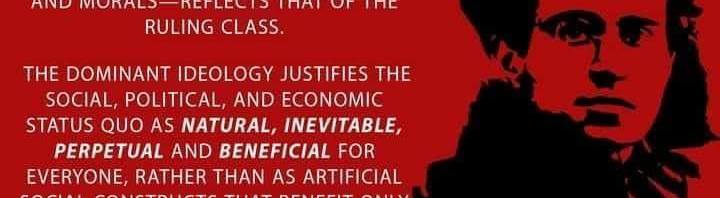
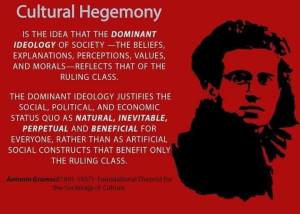
Today, loyalty is sworn not by old-fashioned anti-communist oaths but by assimilating the dominant ideology that corporate capitalism and empire are the only possible reality. The idea that the existing order is normal, natural, or inevitable does far more to shape behavior than all the fine points of political ideologies.

Reality is the product of human activity and political practice. If you can get people to maintain the system with their actions—no matter how they “hold their nose” or proclaim their socialist principles — their hearts and minds follow. This is why the machine works so hard to suppress any political opposition that encourages action outside established channels. The view that any electoral efforts beyond the two-party system are useless or dangerous is a testament to the near-totalitarian power of the existing political order.

While preemptive strikes against opposition forces continue, the election of 2024 is nonetheless stress-testing the cultural and political hegemony of the existing order. Today’s loyalty oath is like none other: Can the left ignore institutionalized racism, austerity, genocide, and the drive to world war to fall into line behind the Democrats?

Genocide: Testing the Limits of Obedience

I have heard many words of sadness and regret about Palestine and the repression of the peace movement that needs to be put to a simple real-life test. Can people somehow be against the war but favor the war party? Even when war is a joint effort with their supposed Republican enemies? Apparently so. Sanders, AOC, Omar, Bush, and Pressley cry over the war but support the war party. Millions follow. Only Tlaib has turned her opposition into acts of dissent.

The Democratic Socialist project was designed to reform the Democratic Party. It has failed to do so as its leaders have been marginalized like Tlaib, eliminated like Bowman and Bush, or assimilated like Sanders and AOC. The real question, however, is not the politicians but the membership of the DSA, many of whom are engaged in productive, even visionary work, outside of the electoral arena. What will they do in light of the hatchet job on the DSA’s project by the Democratic Party bosses? Such hard choices will separate the opposition from the loyal left. 

None of this was lost on the activists at Within Our Lifetime. WOL protested progressive Democrats rallying behind Bowman with three straightforward demands.   

1. Unendorse Genocide Joe

2. Re-affirm that anti-zionism is not antisemitism

3. Recognize the right to resist in accordance with international law

If you want an actual opposition, look to the peace movement. The recent rally and counter-summit against NATO in Washington, D.C., made it clear: loyalty pledged to the Democrats is submission to the Empire.   


Trump is Their Trump Card, and it’s a Losing Hand.

For the loyalists, Trump or MAGA is the avatar of all evil. The systemic and institutionalized reality of corporate power, empire, and creeping fascism is obscured from their vision by Trump’s great girth.

The revulsion at Trump or Project 2025 allows someone to believe they are struggling against fascism when fascism — in its 21st-century form — is the dictatorship of big money that governs both parties. They’re selling the spirit of heroic struggle on the cheap since it never requires anyone to stand and fight their own ruling class. This retreat is sugar-coated with the evidence-free assertion that it will be easier to organize under the Democrats. Instead, union density shows a painful decades-long decline regardless of which party rules. But, the repression of the student peace movement is clear evidence that Democrats are willing and able to wield the police state they so generously fund. 

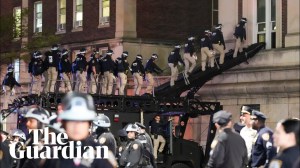
NYPD moves against the students at Columbia U.

Lesser evil arguments are insidious forms of surrender that allow people to accept genocide, austerity, and climate chaos while still maintaining a left identity and thinking of themselves as righteous and reasonable. The loyalists sleep in this field of dreams — that is the point. 

The loyal Left Cannot Act Decisively.

Their devotion to the system is a built-in kill switch limiting dissent.

If Democrats are reelected, they will certainly go to sleep as they did after 2020 when the lullaby “Vote for Biden and then we will pull him left” soothed their troubled minds. It’s not just that they failed; with rare exceptions, they hardly tried. Why? MAGA will always be a threat as long as the two-party system remains intact, while their failure to act against Democrats preserves the system just as it is. It is a trap the loyal left cannot escape from unless they stop punching left and make a credible threat of exit, backing up their words with action.

A group of loyalist intellectuals called Convergence is playing the same losing game in 2024. They claim they will “block and build” while trying to “converge” young activists with the party machine. Fool me once, shame on you, fool me twice……

We will get some joy out of the loyal left if Trump wins. There will be a few spectacular demonstrations like last time. Still, actual oppositional movement building and the kind of organizing that demands is a genie the Democrats do not want to let out of the bottle. Will they fight the Democrats to help build an anti-war movement? Doubtful. MAGA will always be there to keep them in line.

What will happen when the Democrats’ “resistance” becomes the “assistance” on matters of bipartisan consensus, such as war budgets and corporate control—as was the case after 2016? Their loyalty is the kill switch—you cannot buy one-half of the two-party system without buying the entire system. It’s not shopping.

The Loyal Left is Giving Trump Their Permission to Continue War, Austerity, and the Drive Toward Fascism. 

Trump now knows for sure that genocidal war, world war brinksmanship, austerity, and the growing police state are not deal-breakers for either the Republican or Democratic base. When “left” supporters let Democrats literally get away with mass murder, Republicans see that and like it. They are broadcasting — loud and clear — that nothing will trigger their resistance against the system itself. Does this make it more likely or less likely that Trump will move toward even more fascistic rule? With a left like that, it’s no wonder both parties have moved to the right for decades.

Building a Useful Left: Opposition, Action and a Positive Program 

Where can we assemble a real opposition capable of contesting and challenging power? Where the machine cannot reach? Where the corporate mindset is weakest? Where there are no money trails?

Where actions speak louder than words, and the system is not sacred.

We must have a positive program. A loyal left cannot create one as they remain under the tutelage of the Democratic Party — that is the lesson of the two failed Sanders campaigns and the squishing of the Squad. 

We can build a program for peace, economic and political democracy, and immediate climate action, which is already being born by the activists in the social movements.

First, look to the young. Austerity and climate chaos are their lives, weakening their loyalty to the established order. From recent organizing experience, trying to get the Green Party on the ballot in deep blue New York, I’ve seen that younger people are open to change.

The peace movement is leading the way on and off campus. Mutual aid and communal efforts, rank and file groups in our unions, civil rights movements, Stop Cop City, and all those against the bipartisan police state have solid oppositional politics. Jill Stein’s platform is a fine example of a positive program.

Much of the world is no longer quietly submitting to US dominance. Why should we? Someday, the empire will fall, as all empires do. The two-party system is leading us to disaster since it only represents the corporate ruling class. When will the loyal left get the message? Be on the right side of history and help organize a left that is up to the task.

Posted in austerity, Capitalism, Corporate Power, electoral strategy, Empire, Green Party, History, Labor Movement, Movement Culture, organizing, Organizing Strategy, police state, revolutionary strategy, Socialism, Strategy, unions, War, Working Class | Tagged , | 2 Comments

What is 21st Century Fascism?

The Dictatorship of Big Money

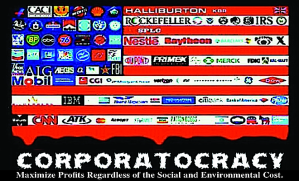
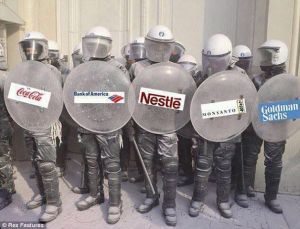
Twenty-first-century fascism is the dictatorship of big money. Finance, fossil fuels giants, other large corporations, and the military-industrial complex have effectively merged with the state, calling the shots in Washington. An immense surveillance and propaganda machine is at their disposal. Narrative and information control is the first line of defense, but the militarized police state acts when all else fails. Big money wants total control and tolerates no rivals.

The dictatorship of big money is impossible without institutional racism paving the way to a new form of institutional fascism.


New Fascism for a New Century

Common understandings of fascism rely heavily on 20th-century European history. By those terms, there is no fascism in the US today, except the small neo-fascist gangs. Trump does not check all the boxes by the old definition.[1] If fascism is to have any real meaning — beyond a deceptive get-out-the-vote strategy by Democrats — then we need to rework old interpretations to find the fascism that evolved specifically to our time. 

While Trump is no fascist by 20th-century standards, he is by the conditions of the 21st century. The problem is — by those same measures  — the Democrats are fascist too. Both parties have managed the rise of corporate fascism and the systematic racism that underlies fascism, old and new.   

The new neoliberal fascism emerged as the corporate order hollowed out all democratic institutions standing in its way, leaving only empty shells behind to dull the mind and distract the eye.[2]  There was no way they could maintain total control and boost profits — in the face of imperial decline, austerity, and climate crisis — without gutting democracy.

The earlier, easy-to-recognize fascism with goose-stepping troopers, explicitly racist ideology, industrial-style death camps, and ultranationalist war machines has been complemented by harder-to-see and harder-to-resist systematic forms.  

From Institutionalized Racism to Institutional Fascism

There is no better way to understand 21st-century fascism than to look at fascism’s evil predecessor: racism.

Black radicals and scholars have argued that African people in the US already live under conditions of fascism and that fascism’s main ingredient is race.[3] Slavery and its aftermath is fascism with American characteristics. As Black Panther Kathleen Cleaver wrote, “Black People have always been subjected to [a] police state and have moved to organize against it, but the structure is now moving to encompass the entire country.”[4] Racism was the soil in which fascism grew.

But, what makes racism and fascism so hard to combat is that it is institutionalized as well as individual. When Kwame Ture and Charles V. Hamilton wrote Black Power: The Politics of Liberation in America, in 1967 they innovated a new understanding of racism that could guide the redefinition and resistance to fascism.

“Racism is both overt and covert. It takes two, closely related forms: individual whites acting against individual blacks, and acts by the total white community against the black community. We call these individual racism and institutional racism. The first consists of overt acts by individuals, which cause death injury or the violent destruction of property…. The second type is less overt, far more subtle, less identifiable in terms of specific individuals committing the acts….The second type originated in the operation of established and respected forces in the society, and thus receives far less public condemnation than the first type.” [5]

Fascism, like racism, “takes two closely related forms.” Overt and covert, individual and institutional, respectable and condemnable, reactionary and preemptive, racism is expressed and enforced across a wide spectrum of political actions — so is fascism.

Notice how institutionalized racism does not rely exclusively on open racist ideology.  All the big racists must do is command and fund the institutions controlling and exploiting Black and Brown people. Democrats and Republicans alike manage the penal system, police, prison labor, and the intricate web of laws that ration housing, healthcare, education, and employment.

Systematic racism is cold, calculating work. Cold, because it does not require hot-blooded hate — even claiming to be “colorblind.” Calculating, because it counts money. Look at how institutionalized racism works and systematic fascism also becomes visible.

“Full Spectrum Dominance” is Fascism’s First Principle. The Preemptive Strike is its First Strategy. 

Systematic fascism uses continuous warfare to impose fascist conditions on war-torn regions and forge alliances with fascist forces. War promotes the most viciously anti-democratic and politically powerful sectors of the US ruling class, as represented by Raytheon and Black Rock. 

But it is the doctrine of “full spectrum dominance” that became the guiding principle of the institutional fascists — at home and abroad.[6] The drive to be “preeminent in any form of conflict” is ruling class religion. Any rival, any alternative systems, social experiments, or mass resistance are treated as existential threats, no matter how small or distant.

So while the US working class is not poised to launch a general strike or depose our corporate masters, and union officials are securely tethered in the Democratic stable, the railway workers’ strike must be crushed nonetheless.

Neither is the Green Party an immediate threat to corporate government. A web of state and federal law poses serious obstacles to any third parties. They must, nonetheless, be suppressed and harassed as the lawsuits against candidates continue. If “everyone knows the Green Party cannot win,” then why have “vote blue no matter who,” lesser evil voting, the “spoiler,” and other political commands almost totally replaced open debate on the burning questions of class, racism, war, and environment? Why did the DNC spend more money to defeat the Green Party in 2024 than the Stein campaign’s total budget?

The DNC lawsuit against Ranked Choice Voting in Washington DC proves the point: a district without voting Congressional representation must nonetheless be stopped from even considering electoral reform. Similarly, Gavin Newsome had to guard even the deepest blue of all blue states from modest electoral reform by vetoing Ranked Choice Voting passed by the CA legislature in 2019.

Attacks on free speech, journalism, and privacy, are glaring examples of neoliberal fascism. A surveillance and propaganda system, unparalleled in scope and sophistication, aims to impose a totalitarian political discourse via corporate media. The endless partisan drama of the so-called two-party system diverts our attention away from the dictatorship of big money.

The Twitter Files are just a recent example of how corporations, political parties, the military, and secret police join forces to shape public opinion and preempt resistance. The fascist corporate state is tightening information and narrative control. Ask Julian Assange or Omali Yeshitela.

If dominance everywhere — all at once — is the guiding principle of the new fascism, there is no need for the imminent threats to the capitalist order that triggered fascism in 20th-century Europe. But still, the war at home remains the decisive front. If the master class loses control here in the imperial core all is lost. That is why the fascists are preparing for just such a war.

In 2020, when the people arose in mass, disrupting total domination by protesting police violence, the full gamut of fascist action came into play. Protests were blunted with symbolic gestures, cold hard cash, and the fall-into-line factory of yet another “Get Out The Vote” campaign. But the police were so threatened by 20 million protesting racist violence that they cracked heads and broke the law to protect their own power. They tried to crush what could not be bought or assimilated.

The Militarized Police State Fights What Cannot Be Preempted

US police are the third best-funded military in the world. They kill at least 1,300 people — year in and year out —  while wounding countless others. No other wealthy country even comes close. Police associations lobby governments, local and national. They help make laws. They rule.

The struggle to “Stop Cop City” contests that rule. Cop City will include a military-style training facility to teach urban assault tactics. A new facility has already been built in Chicago, and there are plans for more across the country.

In Atlanta, the forces of institutional fascism — media, corporations, police, intellectuals, and political officials from both parties — worked through a non-profit, the Atlanta Police Foundation, to promote and fund Cop City. Behind the liberal veneer of a city run by Black Democrats, the police assassinated one protester and charged other non-violent protesters with terrorism, money laundering, and racketeering in an effort to criminalize not just protest but dissenting ideas. Even the most routine forms of democratic input, like petition drives required for a public referendum and public commentary before the city government, have been ignored or blocked. According to AP, prosecutors have linked Stop Cop City with the 2020 protests.

Not to be outdone by the cops on the street, the so-called “intelligence community” has become directly involved in national politics protecting some candidates — as in the Hunter Biden laptop operation — and attacking others — as in Russia-gate and Bernie Sanders’s 2020 presidential bid. The real meaning of Jan.6th will remain unclear until the role of the FBI, DHS, and Capitol Police is revealed. Was it gross incompetence, collusion, provocation, or all three?

The police do not simply enforce the law; they are major political players. 21st-century fascism does not need a fascist militia, a mass fascist movement, or a “properly” fascist party like its 20th-century predecessors. The six hundred thousand uniformed police and the 18 secret police forces do a far better job.

Those who speak confidently about living in a democracy are in deep denial.

The spy and propaganda machines and cop army fight on the front line of 21st-century fascism. But, headquarters is the corporate order. 

Austerity, Ruling Class Unity, and the New Fascism

Austerity is class warfare. It is an attack on the home front to maintain control. The gradual and legal redistribution of $50 trillion from the working class to the very richest is fascism itself. Plus, the desperation it creates sets the stage for the rise of demagogues and the use of scapegoats. Why do you think the mainstream political discourse of Democrats and Republicans is so empty of real issues and so full of scapegoats?

Austerity is classic systematic fascism. It makes the suffering of millions of people appear as the natural working of a free market. Nothing could be further from the truth. Austerity is premeditated policy. It’s a blunt instrument that preempts resistance by weakening and dividing the working class while unifying different wings of the ruling class.  

In “The Capital Order: How Economists Invented Austerity and Paved the Way to Fascism,” Clara E. Mattei documents austerity’s essential role in the rise of fascism.

Class war was the common ground where liberals shook hands with fascists. The alliance between UK and US business and political leaders and Italian fascists is a historical fact we cannot lose sight of because the cooperation between seemingly different elite sectors has become routine in the day-to-day working of 21st-century fascism.[7] 

The corporate-state merger may be peak 21st-century fascism, but the merger evolved from older forms dating all the way back to capitalism’s early days. However, it wasn’t until the 20th century that activists, authors, and politicians became conscious that corporations commanded state power and resorted to fascism to maintain their rule.

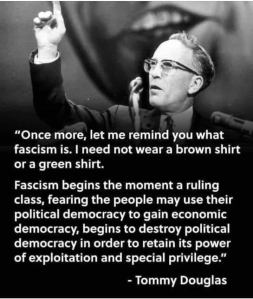
“Fascism begins the moment a ruling class, fearing the people may use their political democracy to gain economic democracy, begins to destroy political democracy in order to retain its power of exploitation and special privilege.” — Tommy Douglas (Seventh Premier of Saskatchewan 1944-1961. Considered “The Greatest Canadian” largely for achieving universal healthcare.)

“It is exactly because of the disintegration of Capitalist-Imperialism that it became necessary for the ruling class of Germany to discard bourgeois democratic institutions and resort to open terroristic dictatorship in order to maintain their position.”  – George Padmore (leading Pan-Africanist, socialist and author.)

“Their final objective toward which all their deceit is directed is to capture political power so that, using the power of the state and the power of the market simultaneously, they may keep the common man in eternal subjection.” Henry Wallace (Vice President of the US 1941-45)

“That, in its essence, is fascism — ownership of government by an individual, by a group, or by any other controlling private power.” FDR (President of the US 1933 -1945)

Who can tell me with a straight face that big money does not own the US government?

Get Out The Vote — But Not For The Fascists.

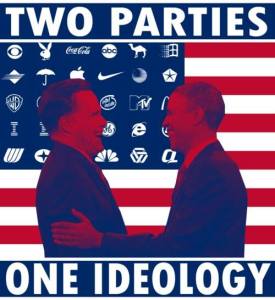
We are going to hear a lot about “saving democracy” and “fighting fascism” in the coming months as a get-out-the-vote strategy for Democrats. The Democrats want our thinking about fascism safely contained within the old European 20th-century definition of fascism, for if we use the 21st-century definition, they lose Trump as a foil and enemy and gain him as a brother in arms every bit as committed to systematic racism, the merger of the corporation and state, and total dominance as they are.  

Capitalism, Socialism, and Fascism all have something in common: they change over time. 

Can we afford not to? 


  1. Enzo Traverso, “Trump’s Savage Capitalism: the Nightmare is Real” in The US Anti-Fascism Reader eds. Bill V. Mullen and Christopher Vials. While I disagree with the editorial slant that sees only the 20th-century European definition as valid, the collection includes many useful articles. In their introduction, the editors apply the old standards and find Trump a danger but something short of a fascist. For example, “His political rhetoric often uses a fascist grammar, but it lacks a properly fascist party or a fascist state.” As I argue, the old definitions are inadequate to our time.
  2. Chris Hedges has popularized this view using Sheldon Wolfin’s concept of “inverted totalitarianism.” I also want to thank Darvish Shirazi for his concise formulations of contemporary fascism.
  3. See Chapter 9 in Cedric J. Robinson: On Racial Capitalism, Black Internationalism and Cultures of Resistance, ed H.L.T. Quan.
  4. Kathleen Cleaver, “Racism, Fascism and Political Murder,” The US Anti-fascism Reader, p. 266.
  5. Kwame Ture and Charles V. Hamilton wrote one of the great classics of US revolutionary thought, Black Power: The Politics of Liberation in America. p.4 
  6. Ajamu Baraka, “The Delusional Commitment to the Doctrine of Full Spectrum Dominance is leading the US and the World to Disaster,” Black Agenda Report.
  7. See also Cedric J. Robinson, p.88-90 155-157 and Gabriel Rockhill, Liberalism and Fascism: Partners in Crime, Counterpunch.


Posted in austerity, Capitalism, Corporate Power, History, Organizing Strategy, police state, Racism, War, White Supremacy, Working Class | Tagged , , , , , , , | 2 Comments

Weapons, War and the Divided Left

It Comes Down To Political Practice, It Comes Down to Weapons 

The deep divisions in the US left over the Ukraine war can be reduced to a single practical question: Do you support sending weapons to Ukraine?

The answer to that question depends on whether or not you accept the idea that we’re the cops of the world. The two parties accept this without question but the pro-weapons left? Behind a facade of left-sounding words, political practice tells the tale.

Does the pro-weapons pro-war left practice what they preach? Do they raise their own funds to run their own guns or organize their own combat units? Are they at least joining Zelensky’s international legion and standing shoulder-to-shoulder with their friends and allies? Hell no, they won’t go! Their practice is to let someone else do the dirty work: that “somebody” is the US military-industrial complex, NATO, but mostly the Ukrainian people they claim to care about.  

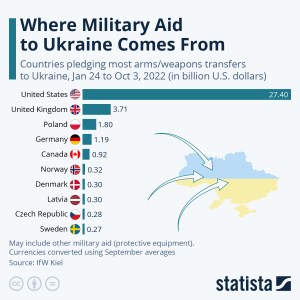
The pro-weapons left hides their collaboration with NATO behind the seemingly simple idea that “Ukraine has the right to get weapons or seek aid from anywhere they see fit.” Except that “anywhere” does not exist in the real world. Ukraine is not a customer in some free market for weapons. There is a highly structured supply chain for weapons that is a long-standing feature of the US empire and it is directed by the US war machine.  The US has dominated the weapons trade since its rise to global power after WWII. Yes, Russia was often in second or third place, but Ukraine will sure not get its weapons from Russia. The only “anywhere” that actually exists is the US government, which is the primary source for weapons transfers to Ukraine.  

The other flaw in the “from anywhere they see fit” formula is the assumption that weapons given from the US to Ukraine are simply an exercise in Ukrainian self-determination — not one way it’s incorporated into the US-dominated global order. Self-determination is not a by-product of the world’s largest military alliance, whose standard operating procedure is to turn allies into pawns and proxies. The drill begins with the mandatory weapons trade demanded of all NATO members. The Ukrainian defense minister recently admitted that Ukraine is a NATO proxy trading blood for weapons.

No, the existing international order is not some normal, natural state of affairs whose peace and harmony was disrupted by the “unprovoked” Russian invasion. To believe that, you’d have to ignore decades of historical context, including the obvious expansion of NATO that put missiles and troops on Russia’s borders, military advisors inside Ukraine and the less obvious policy of “full spectrum dominance” by which the US seeks to dominate “everyone, everywhere, all at once.” The neoliberal world order is no more based on free markets than self-determination or peace.

Instead, Ukraine found itself between two great powers with a long history of hostility and rivalry. Its only hope for self-determination would have been to maintain the balancing act of neutrality and diplomacy, playing one power off the other. Ukraine’s Declaration of State Sovereignty in 1990 and the 1996 Constitution claimed neutrality. After the 2014 coup, neutrality was sold off for an unprecedented supply of weapons and money, US/NATO military advisors, and a false sense of security. Using the Minsk II treaty as a cover for war preparations, the Ukrainian ruling class refused to cut a deal with their own citizens in the Donbas — choosing war instead — and the downward spiral to invasion and disaster began. Russia is not without blame for this war, but history shows a long record of provocation by the world’s dominant military power. The fact that it is “our” country and “our” empire makes all the difference, or should.

Once the Ukrainian ruling elites put their fate in the hands of the west, the IMF and big corporations moved in big time. Today, Blackrock — the world’s largest private bank worth some $8 trillion and deeply connected to the Biden Administration— is in charge of the economic reconstruction of Ukraine. They smell $billions waiting to be made by propping up the new Ukraine. Submission to finance capital is the only kind of  “self-determination” the neoliberal world order offers, yet the pro-weapons left seems to mistake it for the real deal.    

Sunshine Anti-imperialists

As the Ukraine war threatens to escalate out of control, the position of the pro-war left becomes increasingly indefensible. Press them and many will continue claiming they are anti-imperialists. It’s just that Russian or Chinese imperialism is, according to them, more dangerous. But in practice, they are, we all are, failed anti-imperialists who have not seriously challenged, let alone dismantled, the war machine of our own country. The American War in Vietnam was the last time we even got close. Instead of reckoning with that history, the pro-war left has turned its guns on the empire’s enemies. Their return to a pro-peace position can only be triggered by conditions that will never occur in the actual historical moment we live in.     

On some fine and idyllic summer day when the US empire has no rivals; when no other great powers exist; when there are no competing “imperialisms,” when every country abides by the norms of liberalism in their moral judgment — then and only then — will these sunshine anti-imperialists stand against the war machine of their own country. That day will never come again. Until then — climate chaos be damned, class struggle be damned, the risks of world war and nuclear war be damned. Not only has the pro-escalation left assimilated the war-mongers’ gun fetish, but it has also internalized tolerance for collateral damage on a mass scale.

You can reveal the true meaning of the pro-war left’s position against Russia or China or Iran by asking the practical question: “You and what army?” The only honest answer: the armies of the US empire. The sunshine anti-imperialists stand behind the world’s largest military.

Their shared practice unites them in a working political coalition. The Bush-era neo-conservatives, the Democratic party neoliberals, the obedient base of both Republican and Democratic parties, and the humanitarian war crusaders are united with the pro-war left, including factions within the DSA and Green Party. Even some self-described socialists play a role in the pro-war coalition.

That a faction within the Green Party stands for weapons and escalation shows how lost the left can be. Madelyn Hoffman, the co-chair of the Green Party Peace Action Committee, knows what’s at stake:

Peace is one of our single most important values. If we give up on being the party of peace not only do we betray our deepest values but also forfeit our hard-won position as an opposition party.

We Cannot Be Both Pro-war And Pro-worker

So far, the war has strengthened the hand of the entire ruling class which includes some of the most vicious, powerful, and insatiable corporations in the world. Not content with the crushing transfer of wealth over the last fifty years, corporations have taken advantage of the war to jack up prices and maximize profits. At the same time, the Federal Reserve is doing its best to protect corporate power by targeting workers and wages. That is why anyone who claims to support the working class must oppose the war machine. The pro-weapons socialists are walking contradictions and damn fools for giving aid and comfort to the forces waging class warfare.

The pro-weapons left has not attempted to tell us how US involvement in Ukraine is in the interest of the US working class. And, for a good reason: the US working class has no material interests in this war. In fact, the budding labor movement is endangered by the burgeoning war effort. These two things cannot coexist for long. Workers want a voice and economic security, while warmongers want to crush dissent and push the costs of war onto the backs of the working class. Labor leaders must decide which they love more — the war party or the working class.

It’s a bit of a puzzle as to why the US left — which does not have the power to win health care, reproductive rights, free and fair elections, or labor rights — has the strength to summon intense moral indignation about the sins of other countries. We cannot do jack against our bosses or our empire, but boy-o-boy are we going to teach the Russians and Chinese a thing or two about justice and morality. 

What accounts for this virtuous global moralism? One source is the culture we inherited from the first settlers. We tend to see life as a moral crusade, not a political struggle: this “frees” us to disregard both history and power. So I ask the pro-weapons left — so weak in America yet so strong in Ukraine — where does your secret superpower come from? I fear it comes from the same source as the weapons. 

Maybe after years of losing, the pro-weapons and escalation left want to be winners on the “right side of history?” With over $100 billion already spent on US aid to Ukraine, the pro-weapons left must be popping corks and celebrating! I can’t recall the last time the left won such a huge victory! How did they pressure the US government into adopting such a progressive policy?

War Policy is Domestic Policy 

Much of the pro-NATO left has taken this stand to protect its domestic electoral project. If sending weapons is wrong, their political heroes who repeatedly voted without debate for more weapons are also terribly wrong. A narrow choice remains: either admit that the attempts to reform the Democrats have failed or follow their war-mongering leaders to the right. So far, they have chosen the warpath and loyalty to the Democrats. They seem willing to risk everything to do it.

If a wider war comes, history will judge the pro-escalation left harshly — but we cannot wait on disaster. A powerful peace movement will be built first and foremost around unity in practice, not unity in analysis or ideology — just like the pro-war coalition we confront. When working people realize that we, not the ruling classes, pay the price of economic hardship and lives lost, they will turn toward peace. Immediate ceasefire and negotiations remain the best practical demands — demands we make directly to the US government without needing go-betweens who make arms and profit from war. The only “army” we need is the peace movement that we are building. That is genuine self-determination.

To succeed, we must broaden our appeal. The scorched-earth tactics of war accelerate the climate crisis. Climate chaos is the ultimate collateral damage and the surest single threat to life everywhere — on a par with nuclear war. In the end, the pro-weapons left serves the war machine, while the peace movement must serve the people and the planet.   

This essay also appeared in Counterpunch.


Posted in Organizing Strategy | 3 Comments

Moral Crusade or Class Interest? Does the US Working Class Have a Material Interest in Ukraine?

Also in Counterpunch.

Moral crusade or working-class interest? Which should guide our actions on Ukraine and the escalating conflict with China? How do we work through the dilemmas of peace activism given the contradictory mess that is the War in Ukraine? Start by asking the right questions.

Moral Crusades and Cold Wars

Popular support for US involvement in Ukraine is based on a persuasive moral crusade most forcefully advanced by Joe Biden and other leading Democrats. Biden’s speech in Poland was one of those defining moments framing future wars as a repeat of past ones. On behalf of the “Free World,” Biden placed Ukraine “on the front lines” in “the perennial struggle for democracy and freedom.”

Biden did not invent the fiction of the “Free World” or the “perennial struggle” of good v. evil. He simply recycled lines from the first Cold War. Long before him, John F. Kennedy’s “long twilight struggle” committed Americans to an anti-communist crusade that morphed into the unending struggle against any and all rivals after the fall of the Soviet Union.

The problem: moral crusades tend to rule out compromise and negotiations. Behind them lies the mirage of “total victory.” In Ukraine, this is a dangerous illusion for anyone that supports any side in the conflict. Even war at the scale of WWII — that ended in as total a victory as could be imagined — did not finish off fascism, militarism, or empire. Those evils run deep because they sustain capitalism.

War leaders are not about solving fundamental issues so they give us the twin deceptions of moral crusade and total victory. Joe Manchin, who always serves the Democrats by saying the quiet part out loud, entertained the Davos crowd by rejecting negotiations and holding out for a win.

The call to war enjoys strong bipartisan support. Liberal politicians and their supporters  have pushed pro-war attitudes deep into progressive territory by appealing to ideals of self-determination, and “agency.” This also recalls the “cold war liberalism” of the past when some radicals and many labor officials fell into line against the communist menace and supported the Vietnam War.

All the talk of agency and self-determination used to support a war thousands of miles away rings hollow since US workers —right here, right now — are denied effective agency and self-determination. We do not even have health care or reproductive rights — the simplest forms of bodily self-determination. The current organizing upsurge will surely help but true agency still requires mass independent political action as argued by the President of the Vermont AFL-CIO.

Contrary to the stories of triumph we’ve all heard since the Soviet Union collapsed, the Cold War was a disaster for the US working class; the new wars will be worse, much worse.

The war’s mass appeal is not based on informed, analytical, historical, or left-wing arguments but on simple binaries of good and evil promoted by both parties and blasted across all corporate media channels. The moral crusade works to silence any consideration of the material interest of the US working class in this conflict, and for good reason — we have none.  

The Right Question: Is the Ukraine War in the Interest of the US Working Class?

The US working class has a direct and vital material interest in peace. That means the dismantling of the US empire, cutting military budgets, defunding the police army, and in the case of Ukraine: immediate ceasefire and negotiations.

It’s hard to find a single example outside of revolutions and the national liberation struggles of the 20th Century when wars were fought in the interest of the working class. Ukraine is no exception. 

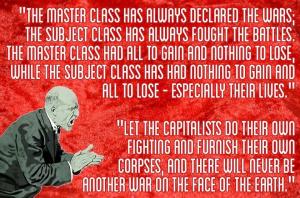
When ruling classes fight each other it’s the working class that does the dying and pays the bills. Wars can only be made when nationalism, fascism or liberalism overcome class consciousness and solidarity. If this argument sounds familiar it’s because it has been a staple of working-class politics since at least WWI. 

Eugene Debs, the great socialist leader, was imprisoned for opposing WWI.

War and sanctions have provided the chaos, cover, and consent for yet another wave of austerity pushing workers down and corporate profits ever upward.   

  • Inflation — an across-the-board cut in pay and social security
  • Rising food prices and possible shortages. 
  • Surging costs of housing
  • Increasing fuel costs for transportation and heating
  • Record hikes in Medicare costs
  • Fed policy ‘to get wages down”

That’s just everything workers need to live.

The war multiplies the power of the very forces that exploit us: big corporations and billionaires. Worst of all, war in all its forms accelerates climate change. Escalation in Ukraine is death to the Green New Deal and a war on Mother Earth. No greater reason to oppose war has ever existed.

Despite these truly existential threats, the ruling class and ruling parties are experts in getting people to vote and act against their own interests. While workers do have jobs in arms factories the weapons industry fails as a jobs program because it produces fewer jobs than any other form of investment. It’s a net loss. Even for those that benefit from war work these imperial privileges are like white privileges: a form of divide and conquer that trades short-term advantage for long-term survival.

Solidarity with the Ukrainian Working Class?

One of the great tragedies of Ukraine was the initial phase of the war that started in the Donbas in 2014. Instead of living up to the Minsk II accords, the Ukrainian state was able to convince one part of the Ukrainian working class to wage war against another part based on nationalism and ethnic differences — with an assist from fascist ideas and neo-nazi fighters. But for the purposes of this essay, I am going to momentarily suspend discussion of that class treachery and the contentious question of what the Russian invasion means for workers in Ukraine and Donbas in order to make clear my argument about the US working-class.  

We have mutual class interests with Ukrainian workers; we both face the assaults of the neoliberal order. Finance capital commands that order by controlling global institutions like the International Monetary Fund (IMF).

In 1992, just after independence, Ukraine joined the IMF and was soon trapped between access to loans and the austerity measures the IMF typically demands. Between 2010 and 2014 the IMF ramped up its assault on the Ukrainian working class by demanding budget cuts, higher home heating prices, the scrapping of pension reform, and the defeat of the proposed minimum wage law. In a move that would trigger his downfall, former Ukraine President Viktor Yanukovych went so far as to seek money from Russia instead. 

The US-supported 2014 coup that ousted Yanukovych was cemented by a multi-billion dollar IMF loan. Monsanto and big agribusiness have grabbed land and profits also with the blessings of the World Bank and IMF. By 2014 corporate control of Ukraine was well underway. Being held hostage to the IMF is not self-determination. US workers have suffered from 50-years of austerity under the heel of the same financial forces. We have a shared class interest and a shared position of servitude under the big money dictatorship.   

From Oxfam: We, the undersigned, call on the IMF to immediately stop promoting austerity around the world, and instead advocate policies that advance gender justice, reduce inequality, and decisively put people and planet first.

We also have mutual interest with Ukrainian workers because the Zelensky regime is seeking new pro-corporate labor laws to bring Ukrainian working conditions more into line with the needs of the global market and further away from its socialist past. The new law proposes exempting workers at small and medium corporations from all legal protections. Approximately two dozen large corporations have already suspended their contracts. In the US, workers struggle under the terms of the 1947 Taft Hartley “Slave Labor” Act which Democrats have refused to repeal these past 70 years. We have common interests in advancing workers’ rights — war or no war.  

We have common ground in that we are controlled by pro-war governments. After its independence in 1991, Ukraine choose neutrality but after 2014 opened the door to NATO expansion with its predictable outcome. The 2015 Minsk II accords were a viable yet never enforced peace plan. As late as 2019 Zelensky himself was elected on a peace platform. Nevertheless, opposition parties were banned outright, and a “uniform information policy” was imposed.

As in the US, the desire for peace among everyday people is subject to intense propaganda and subverted by a political system that allows no alternatives. The US has a far more effective system of suppressing opposition parties. The entrenched parties snag rivals in a web of restrictive state laws and false narratives. Again, we have common ground.

The war has deepened division within an already divided working class in both countries. Perhaps the greatest act of solidarity is to fight our own battles on our own ground. It sure as hell isn’t in handing billions in weapons to a government that does not represent workers any better than our own.

The Global South is leading the way; they are trending toward non-alignment and neutrality. Why should Africa, Asia and South America support war and sanctions that will not only hurt them but are sponsored by the very countries that colonized them? Why should the US working class support a war and war sanctions that hurt us and are backed by the very class that exploits us? We should sit this one out too, except of course for the class struggle that offers a morality far higher than anything the liberal crusaders can offer.

Organizing a Working-Class Peace Movement

The moral crusade has divided, demobilized, and defeated the peace movement — for now.  But changes are afoot.

The pivotal moment was when Democrats gave their unanimous support to the $40 billion funding package and the “lend-lease” bill granting the President even greater powers to make war. All this was done without a word of debate or dissent from leading progressives. We are on our own — and that’s not all bad.

This crisis is an opportunity for the peace movement. The anti-war movement of the Vietnam era was such a driver of social change precisely because the Democrats were pro-war. Participation in the peace movement shifted people into opposition — not just to the war but to the established order itself. 

As the war drags on, working-class support is bound to decline. While polling conducted by the Pew Research Center documents just how successful the pro-war propaganda has been, and just how bi-partisan it is, there’s some evidence that popular support for the war is turning.

Workers are no fools. Over time the price we are paying will become more and more obvious. Inflation is already the most important issue by far.

The sanctions aimed at driving the Russian working class into opposition to Putin may well backfire, turning the US working class against Biden. Tensions with China will further strain working-class support. Since WWII the US has failed to win any wars but has proven quite successful at baiting the bear. Now they are after China. Does anyone believe they can actually slay the dragon?

But the real question for US activists is: will we be able to build a peace movement infused with the kind of ecological wisdom and working-class consciousness that is capable of meaningful resistance to the truly existential threats we all face.

Posted in American Culture, American Exceptionalism, austerity, Capitalism, Climate Change, Corporate Power, Empire, History, Labor Movement, Military, police state, War, War creates Climate Change, White Privilege, Working Class | Tagged , , , , , , | 4 Comments

I Ain’t Marching Anymore

This essay also appears in CounterPunch.

Chris Lombardi’s book,  I Ain’t Marching Anymore: Dissenters, Deserters, and Objectors to America’s Warscouldn’t be more on time. As the US ramps up its proxy war in Ukraine and paves the way for even wider conflict, Lombardi gives us the knowledge we need to help rebuild the peace movement. It’s a monumental task fraught with error and risk, but we can take courage from this story of anti-war resisters who took the most difficult and dangerous of all paths to peace — a route running right through the war machine itself.  I Ain’t Marching Anymore is a must-read addition to books on the US peace movement.*  

Lombardi’s writing is infused with the passion and insight of an activist. Having spent years with the Central Committee for Conscientious Objectors she combines deep political commitment with the skill of an accomplished storyteller and the intellect of a scholar. That alone is a huge accomplishment. It’s a very accessible page-turner and a great book for someone new to the peace movement.

Lombardi shines a light on the unexplored depths of military dissent back to the 1750s. Right from the start, she shares the stories of unknown peace heroes like William Apess, the first known Native soldier dissenter, as well as the infamous Daniel Shay of Shay’s Rebellion. Throughout this survey of war and peace, she introduces us to previously little-known actors while enriching our understanding of high-profile military dissenters like Harriet Tubman, Howard Zinn, Brian Willson, Susan Schnall, and Chelsea Manning.

We also learn a surprising fact: peace organizations led by veterans crop up in opposition to almost every US war of conquest.

Lombardi’s account of World War I is chock full of relevant history. President Wilson — one of the most racist liberals in our history and the invader of Mexico — increased military spending in preparation for war. Yet, he ran on the slogans, “He Kept Us Out of War” and “America First.” The US peace movement was deeply divided, with many repurposing their peace principles and falling into line for war. Remember WWI was sold as the “War to End All Wars” making the world “Safe for Democracy.” It was packaged as a war for peace and democracy. Today’s moral crusade against Russia relies on the same sort of lofty but deceptive appeals to convince otherwise peace-minded people of the necessity for war.

Repression of anti-war voices was rampant at that time too. Congress passed the Espionage Act in 1917; the same law is still used to torture Assange and others. Members of the anti-war union, Industrial Workers of the World, were imprisoned as was Socialist Party leader Eugene Debs. Debs had the audacity to give a speech against war. Mennonites and other Christian pacifists also did hard jail time for their faith-based resistance.

Unlike the Democrats’ current lockstep march to war, a few elected politicians were vocal opponents. Today only one or two libertarian-leaning Republicans make principled criticisms of war. The Congressional “left” is pro-war both supporting massive weapons exports and demobilizing the peace movement as Obama had before them. Although it may feel lonely standing for peace we have anti-war ancestors who saw through the lies and tried their best to oppose WWI. That war would claim 20 million lives, but with nuclear weapons and accelerating climate destruction, today’s stakes are truly cataclysmic.

The section on the Vietnam era is distinctive in Lombardi’s narrative because it takes a helpful detour from the book’s tendency to focus on conscientious objection. Yes, the COs were a vital part of that resistance but were joined by a far larger number of soldiers reacting to the lived experience of blood and brutality — the unavoidable price of US aggression in Southeast Asia.

The Vietnam Veterans Against the War was one of the most influential peace organizations in our history and 80% of its members were combat veterans. They were not, by and large, pacifists. In that sense, we could see them as selective conscientious objectors to the war they fought but that was enough to create the largest military resistance in US history.

When I did my own research on these unlikely heroes many years ago, the very first thing I discovered was that they walked and talked like veterans — that was their leading political identity. They were workers, Black, Brown, and white, but with a special form of class consciousness shaped by the work of war. What gave them their terrible wisdom and their political power was, first and foremost, the fact that they were soldiers and veterans. I treated them as such, and Lombardi did too.

These hard-core activists had not rejected the citizen-soldier role so much as transformed and refashioned it for their peaceful purposes. It was this collective, cultural and political revolution that made the Vietnam Era the high-water mark of soldier dissent in US history— a movement that continues to shape all that would come after it. 

The Veterans for Peace, Iraq Veterans Against the War, About Face: Veterans Against the War and many others would respond to more recent wars by building a permanent military resistance. This movement was able to adapt to the changing terrain of the volunteer army and advances in military technology that the military hoped, and many observers predicted, would prevent resistance. It’s hard to think of a more important historical development for the peace movement.

Lombardi lets her rowdy characters and their wild adventures guide us through the contemporary terrain of high-tech warfare, gender and sexual politics, and the connection with anti-war resistance. She brings all this together when telling of the heroic resistance of Chelsa Manning. Lombardi concludes:

“Manning thus brought together almost all the 21St Century threads…She used Information-warfare techniques, her backups and algorithms, her cutting edge internet hacks, to expose torture and asymmetric warfare, while Manning herself unfurled the misogyny and racism at militarism’s core, between her own gender-dissent and the leaks exposure of US treatment of local allies.”

Mannings’s story helps us to understand that the interlocking crises of war, empire, climate chaos, racism, and misogyny call for a truly interconnected movement capable of alliances and analysis far beyond the fakery of liberal identity politics.

Lombardi navigates the tricky terrain of soldier and veteran dissent at a deep historical level. She gives full weight to the “founding injustices” of slavery, patriarchy, and conquest while not losing sight of the citizen-soldiers’ double-edged struggle. Soldiers often see military service as a means of gaining the rights and security of full citizenship, while simultaneously struggling to free themselves and their community from the very founding injustices of the state they are serving. They want entrance into a house they know is on fire. These contradictions have shaped soldier dissent throughout our history. As Lombardi’s treatment of WWI tells us, even the great WEB Dubois was unable to escape this historical briar patch.

There is so much to learn from I Aint Marching Anymore a short review cannot do it justice. But this much I can tell you (and I am confident Lombardi would agree): a peace movement that does not include, welcome, and help to organize soldiers and veterans will fail. As long as movements for social change continue to view veterans and soldiers as damaged goods and fools — or organizing in the military as a waste of time — those movements can never win. 

Peace, it turns out, has a lot to do with war — it too must be waged. Soldiers and veterans can help lead the way.

*Another important work is Nan Levinson’s War Is Not A Game: The New Anti-War Soldiers and the Movement They Built. 

Posted in American Culture, American Exceptionalism, Climate Change, Corporate Power, History, Military, Movement Culture, Organizing Strategy, revolutionary strategy, unions, War, War creates Climate Change, Working Class | Tagged , , , , | 1 Comment

Basic Training For Organizers

Basic training with Morris Mutual — a mutual aid project in NJ. Thanks to Theresa Markila for inviting me to participate and her assistance with the meeting.

As a labor organizer, I had thousands of conversations with the “unorganized.” But, much of my work was “organizing the organizer” — preparing members and activists to talk to their co-workers. I use the method in the video as a guide to action. If you want to have a successful union or community campaign the organizers need to practice. This is the introduction to our core activity: the one-on-one encounter with the unorganized worker or community person. This method can be tailored to electoral work, union drives, community work, peace and environmental activism, or any other social movement work. The most important part of the training — where people practice talking with each other in small groups — follows the introduction.

Posted in Labor Movement, organizing, Organizing Method, Organizing Strategy, union organzing, unions, Working Class | Tagged , , , | Leave a comment