American Exceptionalism, War and Empire

The First American War Stories Are Still With US

American Exceptionalism remains one of the innermost ideas shaping our national identity and still lies behind all of the war stories used to justify US foreign policy. Exceptionalism has been a part of American culture since the very first European settlers landed. At its core, exceptionalism places America outside of history into a category of its own. For example, a historical view of empire is that all empires rise and fall and the US will be no different. An exceptionalist view of the US empire is: “empire what empire? We’re simply defending democracy.” The initial “escape” from history followed two interrelated tracks: one was the religious radicalism of the Puritans, the other was the frontier experience. Both paths were the warpath.[1]  

The early settlers believed that they were “chosen” — blessed by a special relationship to their God. They viewed their “errand in the wilderness” as a holy mission destined to bring a new and better way of life to the world. God’s judgment on their progress was revealed in the bounty of a harvest or the outcome of a war.  

iu-57American Progress (1872) by John Gast. An allegorical figure representing America’s “civilizing mission” brings light, white settlers and modern technology to the dark west as natives and the bison retreat.

Exceptionalism was not a free-floating idea but was forged into a lasting culture by the frontier wars aimed at the elimination or assimilation of native people and the conquest of land. America’s frontier mythology popularized empire and white settler culture while cloaking their many contradictions.

I know it is hard to believe that the Puritans are still camped out in our minds. The old religious radicalism has taken modern form in the liberal-sounding belief that the US military is a “force for good (read god) in the world.” The double-edged sword of exceptionalism traps us into repeating history: our high moral standards and special role in the world gives us license for wars and aggressions. It is the liberal elements of exceptionalism that are most seductive, most difficult to wrap our heads around, and the most effective at winning our consent to war.

Exceptionalism Wins Our Consent to War

On the one hand, we have the “hard” exceptionalism like that of the Cold War (New and Old) and the War on Terrorism. These war stories revolve around a rigid binary of good and evil. After 9/11, in scores of speeches, George W. Bush repeated the mantra that there were “no gray areas” in the struggle between good and evil.

On the other hand, “soft” exceptionalism takes a slightly different tack by appealing to the liberal in us. Stories of rescue, protection, democracy and humanitarian efforts assure us of our goodness. Obama mastered this narrative by claiming the US had a “duty to protect” the weak and vulnerable in places like Libya.

These two strains of war stories are the narrative one-two punch, winning our consent to war and empire.

Here is how war propaganda works: if authority figures in government and media denounce foreign leaders or countries or immigrants as an evil threat and repeat it thousands of times, they do not even have to say, “We are the chosen people destined to bring light to the world.” They know that millions of Americans will unconsciously refer to the exceptionalist code by default because it’s so deeply embedded in our culture. Once made brave by our exceptional character and sense of superiority, the next moves are war, violence and white supremacy.

The Myth of “Nation-Building” Meets the American War in Vietnam

The Vietnam War, and the resistance to it, profoundly challenged all existing war stories but especially the idea of “nation-building.” The idea that the US could create a new democratic nation — South Vietnam — was an utter illusion that no amount of fire-power could overcome. In truth, the US selected a series of petty tyrants to rule that could never win the allegiance of the Vietnamese people because they were the transparent puppets of American interests. Following the defeat of US forces, the elites shifted gears. The ruling class learned a lesson that forced them to abandon the liberal veneer of “nation-building.”

At the heart of this disruption was the soldier’s revolt. Thousands of US soldiers and veterans came to oppose the very war they fought in. An anti-war movement inside the military was totally unprecedented in US history. The war-makers have been scrambling to repair the damage ever since.

The Next Generation of War Stories: From “Noble Cause” to “Humanitarian War.” 

Ronald Reagan tried to repair the damaged narratives by recasting the Vietnam War as a “Noble Cause.” The Noble Cause appealed to people hurt and confused by the US defeat,  as well as the unrepentant war-makers because it attempted to restore the old good vs. evil narrative of exceptionalism. For Reagan, America needed to rediscover its original mission as a “city on a hill” — a shining example to the world. Every single President since has repeated that faith.

The Noble Cause narrative was reproduced in numerous bad movies and dubious academic studies that tried to refight the war (and win this time!). Its primary function was to restore exceptionalism in the minds of the American people. While Reagan succeeded to a considerable degree — as we can see in the pro-war policy of both corporate parties  — “nation-building” never recovered its power as a military strategy or war story.

The next facade was Clinton’s “humanitarian war.” Humanitarian war attempted to relight the liberal beacon by replacing the unsolvable problems of nation-building with the paternalistic do-gooding of a superior culture and country. In effect, the imperialists recycled the 19th Century war story of “Manifest Destiny” or “White Man’s Burden.” That “burden” was the supposed duty of white people to lift lesser people up to the standards of western civilization — even if that required a lot of killing.

The_White_Man's_Burden_Judge_1899John Bull (Great Britain) and Uncle Sam (U.S.) bear “The White Man’s Burden…by delivering the colored peoples of the world to civilization. (Victor Gillam, Judge magazine, 1 April 1899)

This kind of racist thinking legitimized the US overseas empire at its birth. Maybe it would work again in empires’ old age?

From the “War on Terrorism” to the “Responsibility to Protect.”  

After the shock of 9/11 the narrative shifted again. Bush’s “global war on terrorism” reactivated the good vs. evil framing of the Cold War. The “war on terror” was an incoherent military or political strategy except for its promise of forever wars. Just as the Cold War was a “long twilight struggle” against an elusive but ruthless communist enemy, terrorists might be anywhere and everywhere and do anything. And, like the fight against communism, the war on terrorism would require the US to wage aggressive wars, launch preemptive strikes, use covert activities and dodge both international law and the US Constitution.

9/11 also tapped into deeply-rooted nationalistic and patriotic desires among everyday people to protect and serve their country. The first attack on US soil in modern memory powerfully restored the old exceptionalist binary: when faced with unspeakable evil, the US military became a “force for good in the world.” It’s easy to forget just how potent the combination is and how it led us into the War in Iraq.  According to The Washington Post:

Nearing the second anniversary of the Sept. 11, 2001, terrorist attacks, seven in 10 Americans continue to believe that Iraq’s Saddam Hussein had a role in the attacks, even though the Bush administration and congressional investigators say they have no evidence of this.

The mythology is so deep that at first the people, soldiers especially, just had to believe there was a good reason to attack Iraq. So we fell back on exceptionalism despite the total absence of evidence. Of course Bush made no attempt to correct this misinformation. The myth served him too well — as did the official propaganda campaign claiming Iraq had weapons of mass destruction.

But in due course, some of the faithful became doubters. A peace movement of global proportions took shape. But in the US far too much of what appeared as resistance was driven by narrow partisan opposition to Republicans rather than principled opposition to war and empire.

But fear not war-makers — Barak Obama and Hillary Clinton to the rescue! As they continued Bush’s wars in the Middle East and expanded the war zone to include Libya, Syria and then all of Africa, they sweetened “humanitarian war” with a heaping dose of cool-coated “Responsibility to Protect.” Once again, American goodness and innocence made the medicine go down and our wars raged on.
20110521_ird001_0-2

Obama restored legitimacy to the empire so effectively that it took years for the illegal, immoral, racist and “unwinnable” wars to reveal themselves to the public. I was told by one of the leaders of About Face: Veterans Against War that they almost had to close shop after Obama was elected because their donor base dried up. Obama’s hope was our dope. Just as the daze was finally lifting, Trump started to take the mask off.

Is The Mask Off?

Today’s we face an empire with the mask half off. Trump’s doctrine — “We are not nation-building again, we are killing terrorists.” — is a revealing take on military trends that began with the first US – Afgan War (1978-1992). US leaders gave up nation-building and opted for failed states and political chaos instead of the strong states that nation-building, or its illusion, required. The US military began to rely on mercenaries and terrorists to replace the American citizen-soldier. The soldier revolt of the Vietnam Era already proved that everyday Americans were an unreliable force to achieve imperial ambitions.

Trump is now waging a naked war for oil. Nothing rips the mask off of the humanitarian justifications better than the actual experience of combat in a war for oil and power — so the war managers tried to reduce combat exposure to a few. And they succeeded. The number of official US troops abroad reached a 60-year low by 2017. Even still a new resistance movement of veterans is gathering steam. Can the mask be put back on? It’s hard to say, because as The Nation reports, Americans from a wide spectrum of political positions are tired of perpetual war.

Can the “Green New Military” Put The Mask Back On? 

The recycled imperial justifications of the past are losing their power: Manifest Destiny, White Mans’ Burden, leader of the free world, nation-building, humanitarian war, war against terrorism, responsibility to protect — what’s next? If only the military could be seen as saviors once again.

A last-ditch effort to postpone the collapse of the liberal versions of war stories might just be the “Green New Military.” Elizabeth Warren’s policy claims, “Our military can help lead the fight in combating climate change.” It’s a wild claim that contradicts all evidence unless she is also calling for an end to regime-change wars, the New Cold War and the scaling down of our foreign bases. Instead, Warren is all about combat readiness. She did not invent this — the Pentagon had already embraced the new rhetoric. Given that the Working Families Party and some influential progressives have already signaled their willingness to accept Warren as a candidate, she might just silence dissent as effectively as Obama once did.

original


But, the lie is paper-thin: “There is no such thing as a Green War.” You can fool some of the people all the time and all the people some of the time but you cannot fool mother nature one little bit. War and climate change are deeply connected and ultimately there is no way to hide that.

The New Cold War and More of The Same Old Wars

So far the New Cold War against Russia and China has recycled the anti-communist conspiracy of the old Cold War into the xenophobic conspiracy theory of Russia-gate. Even a trusted tool like Mueller could not make it work as a coherent narrative but no matter — the US did not skip a beat in building up military bases on Russia’s borders.

The media and political attacks on Russia or China or immigrants, or Iran are likely to continue because propagandists cannot activate the exceptionalist code without an evil enemy. Still, it takes more than evil. An effective war story for the US ruling class must project the liberal ideas of helping, protection, saving and the spread of democracy in order to engineer mass consent to war. Hence the need for “Humanitarian War,” “Duty to Protect” or maybe the”Green New Military.”

Let anyone propose a retreat from any battlefield and the “humanitarian” war cry will rally the empire’s pawns and saviors-types. If we take our exceptionalism religiously — and religion it is — then the US empire will never ever pull back from any war at any time. There is always someone for the empire to “protect and save:” from the “Noble Savages” and innocent white settlers of the frontier, to the Vietnamese Catholics, to the women of Afghanistan, to the Kurds of Syria.

We so want to see our wars as a morality play, just as the Puritans did, but the empire is all about power and profit.

politics_and_war_by_milesland-d1x7649-2

“Politics and War” By MilesLand on DeviantArt

“War is the Continuation of Politics by Other Means.” — Carl von Clausewitz

All the Big Brass study Clausewitz because he is the founder of western military science — but they are so blinded by the dilemmas of empire that they make a mess of his central teaching: War is politics.

None of the war narratives and none of the wars can solve the most important question of politics: governance. Who will govern the colonies? The overwhelming verdict of history is this: colonies cannot be democratically or humanely governed as long as they are colonies. Until the empire retreats its heavy hand will rule in places like Afghanistan.

The empire is reaching the limits of exceptionalism as both war narrative and national mythology. This is why our rulers are forced to desperate measures: perpetual war, occupation, intense propaganda campaigns like Russia-gate, the reliance on mercenaries and terrorists and the abuse and betrayal of their own soldiers.

Just as damning to the war machine is the collapse of conventional ideas about victory and defeat. The US military can no longer “win.” The question of victory is important on a deep cultural level. According to the original mythology, the outcome of wars waged by “the chosen people” are an indication of God’s favor or disfavor. In modern terms, defeat delegitimizes the state. Endless war is no substitute for “victory.”

But it’s not military victory we want. Our victory will be in ending war, dismantling the empire, abolishing the vast militarized penal system and stopping irreparable climate chaos. Our resistance will create a new narrative but it can only be written when millions of people become the authors of their own history.

The empire is slipping into decline and chaos – one way or another. Will we be actors deciding the fate of the American Empire or will it’s collapse dictate our fate? But these wars will, sooner or later, become the graveyard of empire — or else America is truly exceptional and we really are God’s chosen people.


1/ Check out these two important recent works that discuss both the history and  contemporary forms of  American Exceptionalism: The Limits of Power: The End of American Exceptionalism by Andrew Bacevich and American Exceptionalism and American Innocence by Roberto Sirvent and Danny Haiphong


Posted in American Culture, American Exceptionalism, Climate Change, Empire, History, Organizing Strategy, Racism, Red Scare, War, War creates Climate Change | Tagged , , , | Leave a comment

Soldiers and Veterans are Anti-War Leaders. Could This Be The Peace Movement of Our Time?

d3cfb3db71a6cd61ec0a91b1f841482f-340x285

“The greatest purveyor of violence in the world: My own government.”  — Martin Luther King

If you want to stop the wars, challenge the empire and deal with climate crisis then support our anti-war soldiers and veterans. Soldiers and veterans carry special knowledge. Sometimes that knowledge starts with the gut-wrenching realization that they have fought, suffered, killed and died in vain — or worse. It’s hard not to hear the echoes of anti-war Vietnam veterans in the words of today’s war veterans. High-stakes betrayal teaches some mighty hard lessons.

But they have always seen first-hand the horror and futility of war. What we understand as endless war, occupation, and empire, they know through personal experience. And that personal experience of America’s wars has forced many of the anti-war leaders to undergo a personal and political transformation — from warriors to peacemakers — from waging war to waging peace.

67406730_3035044303178941_6555539215315107840_n

This shift is embodied by the leadership of the Vietnam Veterans Against the War, (VVAW) About Face: Veterans Against War, Veterans for Peace, Military Families Speak Out and Veteran Power. These organizations are the leading edge of a much broader disenchantment with war. According to the Pew Research Center, a majority of US veterans do not support the regime-change wars in Iraq and Afghanistan.

67153576_3034319233251448_477571857617256448_n


Empire Abroad, Empire at Home

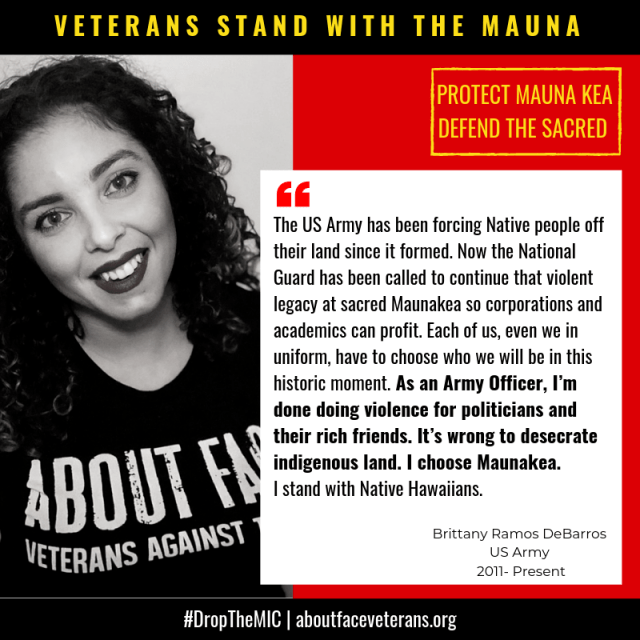
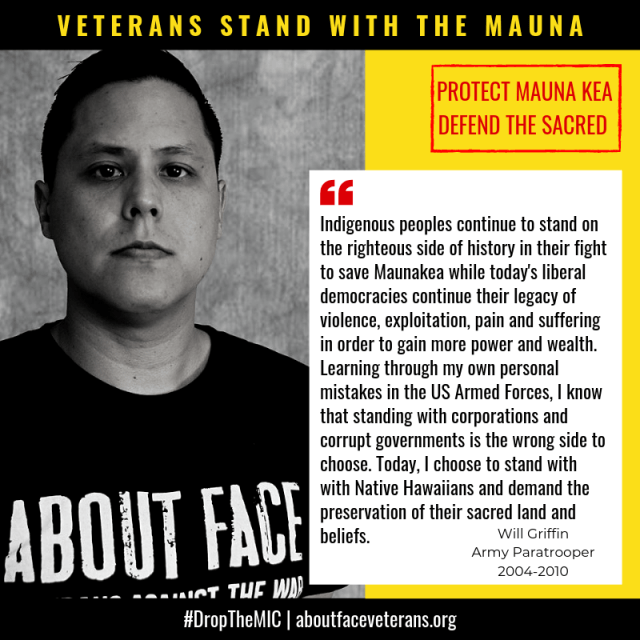
Sharp-sighted, the anti-war vets see militarism everywhere they look.  About Face puts it this way.

We are Post-9/11 service members and veterans organizing to end a foreign policy of permanent war and the use of military weapons, tactics, and values in communities across the country. As people intimately familiar with the inner workings of the world’s largest military, we use our knowledge and experiences to expose the truth about these conflicts overseas and the growing militarization in the United States.

eba2de738ee0253af30d1ae25db31a3b

What happens “over there” happens right here at home to the poor, black and brown. But some of the first casualties are the soldiers and veterans themselves. 

Today’s soldiers and veterans have been treated worse by the US government than any generation of soldiers in well over a century, maybe ever. In an effort to hide war from the public, the war managers put heavy combat duty on approximately 0.5% of the American population. That .5% sees far more combat than soldiers did in WWII, or Vietnam or Korea. So far, 225,000 soldiers have been deployed three times or more and over 28,000 have deployed a soul-crushing five times or more.

The consequences in PTSD, moral injury, suicides and casualties are more than tragic — the empire is eating its own. But, that is what empires do, intentionally or not, and that is also why they collapse. And the enormous burdens veterans carry makes it a real challenge for them to mount resistance to the war machine without a civilian movement to stand beside them. 

And make no mistake about it: the government hides war from us by increasing their reliance on mercenaries and terrorists to do the dirty work. Many quietly accept or even deny our use of “moderate rebels” or soldiers of fortune or that US troops have been brutally sacrificed. That is the price of our “American privilege.” Imperial privilege is one of the most widely internalized, if little understood, forms of privilege — inviting us to go about our days oblivious to what is done in our name. As long as the bombs are not falling on us it’s all cool, right? Except now we know that war and climate change are inextricably linked and militarization abroad leads to militarization at home. The empire has become a threat to our rights, our lives, our planet.

Soldiers and veterans need our help, but also have so much to teach us: they know the military and they know how to organize. Their training can teach us the kinds of dedication and discipline we need to build a mass movement with real power to disrupt the war machine. With a little help from their friends, soldiers and veterans can once again be leaders in a new anti-war movement. Here are just a few of the past and present projects of the Veterans for Peace, About Face, and the Vietnam Veterans Against the War.

  • Drop The MIC Campaign: Raising consciousness about the Military-Industrial Complex and militarism at home.
  • Winter Soldier: More than 200 U.S. veterans and soldiers, as well as Iraqi and Afghan civilians, told of their war experiences. The event was inspired by the VVAW’s Winter Soldier Investigation of 1971.
  • Deported Veterans Advocacy Project: Assistance and support for veterans facing deportation.
  • Veteran Peace Teams: “act as an unarmed, nonviolent presence standing with peaceful protesters, taking a front line if necessary, confronting, documenting, and opposing any and all use of force by police, national guard, regular military, or private contractors against peaceful protesters exercising their right to assemble and seek redress of grievances. Veterans Peace Teams have deployed domestically with the Occupy movement, Standing Rock, and Ferguson. Internationally, the Veterans Peace Teams have also traveled to Palestine, Okinawa, and Jeju Island, South Korea.”
  • Operation Recovery: Stop the Deployment of Traumatized Troops focuses on ending the practice of deploying service members suffering from Post Traumatic Stress Disorder (PTSD), Traumatic Brain Injury (TBI), and Military Sexual Trauma (MST).
  • VVAW Archive Project. The VVAW is where it all started, and they have become our teachers, preserving their anti-war legacy.


67425748_3034631306553574_2477712735517802496_n


I am not a liberator. Liberators do not exist. The people liberate themselves. — Che Guevara

No politician or celebrity will save us, and the sooner we give up that illusion, the better. Since the social movements are far more effective in creating rapid political and cultural change, the real question is: how do we liberate ourselves? No engagement, no finding out.

Ajamu Baraka sets a high standard for how political figures can relate to the peace movement. A veteran himself, Baraka went from being a long-time human rights activist to the Green Party candidate for Vice President in 2016 — returning to the movement as a lead organizer of  The Black Alliance for Peace. This is ideal. Baraka’s seamless (but hardly effortless) transition back and forth between electoral and movement work is a prime example of what the Green Party might become: the electoral wing of the social movements.

iu-56

Are we ready to engage anti-war people wherever we find them? If we can look beyond our electoral obsessions or rigid categories and set our sights on organizing and movement building we might see that there are many thousands of good people that want to stop climate change and end war. We should make the most of it.

Are we going to keep surrendering ground by failing to reach out to them? Is the peace movement so powerful that we can afford the luxury of turning people away because we don’t like their politics or the candidate they support? 

The new peace movement faces many problems that can only be addressed in the field — through the struggle and risk that is the hallmark of organizing and activism.

Leave ideological comfort zones behind and learn to ride the wild wind.

Soldiers are Workers but Workers are Soldiers Too.

And, if you think we can confront the military without confronting the problems of the working class consider the fact that armies throughout history have relied on the poor. Workers and peasants have always done the bulk of the fighting.[1] Think on these facts:

  • The majority (60% or so) of the military is white but overwhelmingly working-class.
  • Overall, 15% of DOD active-duty military personnel are women. 56% of women are Hispanic or a racial “minority.”
  • Racial and ethnic groups made up 40% of the Defense Department active-duty military in 2015, up from 25% in 1990.
  • In 2015, blacks made up 17% of the DOD active-duty military – somewhat higher than their share of the U.S. population ages 18 to 44 (13%).
  • In 2015, 12% of all active-duty personnel were Hispanic, three times the share in 1980.
  • Natives serve in the US military in greater proportion to their population than any other group and have for many decades.
  • The Williams Institute estimated in 2010 that 70,000 members of the U.S. military were lesbian, gay, or bisexual.
  • In 2014, the Williams Institute also concluded that about 15,500 transgender Americans currently serve in the armed forces.

Is this the enemy? Can we dismiss them all as brainwashed or hopelessly colonized? Or are these allies in the making? We have the very populations that today’s social movement grew out of inside the military. So much depends on how we engage.

67171988_3034534046563300_6672433042402836480_n


D_7T7w_WwAAAjxm

The working class joins the military for many reasons. At present, the government does not need a formal draft because an “austerity draft” is in full swing. A country without minimum standards for health care, decent wages and higher education is tracking the poor into the military. Austerity is a favorite weapon of corporate power for many reasons.

1*LEJLvZtxp8S0tT0IhDMgwA

Family and community traditions of service are powerful recruiters as well.

67465360_3034483733234998_2834664100234002432_n

And somewhere in the mix is the belief that the US military is “a force for good in the world.” Can we blame people for believing in American Exceptionalism or other ideas central to dominant culture?[2] Can we blame them for doing as their elders have done?

67403664_3034584949891543_6423077153981595648_n

And remember many have their first contact with military recruiters while still children. Help stop this horrid child abuse by supporting counter-recruitment efforts.

67537468_2479646888733413_1931203684977344512_n

Whatever We Do, We Cannot Stay At Home

Let’s not slip into what I call “stay at home knowledge,” or what used to be called “analysis paralysis.” A prime example of stay-at-home knowledge is the widespread belief that because there is no draft, it’s impossible to organize a peace movement. That piece of knowledge leads to retreat and surrender. That is why it’s essential to know that there is a draft: it’s a class-based austerity draft that tracks the poor into war. Fight austerity to fight the draft. And remember too that the military resistance during the Vietnam era was often led by people who volunteered — not by reluctant draftees. Same as now.

Our job is to engage — not blame people who have simply grown up in America. Condemnation is easy, but it is no way to build the movement.


61634027_2239327526145278_9201323414317582556_n


Remember Standing Rock

gty-standing-rock-3-er-161205_12x5_992

Given an opportunity to stand up for the kind of values and ideals that they really wanted to fight for, a new GI and veteran movement is ready to spring to life. We saw that movement come alive when thousands of veterans supported native leaders at Standing Rock in what was the largest demonstration of radical veterans since the Vietnam era. 

Not only did they stand with water protectors but in a ceremony of political responsibility and spiritual reconciliation offered heartfelt sorrow for our role in attacking native people and stealing their land.

When soldiers revolt their actions have direct consequences on the military’s ability to maintain the war machine. When a working-class peace movement takes shape it will take the shape of soldier and veteran dissent. Reach out to soldiers and veterans, build a peace movement to support them, and when struggles like Standing Rock break out veterans will answer the call.

The question is: will we? 


1/. For material in the bulleted list see Pew Research.

2/ For more see:  American Exceptionalism and American Innocence by Roberto Sirvent and Danny Haiphong.

Posted in American Culture, Climate Change, Empire, Green Party, Martin Luther King, Movement Culture, organizing, Organizing Strategy, Racism, revolutionary strategy, Strategy, War, War creates Climate Change, Working Class | Tagged , , , , , | 3 Comments

A Different​ War Story: The Soldier and Veteran Resistance Against the War in Vietnam

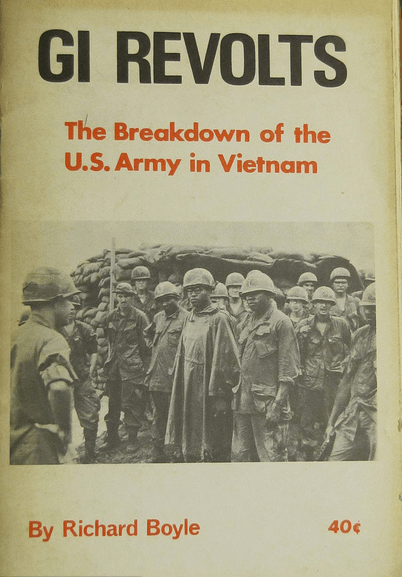
The battle over American war stories began during the peak of the last revolution. Millions of Americans and tens of thousands of veterans and soldiers opposed the war in Vietnam. In the war’s moral outrages, crimes and betrayals, many saw the US empire for the first time.[1] For the last 40 years, the ruling class has been running away from the problems revealed by the Vietnam War.

The war-makers have lots of money and weapons but their stories — and the politics behind them — no longer make sense. The empire is running out of maneuvering room as its war narratives grow weaker and less convincing.

The disruptions caused by the Vietnam Era anti-war movement are part of an unfinished revolution that still begs questions. How can a nation that does not practice democracy — or a government that attacks the Bill of Rights at home — convincingly claim it is “a force for good in the world?” How can a military that drives climate change and guarantees the global interests of bankers and oil companies claim to protect or defend anything at all? How can an empire, as large and militaristic as ours, co-exist with democratic rule at home?

American exceptionalism — the idea that we are a chosen people, inherently good, and outside of the normal constraints and contradictions of history —  is one of the founding ideas of American culture. But, when the empire lurches from crisis to crisis even culture as deeply rooted as exceptionalism can be dragged into consciousness and challenged.

As long-time Vietnam Veterans Against the War leader and former Vets for Peace President Dave Cline once told me, “”Vietnam is where all that history changed.”

The Vietnam Legacy They Do Not Want You To Think About

AAA_0

US Involvement in South East Asia began as an effort to restore the French and British Empire in Asia. But neither imperial power could weather the storm of WWII or defeat the national liberation struggles that followed.  Soon enough the empire was ours — all ours — and so were the wars. Anti-communism and the Cold War positioned the US as “leader of the free world” and insisted that the Vietnam War was the moral equivalent of WWII. The enchanting idea of “nation-building” cast the war effort as benign, high-minded and helpful. But the Vietnamese victory over US forces and the peace movement broke the spell and momentarily revealed the empire for what it truly was.

What cannot be honestly explained must be hidden. Because of its revolutionary implications — and its contradictory nature — the history of the soldier and veteran anti-war movements have been largely forgotten. It’s way past time to remember.

Since the Vietnam War the media has censored war news by listing it low on their agenda, omitting it altogether, or, today, marginalizing anti-war social media sites. The government stopped the formal draft and reduced their reliance on US troops to a mere .5% of the population making soldiers and veterans and war casualties less visible.

In order to keep the numbers down, the military brass cynically abused and wounded their own soldiers by forcing them into multiple tours with far too much exposure to combat. Those that endured the ordeal had some serious survival issues returning to “normal” life. Over twenty soldiers and veterans commit suicide each day. It’s hard to fudge that data.

The military had to attack its own soldiers to avoid the reemergence of a Vietnam era style anti-war movement. It was then that a massive peace movement — in the context of the civil rights/black power, student and women’s movement — became not just a movement against the war and — for millions of Americans at least– against empire itself.

By the early 1970s, the political heart of this wide-ranging peace movement was soldier and veteran dissent. Their power came from two sources. First was the fact that soldier resistance was a real material constraint on military operations and — second to the bloody sacrifices of the Vietnamese people themselves — was a major factor limiting the military’s ability to wage war.

voices_of_conscience-752x490

Just as important, the soldiers and veterans had the cultural and political credibility to help working-class Americans question and challenge the war and, in some cases, the existing order itself.

“The most common charge leveled against the antiwar movement is that it was composed of cowards and draft dodgers. To have in it people who had served in the military…who were in fact patriots by the prowar folks own definition was a tremendous thing. VVAW (Vietnam Veterans Against the War) in 1970 and 1971 was unlike almost anything I’d seen in terms of its impact on the public…We took away more and more of the symbolic and rhetorical tools available to the prowar folks–just gradually squeezed them into a corner…we took away little by little the reasons people had not to listen to the antiwar movement.”[2]

“We took away more and more of the symbolic and rhetorical tools available to the prowar folks.” This is the transformative dynamic at the heart of military resistance which made it both revolutionary, deeply contradictory and hard for people to understand. Ideals like the “citizen-solder” were claimed by the military because they motivated soldiers with high moral appeals. But under the conditions of the period, such ideals were transformed, refashioned and repurposed into a new service ideal that would wage — not war — but peace. They rocked the foundation of military culture not simply by criticizing it or repudiating it — that’s easy — but by transforming it — that’s the hardest thing in the world. Transformation is what revolutions are made of.

The Vietnam legacy reveals the importance of supporting anti-war soldiers and veterans because they have power far beyond their numbers. This argument is not idle speculation. Although I am not a veteran, I was nearly drafted into the Army in 1971-2. It made me rethink my life. Then I got involved as a young activist and organizer in the anti-war and radical movements of the period. Inspired by a few anti-war veterans I knew, I spent a decade researching the soldier and veteran anti-war movement and wrote New Winter Soldiers: GI and Veteran Dissent During the Vietnam Era. 

Here is the shortest possible summary of a movement that came to speak for half of all soldiers and veterans of the time:

During the American War in Vietnam, soldiers refused to go into combat and resisted commands of all kinds. The lowly foot soldier demanded democracy inside their combat units by insisted on discussing actions rather than simply following orders. They marched in protest and sent tens of thousands of letters to Congress opposing the war. In desperation, they attacked reckless officers — their own officers. An international underground newspaper network spread the word. Thousands resisted the war effort in ways large and small. 

Vietnam-GI

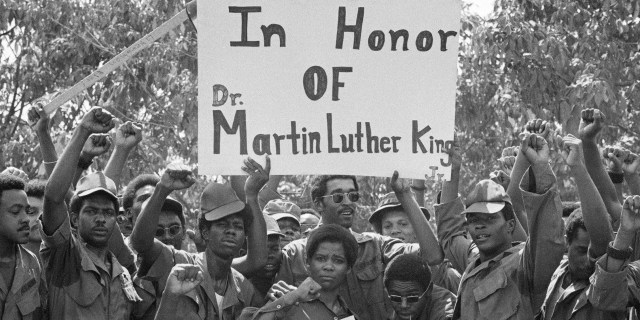
Massive prison riots of US soldiers in American military jails in Vietnam — like the uprising at Long Binh Jail — disrupted military command. Over 600 cases of combat refusal rose to the level of a court-martial, some involving entire units. US soldiers violently attacked US officers over a thousand times. Urban rebellions at home and the assassination of Martin Luther King had a profound impact pushing black troops toward war resistance.

1*BAZUaLpWf-AAdLq6z2H-JwAfrican American soldiers in Vietnam observe the birthday of late civil rights leader Martin Luther King Jr. in 1971. (Bettmann via Getty Images)

The military brass lost their ability to enforce discipline and wage war. In 1971 Colonel Robert D. Heinl claimed: 

“The morale, discipline, and battle-worthiness of the US armed forces are, with a few salient exceptions, lower and worse than at any time in this century and possibly in the history of the United States.”

From the bottom up, US troops replaced “search and destroy” missions with “search and avoid” missions. In some areas of Vietnam “search and avoid” became a way of life. A US Army Colonel recalls:

“I had influence over an entire province. I put my men to work helping with the harvest…Once the NVA understood what I was doing they eased up. I am talking to you about a defacto truce you understand. The war stopped in most of the province. It’s the kind of history that doesn’t get recorded. Few people even know it happened and no one will ever admit that it happened.”[3]

Anti-war soldiers were simultaneously on the front lines of war and the front lines of the anti-war movement.[4]

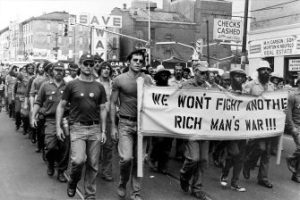
When they came home veterans became the leading protestors. Black veterans joined civil rights groups or revolutionary organizations such as the Black Panthers that connected peace and internationalism with local community service. The Vietnam Veterans Against the War (VVAW) had at least 25,000 members — 80% were combat veterans –and the VVAW became leaders in the anti-war movement in the early 1970’s.

fightrich

The VVAW kicked off some of the largest civil disobedience protests against the war. In one of the most stirring moments of the entire peace movement veterans returned their medals on the steps of the US capital. 

iu-51

This was the most important working-class peace movement in American history. Since those days there has been an unbroken tradition of opposition to war from service members, veterans and their families. Today the tradition is carried on by the Veterans For Peace, About Face: Veterans Against War, Military Families Speak Out. The VVAW remains the only peace group founded during the Vietnam resistance still in existence today.

Soldier and veteran resistance was a blow against the empire. Can it become one again?

1/ See, New Winter Soldiers: GI and Veteran Dissent During the Vietnam War.

2/ Ben Chitty is quoted in, New Winter Soldiers, p.130

3/ Moser, p. 132

4/ See a new collection of essays Waging Peace in Vietnam, Edited by Ron Carver, David Cortright and Barbara Doherty


Posted in American Culture, Capitalism, Climate Change, Empire, History, Martin Luther King, Masculinity, organizing, Organizing Strategy, revolutionary strategy, Strategy, War, War creates Climate Change, Working Class | Tagged , , , , , | 1 Comment

Climate Crisis Means the Ruling Class has Failed. Can the Working Class Inherit the Earth?*

Power For Profit is Still the Prime Directive

The climate crisis is proof positive that the ruling class is an utter failure — but it will not fall on its own. Can the working class rise to the challenge? It sure will help if we understand that our class interests are not merely the economic needs of working people — no matter how important that is — but the universal interests of a healthy planet for all the people. Let’s start acting like it.

The corporate solutions to the climate crisis must dodge the causes of the crisis. The ruling class uses deception and secrecy to limit public debate. When the facts become obvious and overwhelming corporate politicians simply refuse to debate it. Gag rules are back in fashion. When the people demand a Green New Deal the same politicians water it down and disarm it.


what-is-that-place-article

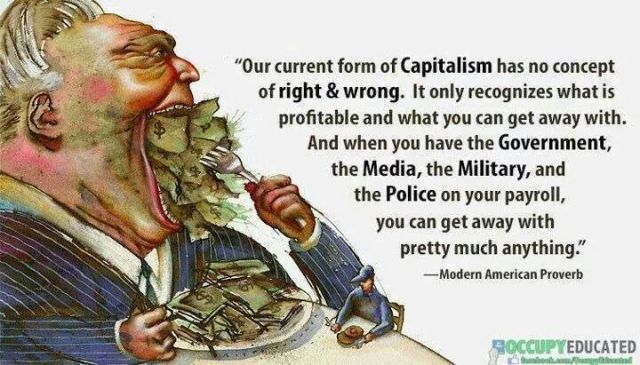
Meanwhile, the Corporate State pursues the only agenda it has ever known: power and profit. If we accept corporate empire as normal, natural or eternal there is nothing left but better management, technical fixes, adaptation, and illusions of endless growth.

Since corporate capitalism is a “grow or die” system, it cannot consider limits even at a time when planetary limits are on display for all to see and verified by our best science. For example, there is no place in corporate plans for the conservation of energy despite the fact that energy not used is the truest form of clean energy. Instead of keeping in the ground, it’s always more and more.   

Former Trump Secretary of State and former Exxon-Mobile CEO, Rex Tillerson repeats the managerial view.

“I’m not disputing that increasing CO2 emissions in the atmosphere is going to have an impact…we believe those consequences are manageable….It’s an engineering problem and it has engineering solutions.[1]

Shell Oil tried those “solutions” by investing $5 billion on Arctic exploration betting that the melting ice caps would clear the way to new-found riches. The “grow or die” dynamic at the heart of capitalism pushes all the corporations into The Race for What’s Left. They cannot stop themselves because the quest for limitless profits compels limitless growth. No capitalist enterprise can opt out of the system for long and survive.

The latest liberal-sounding twist on the management and engineering ploy is for oil companies, the military, and elite think tanks like the Rand Corporation to push “adaptation and resilience” as a form of acceptance to climate catastrophe.

Meanwhile, the corporate state itself boosts yet another “gold-rush.” In fact, the US government led the charge to the “last great frontier” in this 2013 National Strategy for the Arctic :

“This strategy is intended to position the United States to respond effectively to challenges and emerging opportunities arising from significant increases in Arctic activity due to the diminishment of sea ice and the emergence of a new Arctic environment.”

And the #1 concern:

“We will enable our vessels and aircraft to operate, consistent with international law, through, under, and over the airspace and waters of the Arctic, support lawful commerce….”

The government will respond to the “emerging opportunities” of a “new Arctic environment” to support “lawful commerce” with our military might. The new arctic gold-rush is the same as the old one, except now it threatens worldwide disaster. We can count on corporate power to double-down as the crisis worsens. And they are doubling down on us.

Their other plan is to suppress dissent. A new security industry grew dramatically after 9/11 to become a wing of the intelligence community and military. From Nigeria to Standing Rock, to Honduras environmental activists face militarized police and violent suppression including assassination and jail time. Since 2010, 1000 environmental defenders have been murdered, many of them native people. By 2017 nearly 20 States have considered making protest a crime. Protectors have been accused of being terrorists. Even old-line private armies like the Pinkertons have retooled themselves for climate change. There is no border between national security and business opportunity for oil cops and mercenaries who exercise the police powers and military duties of the corporate empire both at home and abroad.

Q. Whose Plans are These? A. The Ruling Class That’s Whose.

wpid-wp-1410178581588

Yes, there is a ruling class. Here are just a few of its major features in regard to war and climate destruction.

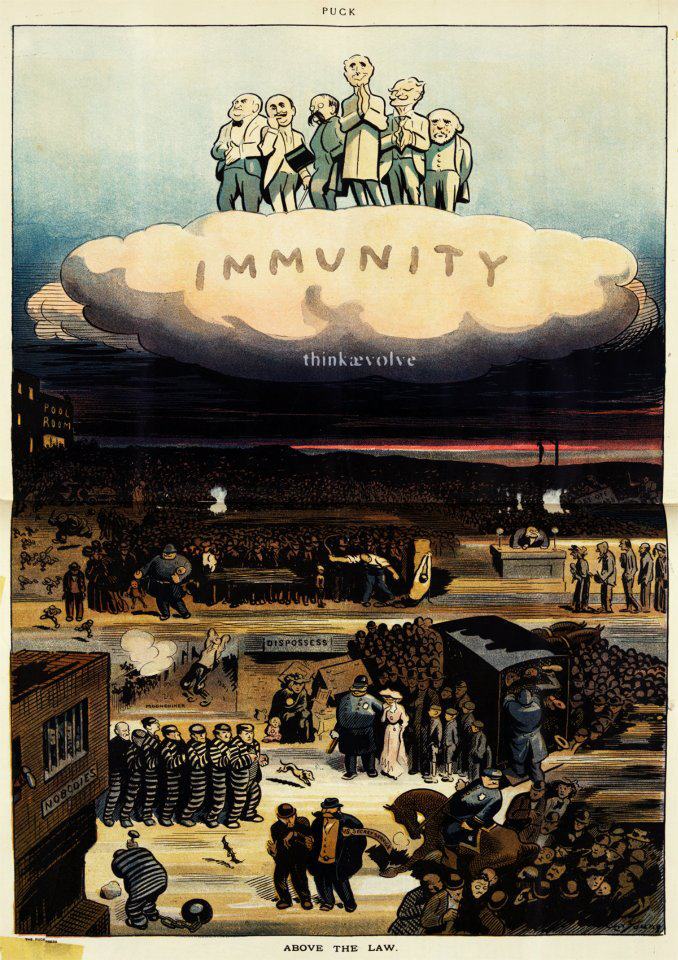
While not without its fissures and fractures, the elites rule through a network of powerful institutions that consolidated power on a global scale by merging the state — the US government in particular — with the largest corporations. This fusion is the systematic foundation of the twin crises of war and climate destruction.

Since the corporate state seeks to use “all their means of power” they have effectively integrated the military, government, big oil, big media and big banks into the interlocking force of corporate power.

Here it is — straight from the Army’s mouth:

“Competition between contending groups using all their means of power has always characterized the international environment….Such competition involved all instruments of state power: diplomatic, informational, military, and economic…expanded in some recent policy documents to diplomatic, informational, military, economic, financial, intelligence, and law enforcement…”

The corporate state came of age as it assimilated “all instruments of state power” into its network.

A key connection, for example, is the deployment of banks and bankers, including the IMF and World Bank as weapons in the pursuit of common objectives — as was obvious in the recent coup attempt against Venezuela that also enlisted “informational” giants like Google, Facebook, and Twitter in the war effort. Even faux-environmentalist groups Nature Conservancy, World Wildlife Fund, and Environmental Defense Fund have taken money from and provided cover for the fossil fuel giants.[2] 

iu-47

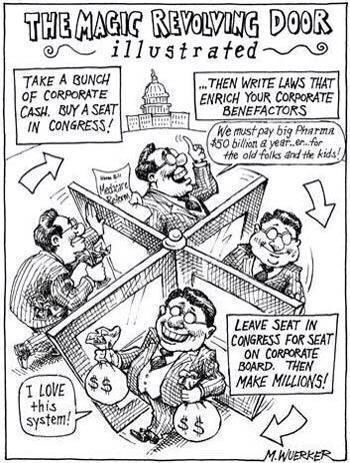
The Revolving Door?

The interlocking institutions work in many ways but one means is the so-called “revolving door.” The merger of finance capital with government has been well documented by Nomi Prins. This CBS News analysis lists the names of Goldman Sachs executives “at the highest reaches of power both in Washington and around the world.” Two recent reports by Public Citizen document the connections between Federal Trade Commission officials and the corporations they are supposed to regulate and the routine transfer of politicians to the front ranks of corporate lobbyists.

The same kind of dual office holding is business as usual for the military-industrial complex.

“As many as 380 high-ranking Defense Department officials and officers…left government to become lobbyists, corporate board members and defense contractor consultants….In 645 instances documented by the nonprofit Project on Government Oversight, officials went to work for major contractors—Boeing, General Dynamics and United Technologies are the top three—with nearly 90 percent of them doing lobbying.”

These officials are lobbying — they work connections. The “revolving door” metaphor fails to describe how corporate power is staffed. These politicians, bankers and generals are not moving in and out of anything. Instead, they are simply being transferred to different “duty stations” — to borrow a military term. Individuals play various roles as a means to develop the connections and gain the experience needed to seal the relationships between the interlocking institutions of the corporate state.

Oil money also greases the wheels making sure the political parties can function. At the pinnacles of power, a global ruling class of highly interlocked corporations showers US politicians with cash. 

56533809_569933926819333_5111955700167213056_n

New research from sociologist Josh Murray reveals the inner workings of the global machine. Murray’s high-powered statistical analysis shows that the more interlocked with each other corporations are, the more they act as a coherent ruling class aware of their global class interest. It is precisely these highly connected organizations that have the strongest relationships with the US political system.

“[T]he most likely to form PACs and donate money to US politicians are those firms that make up the “inner circle”…in the G500 (Global Fortune 500)….[Those] most central in the transnational interlock network are the most likely to form PACs.

An interlocking system of corporations allows them to intervene in US elections as a matter of routine. Citizen’s United just legalized the system. It’s not the Russians, it’s corporate power. Give up the fantasy of free-market fundamentalism — it cannot be proven using evidence. Welcome to Corporate Power — it’s the only form of capitalism that matters — and we can see it all around us.

Will The Working Class “Inherit the Earth?”

iu-44

The ruling elites have an organized class consciousness that thinks globally and acts globally. They use all the means at their disposal. How about us?

They have the corporation, we have the coalition. They already have a network of powerful organizations while we aspire, or should, to a “movement of movements.” Just as the ‘revolving door” cements ruling class ties we should aim to raise an army of “key workers” (a term we use in union organizing to find and support the real leaders) that can build the linkages between the peace movement, the climate movement, labor, and all the other social movements. There is not a single social movement or community that does not have a stake in the climate crisis.

Climate crisis is a revolutionary situation if we have the vision and audacity to make it so. We cannot continue to live or act in the old way and our rulers cannot rule as they have. Something has got to give. I have observed and participated in four decades of the perennial attempts to find ideological unity. We cannot agree on exactly what kind of class consciousness we are after or what socialism really means. We love to argue with each other — me too. But instead, we need to balance our ideological preoccupations with organizing. That means dramatically scaling up our engagements with everyday people and starting where they are not where we want them to be. Careful listening is the first step.

In the end, organizing is about action. In the end, organizing is all about “power to the people.” When millions move we will find the way forward together. There is no other way for us to learn democracy:

“The organizer’s rhetorical, strategic and tactical repertoire is designed to produce social action because it is in the tumult of political life that leaders emerge, relationships develop and transformations in consciousness are realized.”

Organizing also means learning to navigate and find strength in differences — because differences are the concrete conditions of our movement. Nothing — nothing — is ever going to change that. Perhaps we can move forward by developing a program that promotes on-the-ground unity in action without uniformity in ideas or analysis. Coalitions are designed to be just that — unity without uniformity. Here are some tips on coalition building.

The height of political skill is not getting everyone you agree with in a room to draw up a platform, analysis or manifesto. The height of political skill is to build a movement — of people you do not fully agree with — that can successfully execute a plan of action. That is real solidarity that looks like the real working-class.

We are held down by intersecting and mutually reinforcing structures of domination and hierarchy — empire, class, race, gender, age, sexuality and more. These codes and structures of dominion find their ultimate expression as the climate crisis. Perhaps we will be liberated by turning those same intersecting lines of oppression and exploitation into pathways of resistance.

[T]he perspective and political practice some of us currently call intersectionality is fundamentally ecological, is insisting on the organic, interactive, complex, and interdependent nature of oppression, and therefore, by both necessity and our own nature, of liberation…Each kind of oppression has its strategic importance in the reproduction of domination and props up the others, just as each struggle has moments of igniting a broader swath of resistance and leading that moment.” Aurora Levins Morales “Medicine Stories” p. 25-6.

If the forms of oppression intersect, then the forms of liberation must intersect as well. Each struggle, while rooted in the particular conditions of some people, place and time, offer lessons and produce resources that apply to everyone. The Red Nation gets right to it:

Thus the Red Deal is “Red” because it prioritizes Indigenous liberation, on one hand, and a revolutionary left position, on the other. It is simultaneously particular and universal, because Indigenous liberation is for everybody.

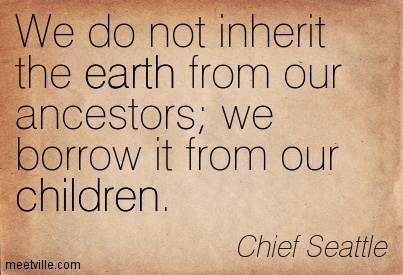
Our movement crisscrosses at the intersection of what is “simultaneously particular and universal.” If you are looking to the working-class for leadership you will know we are ready when we become “a class for itself” that is simultaneously on the way to becoming a class for the whole people and the whole earth. This way we can inherit the earth without owning it and receive its bounty without destroying it. This way we can win.

*Read the entire series on War is Climate Change.  Big thanks to Geoff Herzog for his editorial assistance and close reading of the series.

1/ Tellerson is quoted by Oscar Reyes in “Climate Change INC: How TNCs are Managing Risk and Preparing to Profit in World of Runaway Climate Change.” p 63, in Buxton and Hayes, The Secure and the Dispossessed

2/ Naomi Klein, This Changes Everything: Capitalism vs The Climate, pp 355-365


Posted in American Culture, Capitalism, Climate Change, Corporate Power, Empire, History, Martin Luther King, Movement Culture, Organizing Strategy, Socialism, War, War creates Climate Change, Working Class | Tagged , , , , , , | Leave a comment

Doubling Down: The Military, Big Bankers And Big Oil Are Not In Climate Denial –They Are In Control And Plan to Keep It That Way.

Also in CounterPunch

“Capitalism, militarism and imperialism are disastrously intertwined with the fossil fuel economy….A globalized economy predicated on growth at any social or environmental costs, carbon dependent international trade, the limitless extraction of natural resources, and a view of citizens as nothing more than consumers cannot be the basis…for tackling climate change….Little wonder then that the elites have nothing to offer beyond continued militarisation and trust in techno-fixes. — Nick Buxton and Ben Hayes [1]

The ruling class may be an utter failure but that is not stopping them taking aggressive action on climate change. Their chief concern: maintaining power, control and profits at all costs. 

The plan is well underway and it sure ain’t the Green New Deal. Just imagine a more extreme version of the world that already exists: where healthcare is rationed; where wealth inequality strangles democracy; where austerity is a weapon of class warfare; where millions die prematurely from toxins in air and water; where war and incarceration is the solution of choice; where people are rounded up in concentration camps; where corporations rule unchallenged; where extreme weather wrecks havoc in an expanding circle of misery. The only new thing about their solution is the stench of fascism that grows ever stronger and more odious. 

The Bosses Want More of the Same

When Trump and the Republicans deny climate change, when Pelosi, Pallone, Perez, Biden and Obama join with Trump in sabotaging the Green New Deal or dismissing climate action as too expensive, too dreamy, not practical or too pure — they are all bold-faced liars and frauds.

The Republicans know full well that their partners in crime — oil companies, bankers and the military brass have known about climate change for decades. And, the corporate Democrats know that these same powerful players they too represent already have a risky plan to deal with climate change. From their shared perspective, even the Democrat’s Green New Deal, despite its weaknesses, must be marginalized since it competes with the establishment’s plans for our future. 

Framing Climate Change

To maintain power they need to limit our thinking. The two most important narratives imposed on us are climate change as a “threat to national security” and as a “business opportunity” — the twin rationales for military and corporate power. They want to focus us on how to manage the crisis, profit from it, or adapt to it, instead of opposing it.

Once framed in this way the very institutions responsible for climate change can benefit from disaster while hiding their responsibility for creating the crisis. But the military-corporate management of the crisis will undoubtedly follow the same principles that created the crisis: the costs of pollution, adaptation, endless growth and war won’t appear in the corporate ledger. Military budgets will only grow larger. The costs will be “externalized” and paid by the suffering of everyday people.

The 63 million Americans currently exposed to unsafe drinking water and the 200,000 (according to an MIT study) in the US that currently die prematurely from air pollution are just a down payment. And the US is the wealthiest country in world history. The global figure for air pollution related deaths is 5.5 million annually. The 20 million or so deaths from war since WWII are a gross outstanding debt. How is that for adaptation and management? How will our rulers plan to maintain control as the crisis deepens?

Plans? What Plans?

Unsurprisingly, the military plans to maintain its ambition for “full spectrum dominance.”  A 2014 report from the Department of Defense quotes former Defense Secretary Chuck Hagel who — having previously been on the Board of Directors of Chevron and Deutsche Bank — knows how to unite big oil, big banks and big guns.  

“Our coastal installations are vulnerable to rising sea levels and increased flooding, while droughts, wildfires and more extreme temperatures could threaten many of our training activities….A baseline survey to assess the vulnerability of the military’s more than 7,000 bases, installations and other facilities is nearly complete, Hagel said. “In places like the Hampton Roads region in Virginia, which houses the largest concentration of U.S military sites in the world, we see recurrent flooding today, and we are beginning work to address a projected sea-level rise of 1.5 feet over the next 20 to 50 years…”

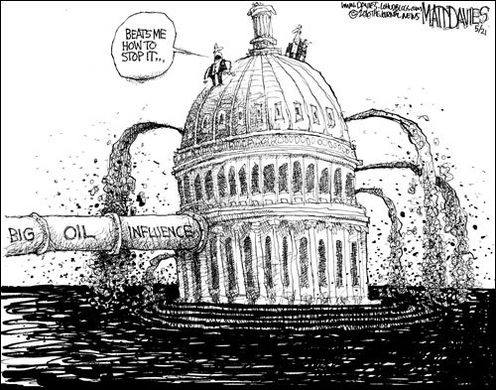
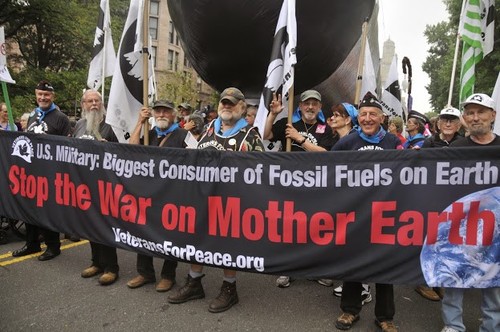
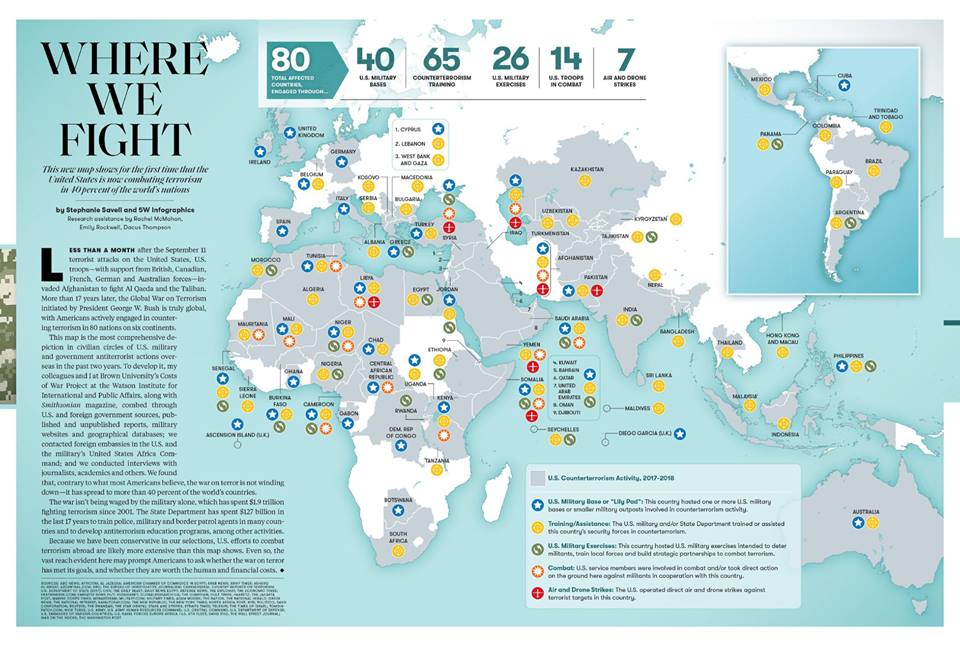
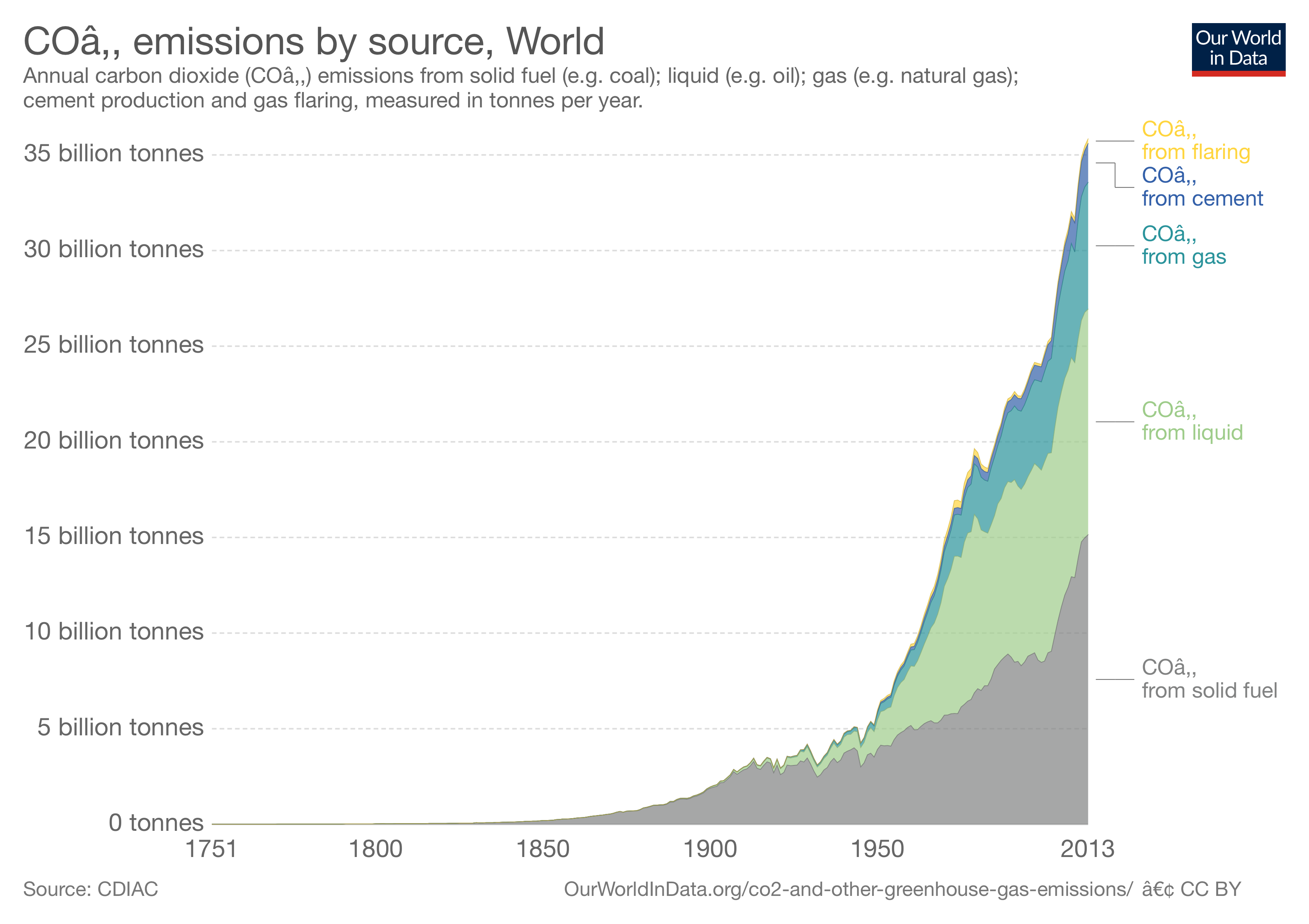
They want us to forget that it has now been proven beyond doubt that the military is the world’s largest consumer of fossil fuels and largest polluter. War will continue, climate crisis be damned. Elizabeth Warren’s 2019 policy statement and the bipartisan letter sent to Trump by over 100 congress members urging Trump to make climate change a national security issue is more proof that war trumps climate. In truth, the military is caught in a crisis of its own making. As Desiree Hellegers puts it: “The US Military Poses a Significant Threat to the US Military.”[2] 

While the pro-war media makes much of the military’s attempts to use alternative energy, the Pentagon failed to reach its puny 2014 goal of 5% renewable.

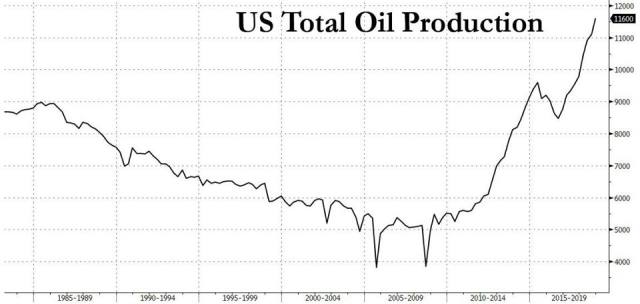
Similarly, Obama’s 2009 stimulus package cancelled out the effects of small green spending with an “all of the above” approach, including money for “clean coal,” record oil production and increased energy use. This pattern of “greenwashing” — minor green efforts masking major investments in fossil fuels is identical to the corporate approach.

45935627_10156990185936518_3896616535359225856_n-2

The oil companies and big banks that make crazy money from fossil fuels also hide the truth by posing the problem as a question of proper management. Sharon Kelly reports the banker’s view of a new “business opportunity”:

“Scientific research finds that an increasing concentration of greenhouse gases…is warming the planet, posing significant risks to prosperity and growth of the global economy,” JPMorgan Chase Bank, Bank of America Corp., Wells Fargo, Citibank, Goldman Sachs, and Morgan Stanley wrote in a 2015 statement. “As major financial institutions…we have the business opportunity to build a more sustainable, low-carbon economy and the ability to help manage and mitigate these climate-related risks.”

So how is it that the bankrollers of climate chaos, investing  $1.9 trillion in fossil fuels just since the Paris Accords, also claim to “manage and mitigate these climate-related risks?”

According to the bankers, the problem with climate change is that it’s “posing significant risks to the prosperity and growth of the global economy.” What they will not say is that the global economy — which demands enormous fossil fuel production and consumption — is posing significant risks to the climate. The global shipping and aviation on which peak profit-making depends is, like the military, exempt from the Paris Accords. The bankers, generals, and politicians are protecting the sources of their power.  

60157650_2367568359933056_2752660805047549952_n

From the Gold Standard to the Oil Standard

What the bankers will not say is that billions of the dollars they trade in are “petrodollars” — as explained in this informative documentary video.  A 40-year back-room deal with the Saudis secretly recycled oil money back to the US. This deal essentially shifted the US dollar from the “gold standard” to the “oil standard.” According to Bloomberg:

The basic framework was strikingly simple. The U.S. would buy oil from Saudi Arabia and provide the kingdom military aid and equipment. In return, the Saudis would plow billions of their petrodollar revenue back into Treasuries and finance America’s spending.

Buying oil in dollars is a form of imperial tribute other countries pay to the US — which is why the US insists all oil trading be in US currency. Iraq and Lybia once traded oil in other currencies. Venezuela, Syria, Iran, Russia and China still do. See?

Since oil props up the US Dollar, bankers have a direct interest in wars that prop up the fossil-fuel regime. It is highly unlikely that the US Dollar, the Military-Industrial-Complex or the global corporate economy can live without its addiction to oil — whatever green capitalists imagine in their wildest dreams. Some contradictions simply cannot be overcome.

Representative Democracy is Dying. Long live Direct Democracy!

It’s “power to the people” or nothing. There is no middle ground. But we will be swamped along with the middle ground if we do not have real leverage and real power. The military, the oil companies and the big banks have plans and power both. The Green Party’s Real Green New Deal is a solid plan, as are the guiding principles offered by DSA Ecosocialists, or Tulsi Gabbard’s OFF Act.

But, the straightest line to the power we need is not just good policy, more manifestos, analytical precision or electoral politics (although those things might be helpful) — it’s the sloppy, contradictory, demanding work of organizing and direct democracy. The many efforts to protect water and confront infrastructure projects are leading the way.  The Red Nation is a new voice telling classic political truths. Listen carefully. The “Red Deal” platform states:

This…will encompass the entirety of Indigenous America, which includes our non-Indigenous comrades and relatives who live here….We cannot expect politicians to do what only mass movements can do…..A mass mobilization, one like we’ve never seen before in history, is required to save this planet. Indigenous movements have always been at the forefront of environmental justice struggles…The Red Deal is not a “deal” or “bargain” with the elite and powerful. It’s a deal with the humble people of the earth; a pact that we shall strive for peace and justice and that movements for justice must come from below and to the left.

“We cannot expect politicians to do what only mass movements can do…from below and to the left.” So true, but how?

Whether you are base-building with workers or tenants, movement-building with the peace and environmental movements or running electoral campaigns, the under-appreciated work of talking with, and listening to, everyday people is the fast track to fundamental change. Talking with everyday people is a revolutionary act. Acting with others is better yet.

A massive Harvard study tells us what we already suspect: we have the most dysfunctional, least democratic electoral system of any so-called “western democracy.” The collapse of real representation is a leading cause of crisis. To think that such a broken system can repair itself and then take on massive problems of its own making without an equally massive and equally disruptive popular movement is more than just wishful thinking — it is a profound disregard for history. Show me some evidence. How was the original New Deal created? The failure to allow moderate and popular reforms like universal health care does not bode well for government’s ability to act on climate and war — issues that strike right at the heart of the existing social order.

We have good blueprints. It’s vitally important to put demilitarization at the center of our efforts not just because the US empire is the world’s largest consumer of fossil fuels or because the same military is the enforcer of the global fossil fuel regime but because understanding the connections between war and climate changes clears the way for fusion and synergy between the environmental and peace movements and movements for economic justice.

But the real question — the unanswered question — is HOW? How do we move on the climate crisis? Can we build it from the bottom up? It sure isn’t coming from the top down. Can the Green New Deal become a revolutionary reform? Ask people what they think about the Green New Deal. Where it leads is up to us.


1/ The best single source is a very well researched collection of essays The Secure and the Dispossessed: How the Military and Corporations are Shaping a Climate-Changed World edited by Nick Buxton and Ben Hayes.  Find the quote on p 234.

2/ You can see much more of this misdirection by looking at this document: Military and National Security Leaders Urge Robust New Course on Climate Change.” Or see Elizabeth Warren’s new plan for a green military.


Posted in American Culture, Capitalism, Corporate Power, Empire, Green Party, revolutionary strategy, War | Tagged , , , | 3 Comments

The Climate Counter-Offensive: Secrecy, Deception and Disarming the Green New Deal

CLIMATE_WARS_ILLUSTRATIONS.0 Also in Counterpunch.

There are things we are not supposed to know and the corporate controlled news industry is not going to tell us. Totally absent from the obedient media is one of the most important stories of all time: war creates climate change. 

The story of how this knowledge has been repressed is essential to understanding how the government and military are at the heart of climate counter-offensive and what it will take to stop them.

The Government Rules by Force, Fraud and Deception

The information blockade starts with the military itself. The military purposely restricts information plus its immense size and bureaucratic complexity means that it is so hard to grasp that political leaders cannot themselves understand the institution they are supposed to command. 

You want proof? Just try reading the US Government Accountability Office (GAO) 2016 report which could not figure out just how much oil the military burns. The GAO concluded: “[C]ongress does not have full visibility over the amount of fuel volume the military services require on an annual basis for their activities…”

This should not come as a surprise. Since its inception in 1950 or so the modern military has resisted any accounting of costs in violation of Article I, Section 9, of the US Constitution. In 2018 the Pentagon failed its first-ever audit. It’s not just about the missing 6.5 trillion dollars, (although that really matters too) it’s that the opaque accounting system is armor — a defensive weapon used to neutralize anyone that wants to understand, let alone oppose, the US government.  

This massive fraud is just the financial side of the serial political con committed by the US government. Article 1, Sec. 8, Clause 11 of the Constitution clearly gives Congress, and only Congress, the right to declare war — but that has never stopped the Pentagon or the President or the Congress or the Courts from betraying their duty to defend the Constitution. 

Not only can’t the government regulate corporations it cannot regulate itself in line with what is supposed to be the highest law of the land— the US Constitution.

But shift your vantage point to see the merger of the corporation and the state and then you see a military perfectly regulated in keeping with a corporate empire that equates profit with power and actively promotes both without limit. The liberal state is no more

For example, the War on Terror increased the Pentagon’s appetite for power and secrecy at the cost of environmental justice. According to legal scholar Hope Babcock,

“[O]ne response to the terrorist attacks on 9/11 has been a significant erosion of basic civil liberties. Congress has given unprecedented power to the President and his law enforcement agencies to wage this war against terror….The military has sought, and largely received, permission from Congress to weaken environmental and public disclosure laws as part of the arsenal of “tools” it needs to fight this war.”

If weakening “environmental and public disclosure laws” is a weapon of war  — then “destroying the planet to save it” is the outcome.

The Dirtiest Of All Dirty Secrets

This very big, very dirty secret — that war drives climate change — is carefully guarded. To keep things hush-hush the military is excused from oversight or obligation. This exception to the rule of law has always been the practice but G.W. Bush formalized it demanding language to that effect in the 1997 Kyoto Accords, which he later refused to sign anyway. 

As Sara Flounders reports:

“The complete U.S. military exemption from greenhouse gas emissions calculations includes more than 1,000 U.S. bases in more than 130 countries around the world, it’s 6,000 facilities in the U.S., its aircraft carriers and jet aircraft. Also excluded are its weapons testing and all multilateral operations such as the giant U.S. commanded NATO military alliance and AFRICOM, the U.S. military alliance now blanketing Africa. The provision also exempts U.S./UN-sanctioned activities of “peacekeeping” and “humanitarian relief.” 

The Kyoto exemption set the pattern for subsequent climate meetings at Copenhagen 2009, Cancun 2010, Durban 2011, and Doha 2012. In a typically toothless and incremental fashion, the Paris Accords replaced the mandatory exemption for the military with voluntary reporting on non-binding goals, disguising further deception as progress.

56416843_10217753921136083_8653001939019104256_n

Speaking of toothless, Obama’s much-heralded 2015 Executive Order requiring federal agencies to cut greenhouse gases specifically exempted all overseas activities of the intelligence and military agencies from having to report contributions to climate change or limit pollution. The military is responsible for 80% of all government fuel consumption.

The Democratic Party’s version of deception is the denial that anything can be done outside of stimulus for so-called markets. Obama’s support for alternative energy was a small part of an “all of the above approach” that provided cover for dramatically increasing oil production, and expanding oil infrastructure for an otherwise archaic and unproductive energy economy. 

160721142411-us-oil-production-soars-under-obama-780x439

30 years of elite efforts to address the crisis did not capture the public imagination because they offered nothing of substance. Emissions only continued rising, as “Global Banks Invested $1.9 Trillion in Fossil Fuels Since Paris Climate Pact.” Decades-old oil wars continue and expand as the US aims to capture and control Venezuelan and Iranian reserves with the backing of both corporate parties.

Trump seized on this record of weakness, withdrawing from Paris, rescinding Obama’s Executive Order, and enforcing the Republican brand of total climate denial (a denial that even the oil companies and military they serve do not share). Trump’s climate death-wish is enabled by the failed outcomes of the non-binding agreements, exemptions, and slick tricks like “all of the above” or Biden’s middle ground. These efforts will do nothing to “keep it in the ground” and that is a true measure of success. 

Trump and the climate deniers so easily mock the liberal attempts at addressing the climate crisis because the liberals make a mockery of themselves.

In fact, the US government is the historic agent and manager of climate change.

“In all past international conferences it was again and again the U.S. government that sabotaged the meetings and refused to be bound by any treaty. The Obama Administration on Aug. 27 again confirmed that at the UN meeting in New York in September to prepare for the 2015 Paris meeting that only a non-binding agreement could be put forward.”

And so the Paris Accords undermined themselves by design. From the first international climate conference in Rio de Janeiro in 1992 to Paris 2016, we witnessed a series of performances by the most accomplished actors on the world stage. By every critical measure, the elite climate meetings have failed — except they have succeeded in offering false hope and distraction away from the massive movements it’s actually going to take to bring about change. 

These treaties did not fail for lack of an executive power to enforce limits on member nations. NAFTA, IMF, WTO, and the World Bank all create and enforce the rules of global corporate order by imposing international financial regulations and punishing all restraint of global trade. “Who elected the IMF to be the ministry of finance for every country in the world?’’ asked Julius Nyerere, the former president of Tanzania. Well no one, but that is exactly how the IMF operates.

On a twin-track, the US government/military enforce the political rules of empire. The empire aims for total hegemony, known in military lingo as “full-spectrum dominance” and will do whatever it takes to prevent the emergence of a multi-polar world. We spend trillions and kill millions policing the world.

But when it comes to climate change — where is a cop when you need one?

Well, there are far too many cops but they are busy enforcing the global order and a fossil-fuel economy that would collapse tomorrow if the true costs of oil and war had to be reckoned with. 

Despite the fact that the recent UN’s IPCC report has succeeded in sounding the alarm that we have precious little time before irreversible climate damage, it also continues earlier UN shortcomings by not mentioning the military’s role in climate change. As bad a future as the IPCC report predicts, is it does not include military pollution in its calculations.

Naomi Klien’s This Changes Everything: Capitalism vs The Climate fails to recognize the US government and military as key players in the climate crisis. Why so? To accept the government’s role would be to upend her claim that free-market fundamentalism is to blame and government regulation is to wish for. And despite all the good work done by 350.org their website hardly refers to government, let alone the military, as a source of climate destruction.

Disarming The Green New Deal

It is within this context of 70 long years of secrecy, special legal exemptions, deception, fraud, lies by omission, non-binding agreements — and the global role of militarism as climate crisis multiplier — that we can best evaluate the Democratic Party’s version of the Green New Deal (GND).

Alexandria Ocasio-Cortez bought the GND to the world’s attention which now has overwhelming public support.  There can be no “just transition” to a new economy without security for workers and the communities most impacted by climate change. But in its current form, the DNC’s plan also uses the language of market solutions and technical fixes that sadly repeat the weakest features of failed climate “action” already offered by elites.  

But most importantly, the Democrat’s GND omits the US government and military as a cause of climate disaster. The other — almost unbelievable omission — is the failure of the Democrat’s GND to explicitly call for dramatic reductions in the use of fossil fuels. In fact, the words “oil” “gas” “coal” or “fossil fuels” do not even appear in the final document that established the committee. It’s just amazing. It’s a dangerous replay of how we got sold the substandard ACA: take universal health care off the agenda from the very beginning and then craft a corporate “solution.”

The Democrat’s GND remains a vague non-binding wish. The 2050 deadlines are standard political dodge-ball. When faced with crisis, corporate politicians always want to ‘kick the can down the road” — postponing real action until the damage is already done and someone else takes the blame. Adaptation to disaster and management of the crisis rather than prevention of climate chaos is the hidden but actual program of the Democrat’s GND.

Given the far-reaching influence of big oil, the near-total dysfunction of Congress, the GND committee is likely to remain yet another exercise in fraud and deception.  Republican members of the committee have terrible voting records on environmental issues and like some Democrats have significant financial connections to oil.  The New Yorker reported:

“Forty-one of the House’s four hundred and thirty-five members have pledged “to not take contributions from the oil, gas, and coal industry…” But only one pledge-taker… is on the new climate committee. The rest, as E&E News reported, have fossil-fuel connections…”

Pelosi staffed the committee to kill it. Ocasio-Cortez was invited but chose not to serve. Why? Most likely she does not want to waste her time or spoil her reputation on a loser committee. But her real “contribution” came in deceiving the public. In March 2019 McConnell called the Democrat’s bluff by bringing the Green New Deal to a vote. Pelosi and AOC organized a “present” vote to hide the lack of support among Democrats. The three Democrats that broke party discipline and did not vote “present” all voted no.

The very next month 224 Democrats, including Ocasio-Cortez, voted to subsidize fracking and gas infrastructure, spending $580 million to open up new fossil fuel markets tied to the US as a rebuff to Russia. Russiagate and “security” trumps climate again. A real GND would ban fracking right now.

Like the Paris Accords, the Democrat’s GND is designed to fail us. All the decades of exemptions, denials, omissions and non-binding agreements gave the impression of action being taken. But they were all Orwellian theatrics scripted to distract from the vast consumption of fossil fuels and the military’s enforcement of a world order dependent on oil, gas and coal.

Meanwhile, we twist in the wind. 

What is Viable?

The same historical context suggests that a program like the Green Party’s Green New Deal — the idea that inspired Ocasio-Cortez — gives us a real fighting chance because it accurately identifies the political and military roots of climate change. Such are the contradictions of the political crisis. A small, poorly funded and too often ignored organization like the Green Party is nonetheless freed by its independence to make a historic contribution to the most important issue of our time. 

The environmental crisis is beginning to reconfigure political debate. Incremental change is no longer an optionThis is precisely what happens in a revolutionary situation: prevailing wisdom and common sense are turned on their heads. Ideas once dismissed as utopian become the practical answer. 

Threatened with climate destruction is there any real meaning left to the “lesser of two evils?” Do we vote for permanent damage in 12 years as opposed to 8? Wouldn’t that be so cunning and clever? At least you couldn’t be accused of “purity.” Even the arguments about “viability” — designed to silence dissenters — are being weakened by the obviously unsustainable form of government we now have.  

What is viable? Any strategy, form of government, political party, or economic system that gives us a mere 10 years before irreversible climate chaos is not viable. Here is our paradox: watered-down programs like the Democrat’s GND are totally inadequate to the task at hand but may (or most likely may not) be politically “viable.” The Green Party’s GND — if enacted — would actually give us a real fighting chance against climate destruction but we are told it is not “viable” within the existing system.

Make your own judgments but make no mistake: the most powerful jury is not out; the verdict is in. Mother Nature has spoken: it’s the existing order that is not viable.  

Posted in Capitalism, Climate Change, Corporate Power, Empire, Green Party, History, Organizing Strategy, Strategy, War, War creates Climate Change | Tagged , , , , | Leave a comment

War is War on Mother Earth

iu-10

Second in a series on War and Climate Chaos. Read the first here.  Also find this article at Counterpunch.

“In order to achieve the massive systemic and cultural transformations required for mitigating climate change…we’re going to have to deal with the socially sanctioned, institutionalized violence perpetrated by U.S. foreign policy that is pouring fuel on the fire of global warming.” Stacy Bannerman

Climate Change Causes War 

There is the close relationship between war and climate change that can be seen in a cycle of feedback loops creating the interlocking crisis. 

Take the case of Syria, the perfect example with its direct relationship between war and drought. In an exacting statistical analysis of wars fought between 1980 and 2010 the connection between war and climate change is undeniable. 

The US military itself has long recognized climate change as a “threat multiplier.” The last three Pentagon Quadrennial Defense Reviews characterized climate change as a threat to national security.[1]

Since the idea of climate change as “threat multiplier” tends to encourage militarized responses, (like Elizabeth Warren’s recent proposals) this information is widely reported in the pro-war media and I will not repeat it here. The military and their media allies fall silent when it comes to a far more important truth: war causes climate change.

War Causes Climate Chaos

At the core of the corporate state is the war machine, the world’s largest polluter. Despite the exemptions from reporting on military pollution that the US demanded in the 1997 Kyoto Accords and continued suppression of information by the military, the general picture comes through. Consider the evidence linking fossil fuels and war making.

  • The US military is the world’s largest polluters of all forms of toxins. Almost 900 of the nearly 1,200 Superfund sites in the U.S. are abandoned military facilities or sites that otherwise supported military needs.
  • While there are many sources, a 2016 report by the GAO itself stated: “The Department of Defense (DOD) generally, and the military services in particular, are the largest consumers of fuel in the United States Government.”  
  • Military pollution is particularly poisonous. Fighter jets, destroyers, tanks and other weapons systems emit highly toxic, carbon-intensive emissions, not to mention the toxins released from the detonation of bombs including the forever-poison depleted uranium munitions.

Given the historically unprecedented size of the US empire and its permanent war- footing we can safely assume that the US military is the largest consumer of fossil fuels and largest producer of greenhouse gasses in the world.

“Possessing the world’s largest fleet of…aircraft, helicopters, ships, tanks, armored vehicles…– virtually all powered by oil — the Department of Defense is, in fact, the world’s leading consumer of petroleum… [A]n April 2007 report by a defense contractor…suggests that the Pentagon might consume as much as 340,000 barrels (14 million gallons) every day. This is greater than the total national consumption of Sweden or Switzerland.” Michael Klare

49206790_10156800777978608_4875017069004849152_n

The military guarantees the profits and political power of the oil giants. As Nick Turse, author of The Complex: How the Military Invades Our Everyday Lives, explains in an article about the military-petroleum complex: 

“[T]he DoD had some of the planet’s biggest petroleum dealers, and masters of the corporate universe, on its payroll. In 2005, alone, the Pentagon paid out more than $1.5 billion to BP (British Petroleum)…(on whose behalf the CIA…covertly overthrew the Iranian government back in 1953). In 2005, the Pentagon also paid out over $1 billion to…the Royal Dutch Petroleum Company (best known in the United States for its Shell brand gasoline) – and in excess of $1 billion to oil titan ExxonMobil. In 2005, ExxonMobil, Royal Dutch Petroleum, and BP ranked sixth, seventh, and eighth on the Forbes magazine’s list of the world’s five hundred largest corporations in terms of revenue.”

The subsidy to oil is so great it’s hard to tell where the military ends and the oil companies begin. And this does not even count other forms of direct and — the even more massive and hidden indirect subsidies — showered on fossil fuel giants by the US government.

Securing America’s Future Energy, a group of retired military and business leaders counter the official claims that the military spends zero dollars defending oil by making a conservative estimate that $81 billion a year funds oil capture and production.

Environmental engineer and Director of Traprock Center for Peace and Justice, Patricia Hynes captures the big picture in this excellent video.

“[T]he US military consumes fossil fuel beyond compare to any other institutional and per capita consumption in order to preserve strategic access to oil — a lunacy instigated by a series of post-WWII Presidential decisions.” Patricia Hynes

The war machine burns oil to capture oil to burn oil to capture oil. The empire is no marketplace: it’s both supply and demand. So while the consumption of oil by the military is a small percentage of the world’s total consumption, its role as coordinator and enforcer of the fossil fuel regime is what makes the US military a threat to our living planet. Hynes again captures the big picture in a recent article:

“The United States is the central actor and agent for more reasons than its historical megaconsumption of fossil fuels. The U.S. has functioned as the stimulant and model for social, economic and political systems driving GDP growth in other rich and newly rich countries, resulting in fossil fuel use spiraling “out of control since the mid 20th century.” Not only that, but the U.S. mode of consumption is continually being reproduced across the world.”

As the US empire grew around the world it held up the “American Way of Life” as proof of our superiority and a standard for others to follow. And that standard meant growth without limit and burning fossils, lot of them.

The Historical Context Reveals Everything: It’s an Oil Empire

iu-2

The fusion between the military and oil giants created a dramatic spike in fossil fuel use starting around 1950. This merger and its consequences occurred in a particular historical context: the supremacy of the US empire in the years following WWII. Elaine Graham-Leigh sets it out:

“The rapid rise in greenhouse gas emissions that created the current climate crisis began around 1950…in the period immediately following the Second World War…..The Allies would not have won had they not been able to cut off German access to oil and to maintain it for themselves. The lesson for the US…was that… monopolization of the world’s oil was essential if it was to be the world’s superpower. This made oil a central military priority, and also cemented the dominant position of the petroleum/automotive sector in the US.”

Oil became “a central military priority” and engine of seemingly unlimited economic growth. The US military became traffic cop for the oil trade.

CO2-by-source

A Marriage Made in Hell

In the decades following WWII only two global superpowers were left standing: the neoliberal regime of huge transnational corporations that operated above and beyond national borders and the US empire with its vast global network of military bases and perpetual wars operating above and beyond international law. The global economy and the global empire were a perfect match. It was a marriage made in hell.[2]

In 1980, President Carter reasserted the connections between US policy, military force and oil. Shaken by the overthrow of a CIA-installed regime in Iran in 1979 and the Soviet invasion of Afghanistan, Carter’s State of the Union Address proclaimed US control over Middle East oil.

The region which is now threatened by Soviet troops in Afghanistan is of great strategic importance: It contains more than two-thirds of the world’s exportable oil….Let our position be absolutely clear: an attempt by any outside force to gain control of the Persian Gulf region will be regarded as an assault on the vital interests of the United States of America, and such an assault will be repelled by any means necessary, including military force.

The so-called “Carter Doctrine” was the work of Zbigniew Brzezinski (organizer of the Mujahadeen and father to corporate media star Mika Brzezinski). Apparently the US was not an “outside force” in the Middle East but there was nothing “outside” of its “vital interests.” Ronald Regan built on Brzezinski’s vision of limitless world hegemony by defining the security of Saudi Arabia as essential to US interests — to this day it still is.

The US government married its fortunes to oil — “until death do us part.” We shall see about that.

The Arctic as the “Last Great Frontier”

The other revealing context reaches to our oldest cultural mythologies of frontier and American exceptionalism. Only in the US could the disaster of climate change become a new frontier complete with profitable business opportunities.

petromodernity_2

The Obama Administration discovered, in the melting Arctic, both our past glories and potential for future wealth.

The Arctic is one of our planet’s last great frontiers. Our pioneering spirit is naturally drawn to this region, for the economic opportunities it presents and in recognition of the need to protect and conserve this unique, valuable, and changing environment.” 

Are we supposed to believe that the very institutions that melted the polar ice caps can now be trusted to “protect and conserve” what’s left? The same document claims it’s going to “account for indigenous communities.” Right, just like natives were accounted for at Standing Rock (to name but one of many examples).

Falsehoods of this magnitude can only seem believable when they are part of a culture’s deepest mythologies. The “last great frontier” and “pioneering spirit” is code for empire, the colonial project and in this case — an updated version of the Doctrine of DiscoveryObama called forth the frontier spirits — a year later the US staked its claim to the newly “discovered” territory with a military strategy for the Arctic. 

903780_orig

Then along comes Trump, another frontiersman — without the righteous pretensions — but still a product of the same myths each and every President has passed on to us.

Trump is rushing us toward destruction by escalating wars inherited from Bush and Obama even adding new fronts in Venezuela and Iran. He declared open season on Arctic oil production and native rights. Trump’s Secretary of State Mike Pompeo repeated the age-old formula seeing “opportunity and abundance and military advantage in the ice-free waters of the north pole. Trump’s new Arctic military strategy totally misses climate change while targeting Russia and China. Now we have a new arms race and record global military spending led by Trump but provoked by the Russia-obsessed Democrats and pro-war media.

It’s a perfect storm of a system. 

In elevating military power over climate change Trump takes his proper place as an All-American President much like the ones that came before him. Deal with it. Trump did not drop from the sky.

Unless we reckon with our past we will not have a future.

The war on Mother Earth demands the kind of transformative change that only a massive “movement of movements” can create. I hate being the bearer of bad news but we face an interlocking crisis of militarism and climate change driven by the interlocking institutions of corporate power  — all deeply rooted in national mythology.

Hope alone is not a strategy. Hope leads us to shallow moral politics that substitute our desires and dreams for the daily concrete work of organizing ourselves to confront power. A real political strategy begins with an honest assessment of the problems we face. Yes, we face a ruling class with a single-minded fixation on profit and power. No, there is no evidence that they will regulate themselves. In fact, they are driving us to the precipice.

Only we can steer us away from cliff. Grab the wheel.

1/For more on “threat multiplier” see Ben Hayes, “Colonizing the Future: Climate Change and International Security Strategies,” in The Secure and the Dispossessed: How the Military and Corporations Are Shaping a Climate-Changed World.

2/ The persistent idea that the Soviet Union was a superpower on par with the US was ultimately proven false by the collapse of the Soviet state. The massively researched and award-winning book by Melvyn Leffler, A Preponderance of Power, shows that during the early formative years of the Cold War the US was without rival.

Posted in American Culture, Capitalism, Climate Change, Corporate Power, Empire, Green Party, History, Movement Culture, organizing, revolutionary strategy, Socialism, Strategy, War, War creates Climate Change | Tagged , , , , , | Leave a comment

The Interlocking Crisis: War and Climate Chaos

iu-3

Also in Counterpunch

“Not everything that is faced can be changed, but nothing can be changed until it is faced.” — James Baldwin

Climate change is the apex crisis of all time and the US military is the prime crisis multiplier.  

As we approach the horizon of climate disaster it certainly looks like the predatory phase of human history — of which war is just the most glaring example — is related to our predatory relationship with nature. At the center of the storm is the interlocking crisis of militarism and climate destruction.

We will evolve beyond perpetual war and global empire or face climate chaos.  

The climate crisis is rooted in a set of interlocking institutions with a common cause of power over others and a shared strategy of violence, plunder and deception. The military is the linchpin, playing a pivotal role intensifying the climate crisis.

Consider the basic facts. The US military is:

The war machine’s enormous consumption and strategic capture of fossil fuels and their behind-the-scenes management of the crisis hints at its true role: sponsor of big oil and co-creator of the climate crisis.

The dominance of fossil fuels and the supremacy of the US empire rely not on victory in war or on market savvy or “value added” to the economy but on their political power. That power makes destructive and wasteful industries extremely profitable. The Oil Empire relies on massive public funding, carefully crafted exemptions to law and immunity from the economic, social and environmental damages they inflict. 

56416843_10217753921136083_8653001939019104256_n

The military can only maintain the fiction that it protects our security by concealing its role as destroyer of the very things we really need to survive: a healthy environment and a democratic society. The fossil fuel giants can only maintain the fiction that they are profitable players in a free market by winning trillions of dollars in direct and indirect subsidies and by eliminating its major cost: pollution. 

Mark Jacobson, director of Stanford’s Atmosphere/Energy Program speaks to the true costs of the choices ahead.

“[A] wind-water-solar system uses half the energy as a fossil fuel system and also eliminates health and climate costs due to fossil fuels. U.S. consumers will pay only $1 trillion per year in energy costs with the GND, whereas under a fossil fuel system, they will pay $2 trillion per year in energy costs and $600 billion per year in air pollution health costs, and will incur $3.3 trillion per year in global climate costs due to U.S. emissions, for a total economic cost of $5.9 trillion per year. Thus a wind-water-solar system costs society one-sixth that of a fossil fuel system.”

The carbon, methane, oil spills and fracking fluids wrecking our one and only home are — by the wonders of capitalist accounting — simply made to disappear as a cost of doing business.

Get this: giant corporations claim legal ownership to the fossil fuels created by nature; they own the machines and labor to refine and transport it; they hide and control the formula for fracking fluids as a trade secret. But, the toxic chemicals themselves, the oil spills, the carbon and methane waste — without which no fossil fuels are produced or consumed — are not their property but ours. Only the profits remain with the corporations. Pollution is considered by both corporate and government actors as an “externality” that is not counted. But, its poisons are not external to nature or our bodies and we are already paying for it with the sixth extinction, premature death for millions and hundreds of billions of dollars each year.

If the true costs of oil, gas and coal were accounted for in the capitalists’ equation — including massive public subsidies — the fossil fuel giants would quickly go from being among the richest and most connected corporations in the world to bankrupt orphans. But, those costs are cloaked by the war machine because it is essential to the military’s own need to hide the true costs of war.

The power of the corporations and the military are by no means the product of some mythical free market. Instead it’s an economic system — well rigged, well maintained and well enforced by US military muscle. Like the hub in a giant wheel of misfortune, the US military is the central point anchoring and protecting the global corporate power that is pushing us toward the planetary precipice. 


iu

We Knew This Once, Let’s Learn It Again

Over half a century ago Martin Luther King named the enemy: the evil triplets of racism, militarism and exploitation. In our time, the evil triplets have a new and monstrous brother: climate destruction. King was drawing our attention to the interconnections between all forms of oppression and exploitation. Fifty years later the links have become more intense and more obvious.

Along with the interlocking crisis and institutions, our troubled relationship with the planet is the single most revealing consequence of a deeply rooted culture of dominance. From the very beginning, European empires used the Doctrine of Discovery to claim ownership of “discovered” lands because the natives who lived there were pagan “others” with no rights Europeans should respect. Natives were threats to be assimilated or eliminated through war. The domination of “others” and the domination of nature have been linked ever since. Like our hostility to nature, war is not simply a policy or action — war is a culture — a way of understanding and acting in the world.

It’s the same culture that underlies our empire, our failed economy and failed political system. All the racism, the class exploitation, the misogyny, the homophobia, the inequality — all the hate and fear of “others”– are summarized, magnified and implicated in the degradation of the planet.

These ancient ideas of dominance live on in modern systems. Together they are like the “feedback loops” climate scientists warns us about. And, they are just as dangerous.

Today we face a constellation of powerful institutions that have magnified corporate power by merging the corporation and the state. It’s hard to see the boundaries between the big banks, oil companies, media giants and US government because they are united in purpose, design and culture. 

Where Do We Go From Here? Organize!

What is not obvious are the implications that the interlocking nature of corporate rule hold for our actions and strategies for change. What are the system’s weak links? Is there time for incremental change? I am afraid we have backed ourselves into a corner: it’s peace and revolution or climate catastrophe.

We can start by casting away illusions. The intertwined and escalating nature of the crisis will make it nearly impossible to fix within the existing order because the crisis was created by the current system of corporate governance. 

The evil triplets King identified were not simply free-floating ideas or bad attitudes. Each have a systematic and institutional foundation whose long history is both justified and hidden with cover-stories repeated thousands of times by the corporate media. These narratives are also related. “Free-market fundamentalism” is to corporate power what “colorblindness” is to the vast militarized penal system and “humanitarian war” is to empire: nice liberal sounding doublespeak that promotes the transition from old forms of dominance and exploitation to new ones. 

The interlocking nature of the crisis means the task ahead is monumental. Our actions must be truly historical in their sweep and consequences or we will be overwhelmed. We can begin by pushing back against the systematic interlocking crisis with a loosely interlocking movement of movements. As Michael Eisenscher wrote:

“What compels these different strands of progressive struggle to weave a new progressive tapestry is recognition that none of these movements can achieve their objectives without achieving the objectives of the others. We will not be able to successfully decarbonize our economy if we do not also demilitarize US foreign policy.”

We need each other to win.

Our rebellions against climate change and war should continue the work and extend the vision the black revolution started.

“[T]he black revolution is much more than a struggle for the rights of Negroes. It is forcing America to face all its interrelated flaws —racism, poverty, militarism, and materialism. It is exposing the evils that are rooted deeply in the whole structure of our society. It reveals systemic rather than superficial flaws and suggests that radical reconstruction of society itself is the real issue to be faced.” Martin Luther King Jr., “A Testament of Hope,” 1969

“Interrelated flaws.” “Rooted deeply rooted in the whole structure.” “Systematic rather than superficial.” We must see what King saw. Tell me the last time that elections alone accomplished the radical reconstruction of society.” Instead, the revolutionary project holds the greatest potential for overcoming the climate crisis. 

Ok, Smartass: But You And What Army?

Got me. In this article and those that follow, I look at the interlocking systems of war and climate crisis. If we don’t know the enemy we can never win. But what about knowing ourselves? The finest strategies, ideas, and analyses are barren without an army of organizers and activists to make ideas into real material forces that must be reckoned with.

While the fresh energies and creativity of new political movements are our best hope, we still face the same old problems of organizing: “you and what army?” Extinction Rebellion, Youth Climate Strike, and About Face are rallying the troops we need — as are many other trends and organizations. Occupy Sandy showed us how a people-centered adaptation to climate disaster might work. Actions against more oil wars in Venezuela and Iran have the potential to knit both issues together.

But, we still need to build an army of organizers. Face-to-face work is the most labor-intensive method, true, but also the most effective. That actually makes organizing the quickest path to base-building and movement-building. Slow is the new fast.

While the Green Party thought up the Green New Deal, it is Sanders — operating on the left edge of the dysfunctional two-party system — that has the closest thing to the raw numbers of volunteers change demands. That alone means we need continued engagement with, and coordination between, various tendencies aiming to challenge the system. We can become greater than the sum of our parts if we have the political skill to allow for both unity and struggle in our political relationships.

We also need to recognize that organizing is a practice not a science. We are all perennial beginners. Here is a place to start again: check out my blog at befreedom.co. You will find a series of articles on organizing. Face-to-face organizing remains the gold standard for raising consciousness, building organizations and taking action. There is no way to challenge the war machine and face the climate crisis without it.


Posted in American Culture, Capitalism, Climate Change, Corporate Power, Empire, Green Party, History, Martin Luther King, Movement Culture, revolutionary strategy, Strategy | Tagged , , , , , , | 2 Comments

Howling Hypocrisy?

After two years of non-stop saber-rattling and war preparations against possible microscopic meddling by Russia, the mere mention of a verifiable truth that Israel meddles in our affairs on a continuous basis draws faux-righteous rebukes from the elites. With the next breath, plotting coup against Venezuela or waging the many wars we fight against the Middle East, is supported by the same party bosses and bankers as our god-given right.

So I am supposed to believe that the architects of perpetual war — at whose hands millions have died, trillions wasted and climate destroyed — are so sensitive to the evils of the world that they simply cannot tolerate hatred? No, they love hate. Hate is the inevitable product and precondition of war. That is what Russia-gate is about. This is why we bomb Muslim-majority countrys, not Christian ones, or run coups against brown peoples but suppress even the news of the French revolution. Show me an empire that does not rely on hatred and I will show you a belief in American exceptionalism. Of all the empires, in all the world, we are supposed to believe that only the American empire fights for democracy or for humanitarian reasons.  It is this belief — more than all the criticism of our imperial actions and allies — that will eventually lead to imperial decline because it prevents us from knowing ourselves. 

5a43eabce0a97ef0f9752f804056d97e

By attacking critics of Israel as anti-semitic, the Democratic elites are simply doubling down on their most despicable (and failed) 2016 electoral strategy of using corporate-identity politics to attack dissent, limit free speech, and promote corporate power. This does incalculable damage to those who are actually struggling against racism, sexism and anti-semitism by masking the systematic nature of oppression —a system the party bosses have built and rule over.

What might seem like howling hypocrisy really isn’t. They know the existing order is based on war and empire and will do everything in their power to defend it. We must do everything in our power to overthrow it.

Posted in American Culture, Corporate Power, electoral strategy, Empire, Racism, Red Scare, War, White Privilege, White Supremacy | Tagged , , , | Leave a comment

Beyond Corporate Power

Also in Counterpunch

iu-26

The problem is not that the corporations are “out of control,” the problem is that the corporations are so much “in control.” By seeing neoliberalism as Free Market Fundamentalism (FMF) rather than Corporate Power we underestimate the challenges ahead. FMF does not help us to know what tactics and strategies are best because it cannot tell us about the enemy we face: Corporate Power.

If the corporations have merged with the state, then the liberal-regulatory state is finished and our faith in it’s ability to protect us is a poor substitute for self-knowlege and self-determination. Instead, we should realize that we are finally on our own. Mass movements making revolutionary demands and organizing projects aimed at building independent people power will have the best chance at overthrowing the corporate power.

The tension between seeing the problem as FMF or as corporate power will only be resolved by the highest stakes gamble imaginable. Can we dismantle corporate power and stop climate change through normal electoral means or will revolutionary upheavals provide the answers we need?

Desperate Times Call for Desperate Measures

The recipes for action suggested by those writers who emphasize FMF give too much weight to elections and incremental change. Take Monbiot’s Out of the Wreckage for example. On the one hand Monbiot supports community projects. Agreed. Communal approaches are very important and benefit from being rooted in existing institutions and relationships.

Monbiot also calls for the return to the “protective,” liberal state including an intriguing call for a constitutional convention by citizens and important electoral reforms. But his proposals for recapturing the state are essentially a more energetic version of electoral campaigning. The mass upheavals and deep organizing that created the liberal state in the first place are largely absent. We need both the commune and revolution

Naomi Klein’s No is Not Enough, while full of good advise and insight, also shows just how hard it is to see a passage beyond the corporate order. The author’s vantage point shifts back and forth between FMF and corporate power and her strategic advice reflects that.

Klein’s re-telling of Standing Rock is moving and true. Standing Rock calls on us to take action by building transformative social movements against what Klein rightly calls “ecocidal capitalism.” She recognizes that native communities have the experience and knowledge to lead the new environmental movement. So far so good.

Klein’s other major example is the LEAP Manifesto. It’s another good start, as is the coalition-building it hopes to promote: but to what end? Utopian visions are important, as Klein argues, but the future LEAP calls for is not nearly utopian enough. LEAP calls for more rigorous corporate regulations, ending austerity and expanding social inclusion. It’s all fine, but how is that different from returning to a new and improved liberal-regulatory state?

Klein praises social movements but tends to distill them into their programs, platforms and manifestos, which can then be deployed in the electoral arena. Although Klein addresses the shortcomings of the electoral process she then writes, “But the real trick is going to be to get those dreams on the ballot with a winning strategy as quickly as possible.”

Programs and manifestos are half the story. The other half is the capacity of social movements for disruption. Martin Luther King’s take on this is classic:

“The purpose of our direct-action program is to create a situation so crisis-packed that it will inevitably open the door to negotiation.”

Yes, social movements are the true creators of ideals and visions but they are also the source of the kind of actions that put pressure on the system from the outside.

For Klein, recent “left-wing almost-wins” in US or French elections, took us “within an arm’s reach of power.” While a Sander’s win may well have been, and may well be, a huge step forward, his agenda would have been hamstrung by the corporate state and the war machine. The fact that corporate Democrats closed ranks to cheat Sanders out of the 2016 nomination was a very telling indication of what Sanders would have faced if elected — even from his own deeply corporate and pro-war party.

If we ever want to get closer than “an arm’s reach of power” we will need millions of people acting in ways that threaten the elite’s power and profit. The quest for limitless power and profit is the new rule underlying the corporate state and the main driver of climate disaster. We must overturn this rule knowing full well just how deeply entrenched corporate power is. No easy victories.

So instead of revolution — a word barely mentioned — or the stranglehold of the two-party system on government — a problem not analysed — or electoral fraud by both parties — an obstacle not considered — Klein’s understandable desire to instill hope, plus the focus on FMF, cycles us back to elections as the main strategy.

If only neoliberalism were simply an extreme form of capitalism we could turn off like a switch — instead of the final outcome of capitalism’s historical development — or just bad ideology and bad policies  — instead of a system of corporate rule exercised by the state — then maybe the people could take power using normal electoral means.

Solutions Need to Match the Scale of the Problems

Among the popular writers on neoliberalism Chris Hedges most persistently points to the need for massive non-violent civil disobedience as the way forward. Perhaps it was his 20 years as a war correspondent that allowed him to see the depths to which we have fallen and the heights to which we must climb — if we want to win. It is no coincidence that Hedges uses the concept of corporate power more than any other major popularizer of the neoliberal critique.

“The problem is not Trump. It is a political system, dominated by corporate power and the mandarins of the two major political parties….We will wrest back political control by dismantling the corporate state, and this means massive and sustained civil disobedience like that demonstrated by teachers around the country this year…”[5] 

Corporate power has produced multiple interlocking crises that cannot be resolved within the existing system. Consider the mountain of evidence on wealth inequality — a crisis responsible for much of the social dysfunction we face precisely because it combines and intensifies the inequalities of race, gender and class, threatens our environment and democracy and magnifies global inequalities produced by empire and colonialism.

Researchers from fourteen universities have studied wealth inequality over thousands of years finding that the US is one of the most unequal countries in all of history. In The Great Leveller, Stanford Universities’ Walter Scheidel has concluded that once inequality has grown to existing levels, history gives us no examples of it being resolved using normal means. Scheidel claims that mass warfare, pandemic, state collapse or transformative revolution are the most likely outcomes.  

50252790_10213094604859373_4275355491778953216_n

All the Means At Our Disposal

It’s hard to see that any movement against corporate power could succeed without using all the non-violent means at its disposal: social movement unionism, tenants unions, massive non-violent civil disobedience, strikes, communes, cooperatives of all sorts, occupations, rank and file groups, full-fledged social movement for peace and justice and all the forms of disruptive protest activities they can produce. Election do matter, but without these struggles and disruptions electoral efforts will fail to deliver. 

No one is going to save us. How do we save ourselves? It is impossible to know in advance, with any certainty, which tactic or strategy is best. Wild experimentation with strategy combined with disciplined, dedicated practice will resolve what debate alone cannot.   

We must also use all the visionary means at our disposal.  

We should make revolutionary demands that would lead to dismantling corporate power: abolishing the fossil fuel regime, ending empire and war, converting large corporations — the banks first of all — into public utilities placed under democratic control, expropriating billionaires, cancelling debts, abolishing the militarized penal system, returning large tracts of land to natives, paying reparations to populations once enslaved and no taxation without representation. We need many forms of experimentation in economic and workplace democracy, including worker ownership of enterprise and housing, public promotion of local economies and the transfer of significant political authority to local assemblies.  

Revolutionary demands take on their ultimate power when linked to universal values — for it is with universal values that we can communicate with the millions. When such demands are carried by mass movements in the name of values like freedom and democracy, then the political climate changes and new horizons become visible. Whatever name you wish to call it, this would be transformative revolution.

A new political climate based on revolutionary expectations will be the conditions under which the demands for minimum standards and minimum reforms can best be gained — rather than relying on a slow build-up of reforms. Minimum standards such as universal health care, free and fair elections, living wages, decent housing, ending prison labor — these kinds of reforms are achievable only when we aim much higher. 

Revolutionary Reforms

We might bridge the gap between reform and revolution, developing better synergy and coordination between different wings of the movement, by pursuing “revolutionary reforms.” What issues will move millions by the self-evident righteousness and reasonableness of the cause but also be something that corporate power cannot agree to without undermining their own hegemony?

We need a special kind of intermediate program sometimes described as a transition program or revolutionary reforms. What kinds of struggles would allow millions of people to make the passage between what is and what ought to be?

Perhaps the best bet is the environmental crisis because it is so universal and so catastrophic. The Green Party’s Green New Deal recalls past periods of reform but since it must include an uncompromising call for an end to war and dismantling of empire — if it is to work — then we have a reform with revolutionary potential.

50639486_539269073217234_1850913952892977152_n

Naomi Klein starts us off on the climate crisis with a focus on ideology and markets when she writes,

“To admit that the climate crisis is real is to admit the end of the neoliberal project….[T]o avert climate chaos, we need to challenge the capitalist ideologies that have conquered the world since the 1980s….[T]he oligarch class cannot continue to run riot without rules.”

But, Exxon the Davos elites, the IMF  the corporate Democratic Party leaders and the US Military “admit that the climate crisis is real.” That has not stopped their predatory practices.

Obama proved, with record oil production, that it takes more than admitting to problems — it requires sweeping and decisive action — and fast. Massive movements for a whole and healthy earth will finally reveal whether or not neoliberalism is more than just an “ideology” and whether or not it “runs riot without rules” or has created a new set of rules enforced by the state.

By recognizing corporate power Chris Hedges offers a strategic counterpoint:

“To assume that Obama or the Democratic Party, simply because they acknowledge the reality of climate change while the lunatic fringe of the Republican Party does not, is better equipped to deal with the crisis is incorrect. [B]oth parties have and will do nothing to halt the ravaging of the planet. If Sheldon Wolin is right–and I believe he is–then when we begin to build our mass movements–and…acts of civil disobedience…We have to understand that the corporate state, including the Democratic elite, will react the way all calcified states react. They will use the security and surveillance apparatus….If the response of the corporate state is repression rather than reform, then our strategy and our tactics must be different… We will have to view the state, including the Democratic establishment, as antagonistic to genuine reform, and we will have to speak in the language of overthrow and revolution.”

The corporate state is not just bad ideology. It’s a system of hard and fast structures that command violence, surveillance and propaganda to achieve its goals. When “the language of overthrow and revolution” is spoken, it will be given voice by mass movements to defend the planet and realize the promise of universal values.

iu-24

Finding Passage

While different interpretations of neoliberalism lead to different strategies, the point is to plot a course that can allow better synergy between reform and revolution — a course that will allow millions of everyday people to transition beyond the existing order. If people want to stop big oil’s pipelines thinking regulation is the answer — there is nothing wrong with that. Let’s test it out. Projects like the Green New Deal can draw support from reformers as well as revolutionaries. Let’s test that one out too.

Let’s be good organizers and start where people are at, not where we want them to be. If we do that we just might end up with a whole people fighting for a whole earth. And that would be enough to bring down the corporate empire we have bowed down to for far too long.


Posted in American Culture, Capitalism, Corporate Power, electoral strategy, Green Party, History, Martin Luther King, Movement Culture, organizing, revolutionary strategy, Socialism, Strategy, Uncategorized, Working Class | Tagged , , , , , , , , , , | 1 Comment