The Democrats Must Attack Democracy to Serve the Corporate Power

13652514_10154450274692873_713090278_n

This article also appeared in Counterpunch

Insatiable

You might think that pervasive election fraud, the conversion of mass media into propaganda, and the already insignificant role that everyday people play in federal government would be enough to satisfy the elite’s lust for power.

Or, that record corporate profits, legal and illegal tax evasion, billions in tax-payer funded subsidies, unprecedented global bailouts and the resulting poverty of billions of human beings would appease the Goldman Sachs of the world and their demand for unlimited wealth.

Or, that endless war on multiple fronts, 650 major military bases,  $600 billion annual budgets, the most lucrative world-wide arms trade, a $trillion more to update our nuclear arsenal and the ritual incantation of American Exceptionalism by Democrats and Republicans alike — even in the face of military failure and environmental disaster — would satisfy the souls of the most ambitious imperialist. But no.

The corporate power is nothing if not relentless. It knows no limits except those we can impose on it. And that is why the managers of corporate power must attack what remains of representational democracy.

Colorado on the Cutting Edge

Colorado is contested turf. It is a battleground between local folks who want to drink clean water, breath clean air, live freely and exercise democracy against the fossil fuel companies that call the shots in both the Democratic and Republican Parties.

Clinton’s choice of Ken Salazar, former US Senator from Colorado and Secretary of the Interior, to lead her transition team, “means the oil and gas industry just hit a political gusher.” But, even with their unlimited funding and political control, the elites are worried about the people of Colorado.  The people have legalized marijuana and now take aim at raising the minimum wage, creating a universal healthcare system and ending the modern slavery of prison labor.

Colorado’s constitution is just too democratic so establishment Democrats have joined forces with Republicans — both bankrolled by big oil and gas — to create proposition 71.  71 is an attempt to “protect” the state constitution from citizen activism. The main media argument is that the current arrangements are far too “messy” and allows “special interests” to amend the constitution. The Democrats plan on “raising the bar” by making constitutional revisions far more difficult and expensive to enact.  In effect, the only special interest that will be prevented from revising the constitution is “We the People.”  There is good evidence that the main goal is to stop the movement against fracking.

Democratic Governor Hickenlooper, Democratic Senator Bennett and media corporations have sided with insurance companies, Republicans and the Clinton machine, to hold the line against universal health care.

It’s not just the bad example of real health care that has Democrats worried. “Amendment T” abolishing prison labor would strike at one of the pillars of profit and social control. The Colorado Constitution, just like the 13th Amendment to the US Constitution, allows for slavery — yes slavery — for people convicted of a crime.

The US currently puts nearly 1 million such slaves to task. These prison workers generate at least $2 billion a year and produce military gear. Unlike slavery of old, the new slave masters, often large corporations, do not even have to provide for food, shelter or clothing; all that is done with our tax dollars. And all this publicly subsidized slave labor depresses the labor market for every other worker.

The current Colorado constitution allows citizens seeking justice, but holding little cash, to pursue the unfinished agenda of the civil rights and labor movements.  And that worries Democrats.

So worried are they about democracy that Hickenlooper, once considered for the Vice Presidency under Clinton, and all superdelegates from Colorado maintained their allegiance to Clinton even though Sanders won Colorado’s caucus by a nearly 2 to 1 landslide.

So worried are they about democracy that top Democrats joined forces with the oil and gas lobby to oppose citizen initiatives to empower local communities to resist fracking.  The measure failed to make the ballot because the gas and oil industry spent $15 million in opposition and the Colorado Secretary of State determined that too many petition signatures were invalid. This determination was made after a 5% sample of the 107,000 signatures were evaluated. Why not count the other 95%? Too messy for sure, and too expensive since “we are broke” in the richest county in the history of the world.

And now, Hickenlooper threatens to punish any municipality that bans fracking.

Yet, the people of Colorado tend to be an independent-minded lot. Both Jill Stein and Gary Johnson are polling well. Arn Menconi, the Green Party candidate for US Senator is making a serious run against corporate Democrat Bennett who, like his role model Hillary Clinton, has support and funding from elite Republicans.

The attack on local democracy is particularly revealing given that Colorado is a so-called swing state.  We can give up any hope that the Democrats will offer anything to the millions of Bernie voters beside fear and look instead to the small slice of moderate Republicans disgusted with Trump.

The only “incremental change” will be the incremental growth of Corporate Power and the scaling back of what is left of state and local democracy. Perhaps they learned from the Koch brothers who pioneered the use of big money in small places.

What is the Corporate Power?

Most critiques of the Clinton Foundation and Clinton machine focus on the idea of corruption and scandal. True enough, but the Clintons’ corporate worldview goes far beyond greed, corruption and “pay to play.”

The deeper conflict is between a new form of corporate governance — in full command of all three branches of national government — and the remnants of the older legal and political structure. Violations of the now outmoded functions of government — individual rights, free elections, checks and balances, rule of law and the national interest itself — are called out as corruption but are in fact the “new normal.”

The managers of the new system must be above the law and the Constitution to do their job. These corruptions are but evidence of a Corporate Power that must burst the remaining shell of democracy to complete its ascendancy.

The Corporate Power fuses the corporation with the state. This new relationship — a century in the making — was formally recognized by “Citizens United” and is currently managed by the global political corporation known as the Clinton Foundation.

The boundaries between what was once “private,” such as wealth created by economic activity, and what was once “public,” such as governments, are no longer meaningful.  Corporations were born political actors that must commandeer government to claim and control the wealth created by nature and produced by all the people

The seamless interactions between the “public” State Department and the “private” Clinton Foundation exemplifies corporate rule and is the shape of things to come; unless we revolt.

And revolt we must because profit and power are also governed by the same principles.  Just as earlier forms of free-market capitalism, with its more limited profit motive, have been replaced by the corporate order and the drive for the maximum possible profit; the maximum possible power now moves the Corporate Power beyond the limits of representational democracy. There is no role for democracy in the corporate state, except as an obstacle to it supremacy.

And if you believe that democracy remains a vital part of government in the US, I challenge you to provide evidence for where it exist and how it functions.

Today, the only form of democracy worth a damn is the many growing social movements and our electoral wings: the Green Party, the local activists continuing the work of Bernie Sanders under the banner of Our Revolution and Brand New Congress and the independent Left Elect.

If only this were a simple matter of greed or bad men, but it is not. It’s a system in which each corporation must grow or die; even if ecocide is the outcome of collective corporate growth.   The world is so sick because the Corporate Power has learned to thrive even in disaster, war and chaos.

Perhaps it will die as it has lived. But that is up to us.

But when a long train of abuses and usurpations, pursuing invariably the same Object evinces a design to reduce them under absolute Despotism, it is their right, it is their duty, to throw off such Government, and to provide new Guards for their future security.[1]

Enough abuses and usurpations for you? When will revolution stop being for other times and other people and instead become the best way to recover the greatest of American traditions? Whatever happens in November we must organzine like our lives, our security and our democracy depend on it. After all, they do.


[1] US Declaration of Independence
 

Posted in American Culture, Electoral Strategy for 2016, Movement Culture, Organizing Strategy, revolutionary strategy, Strategy, Uncategorized | Tagged , , , | Leave a comment

Grassroots Rap for Jill Stein


13907015_595713070271_2477602953610569059_n

We grow from the grassroots! Let’s help each other send Jill Stein to the White House. It’s in our hands!

The following is a one minute script for face-to face organizing. I am a local activist and this is not an official part of Jill’s campaign literature. Take what you like or pass it by. It is very introductory but well suited to outreach at concerts, farmers markets, and downtown street corners. Remember 40% of Americans do not vote and many people have never heard of, or thought seriously about, Jill Stein or the Green Party. Particularly the 70% of Americans that still get their news from the corporate media. Get out there and go for it. It’s in our hands!

This rap is meant to go with a flyer that has the issues listed. I suggest the 1/4 page handouts on at Jill2016  They are easy to download, print and cut.

————————————————————————————————————————-

Hi, I’m supporting Jill Stein for President. Jill is the candidate for the Green Party. She is not a Democrat or a Republican. I support Jill because I think the two parties have failed us, and don’t like either candidate.  What do you think?  Jill Stein is a great alternative.

Or, if you are the kind of person that votes for the quality of the candidate rather than the party, Jill Stein is far and away the best presidential candidate we have. And that is because Jill is totally independent and takes no corporate money. It’s all small donors like us.

For me, the trends on climate change, war, and economic inequality, are so troubling that four more years of “more of the same” will lead us to disaster. We need to change course now.

(And/Or) I was a big Bernie supporter. After the Democrats pushed him aside I decided that Jill Stein was the best way to continue the effort to get money out of politics and the people back in. Jill’s politics are a lot like Bernie’s but even more so.

The Green Party sides with everyday Americans not the corporations and billionaires.

Our democracy is in such deep trouble that we really need more voices and more choices. It’s up to us now.

What do you think?

Would you like to sign up for our email list for more information? Local Facebook group? Come to our meeting?

—————————————————————————————————————————-

People have been so heavily propagandized by the corporate media that the negative comments or questions are fairly predictable. Here are some standard Q&A.

Q. “Electability” If they say: But third parties can never win. or Can Jill win?

It’s hard for sure, but now 40% do not vote and for the first time 43% of registered voters are independent. That shows that its time for change. People have already had enough of the Democrats and Republicans. Clinton and Trump are the two worst candidates ever. And, we don’t have to win the election to make a real difference. If we get just 5% nationally the Green Party will get federal funding and we can continue the debate. A vote for Jill is a vote for the long-term project of building a real opposition party.

Q. “Spoiler” If they say: “But this will split the Democratic vote like Nader did.”

I know this was repeated by the media a million times but it does not stand up to the actual history. You may have never heard the fact that 12-13% of registered Democrats in Florida voted for Bush. That is 300,000 votes for Bush by Democrats in Florida alone but the media did not mention it.  Nader got 97,000 or so in Florida about 24, 000 of which were Democrats and that was supposed to be the reason Gore lost? Not the 300,000 Democrats that voted for Bush?  53% of white women voted for Bush in Florida. Why? Those votes were Gore’s to lose. And 40% of the people stay home. Why didn’t the Democrats get them? Gore lost his home state of Tennessee where Nader was not a factor and the Clintons’ home state of Arkansas where Nader was not a factor. The real spoiler is that the two parties don’t represent us anymore and run weak campaigns because they have nothing to offer. Gore failed to excite his base just like Clinton is failing now.  So they resort to fear instead.

Q. “Lesser of Two Evils” if they say: I am afraid of Trump.

A. Trump is scary, but on all the really big issues of importance to me, the differences between Clinton and Trump are so small it’s hardly meaningful. Trump denies climate change, Clinton supported fracking around the world as Secretary of State and is in the pay of the fossil fuel industry. Trump talks war, Clinton makes war and has destabilized Libya, Yemen and Syria leading to more terrorism and more refugees. Trump cheats his workers and opposed unions, Clinton has held down wages when she supported NAFTA, TPP and ended welfare. While Trump talks racism, the Clintons were architects of mass incarceration, the biggest form of institutionalized racism today. It’s like a choice between arrogance and blatant racism and the abuse of power and institutionalized racism.

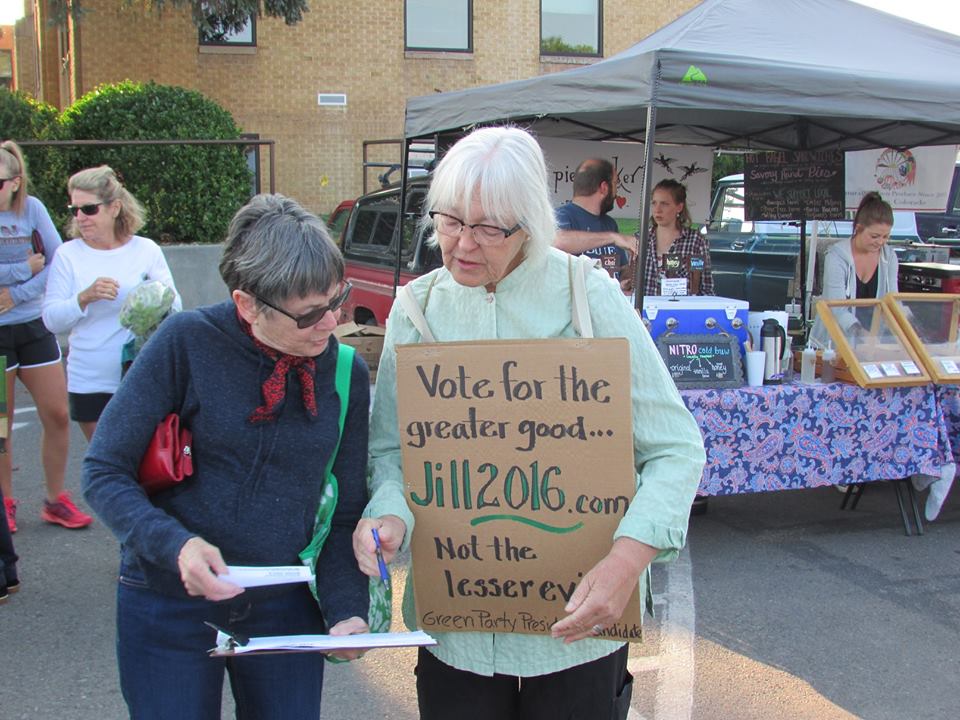
As a county we have been voting for the lesser of two evils for decades and these two candidates is exactly what that way of voting produced. By telling Clinton that she does not have to earn your vote, the Democrats are free to turn into Republicans and serve Wall Street instead of the American people.

Posted in Electoral Strategy for 2016, Organizing Strategy, Strategy | Tagged , , , | Leave a comment

The Party is Over

13681019_1062049623874428_3387464798946983100_n

This article also appeared in Counterpunch.

The Party’s Over

Well, the party is over and the machine has prevailed. Our attempt to revive democracy in the electoral arena failed. Still, we owe Bernie so much. He has raised consciousness and expectations while others appealed to fear and told us there is no alternative to the corporate power. But, the struggle continues both within and outside the electoral arena.

The corporate elites and the Clinton machine have no idea how deep the divisions go. Trump not Clinton will most likely be the beneficiary of the election fraud, voter suppression and discontent. The DNC has made a historic blunder and it’s not going to be pretty either way. Fighting Fascism with the corporate power seems a doomed project since it is precisely the merger of the corporation and government that sets the conditions for the rise of fascism. That is the historical moment we are in and paradox we face.

There is already lots of suffering and there is going to be more; much more. We are just going to have to own up to what this country has become. The system is so rotten and dysfunctional that there is no easy way out. No amount of moralizing is going to change anything — that will take political action and organizing.

I plan on working for Jill Stein and I will count it a victory if we can get 5%. That will allow the Green party to get federal funding for next time and maybe help to create a viable opposition party. But this is no 20th century election. The trend lines on war, class warfare, propaganda, the failure of democracy and the vast militarized penal system all point toward deep trouble. On environmental issues alone the crisis will deepen and most likely in a dramatic way. We are woefully unprepared for what lies ahead.

But at least millions more have learned that the political system and the economy is rigged. That the lesser of two evils argument or the spoiler are forms of social control that have led us to exactly the choices we now have. If we do not have serious social change it is likely the Trumps of the world will just keep coming right out of the social conditions the Clintons of the world have created. I hear a lot from Clinton supporters, reluctant or not, about how they will continuing the struggle. I hope they are serious. How hard you worked for Bernie or other social movements this past year might be one indication of the value of your claims.

No one said revolution was easy, if fact its the hardest thing in the world. I hope mother earth has the patience for us to learn.

People will say I am privileged or childlike or a dreamer for dissenting. In some ways I am all three. And you? I listen to people’s claims of moral superiority, or paternalistic authority, or “realism” as they endorse and obey the political machine of the rich and powerful. We will all have to live with the consequences of our actions. All of us.

And, if you decide to persist in building an opposition movement, brace for a fear campaign unlike any you have seen. It’s all they has left.

“Fear,” Gandhi said, “is the enemy. We thought it was hate but it’s fear.”

Posted in Uncategorized | 14 Comments

Mr. Halle, Mr. Chomsky: Our Actions Express Our True Priorities

Action-expresses-priorities1

This article also appeared in Counterpunch

Actions Express Priorities*

It is far easier to criticize the social order than to change it. And our actions express our true priorities.  The Halle/Chomsky article advocating lesser of two evils voting demonstrate the poverty of radical strategy that does not seek alternatives to the two-party system and the existing order.

The authors do get two big things right: tactics are provisional and there are serious consequences to political choices. But they act as if only those that refuse to vote for Clinton face the consequences of their action. Every political act leads to consequences intended or not. No one is free of that. There have been plenty of negative consequences from four decades of lesser of two evil voting that the authors fail to reckon with. Tactics should be provisional but it is the lesser of two evils has been the in-grained routine tactic for decades.

At the core of the argument the authors damn dissenting voters as selfish moralists seeking only to feel good. Yet, the authors are every bit as involved with selling a morally correct argument that encourages people to feel good about voting for Clinton because it will, they seem sure, results in less oppression of already exploited people. But a truly political and strategic choice is not between voting for the lesser evil and feeling good. The choice is between continuing four decades of failed lesser of two evils voting or attempting to create a strategy and a movement to return the US government to the people.

It is vitally important that we protect historic gains made by the social movements, but that does not require us to sign on to the established order of endless war, mass incarceration and corporate power by voting for Clinton. Quite the opposite — it requires movement building and opposition. The failure of the lesser of two evils is a strategic failure.

One of the political problem with the lesser of two evils line is that it blunts criticism of the two-party system, a system the authors certainly claim to oppose. Not a word is said about the failings of the Democratic party machine. By insisting on a deeply flawed political boss instead of a reformer that would handily beat Trump, by all the evidence at hand, they are counting on compelling people to vote for candidates they despise. Sanders and a vigorous movement is the solution to Trump that we already have at the ready. The writers never mention that. Why? Only the opposition is criticized.

So the opposition is blamed for mass disgust with the two parties candidates not the disgusting candidates of the two parties. Instead we are taught to fear. But, the Clinton Democrats are not afraid of Trump, at least not afraid enough to give up their positions of real political power, control and immense privilege.

One basic fact undermines all the lesser of two evil arguments. There is no scarcity of voters. Why does the vote of a small percentage of activists and dissidents matter so much when 70-90 million people do not vote in America? Why doesn’t Clinton go get them? Why doesn’t Clintons supporters or Halle and Chomsky go and get them? Bernie did and many others helped.

The answer I am afraid is simple. Mobilizing the 70-90 million non-voters, as Sanders and Stein have started to do, demands a program directed at their interests. This the Clinton machine cannot do and serve the 1% at the same time. Instead the social control discourse of the lesser of two evils, the spoiler, and the horserace are deployed to attack dissent.

Despite the highly rational style of writing the authors use, Halle/Chomsky’s core arguments drag the discourse onto the ground of moral politics and psychology instead of the terrain of politics we so desperately need to understand better: evidence, history, strategy, conflicts of interest, community of interest, and questions of power. A more useful political version of the lesser of two evils argument would raise issues of representative democracy, not just feelings. Should people vote for candidates and parties that represent their interests and values? If not, then we are forgoing the basic assumption about how representative democracy is supposed to work in favor of some clever tactic that will, in some unspecified way, allow us to reclaim democracy in some unspecified future despite all evidence to the contrary.

The one attempt at a historical analogy offers a dubious and hotly contested interpretation of the Sixties. in 1968 the liberal democrat Hubert Humphrey gave no indication he was going to do anything but continue the war in Vietnam. Keep in mind it was a Democrat’s war for years under Kennedy and Johnson. Nixon actually ran to Humphrey’s “left” as a kind of peace candidate seeking an “honorable peace,” or what was refined into “peace with honor.” And it is likely that Trump will run to Clintons “left” on a number of issues. Writers like Halle and Chomsky attribute the decline of the left to anti-war opposition to the Democratic war managers.

It was the civil rights revolution and opposition to the Vietnam war that lead many to realize that the war was part of deeply rooted systemic problems: empire, racism and exploitation. The anti-war movement was the passage beyond the liberal consensus into revolutionary territory for millions of people. Martin Luther King and others spoke it aloud.

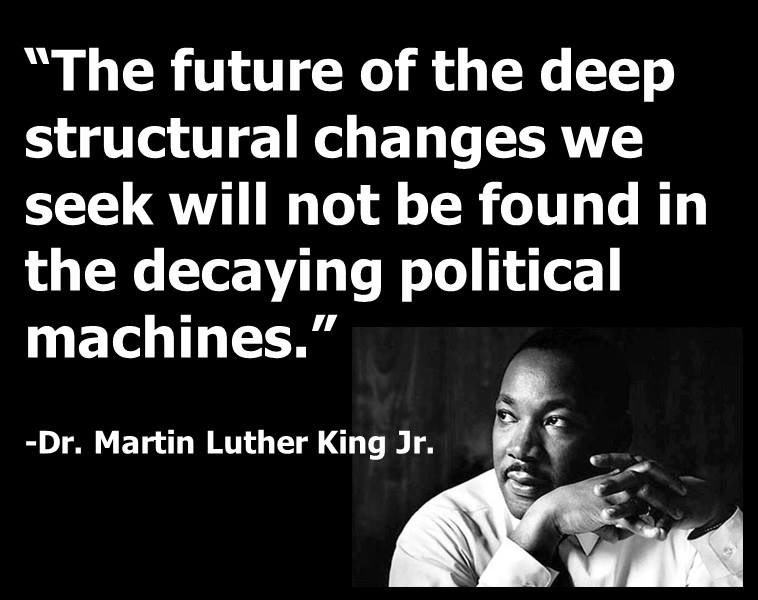
[T]he Black revolution is much more than a struggle for the rights of Negroes. It is forcing America to face all its interrelated flaws—racism, poverty, militarism, and materialism. It is exposing evils that are rooted deeply in the whole structure of our society. It reveals systemic rather than superficial flaws and suggest that radical reconstruction of society itself is the real issue to be faced.[1]

The radical movements the authors wrongly see as dying after 1968 never disappeared but were slowed and challenged for many reasons: the giant triplets of racism, militarism and economic exploitation could not be overcome, to say nothing of government repression and the so-called war on drugs.  Of course, if the authors recognized the powerful institutional obstacles to change then they would also have to reckon with the Clinton machine’s role in continuing and expanding the many forms of power and social control.

Lesser of two evils is an admission that we can never expect fundamental change and must stay forever on the road we are on. Except that road is increasingly unsustainable and crisis ridden. We cannot avoid serious consequences in any event.

Despite the authors moralizing, there is no moral clarity here. It’s just judgement. Some people think that voting for the Green Party will create more suffering. I think that given the history of the last half century that voting for the lesser of two evils has created plenty of suffering we can document in abundance. I blame you, you blame me and the machines are off the hook. Morally, we are all implicated in the existing order. Every one of us. Moral politics of this sort are a political dead-end.

Yet, its true that we cannot completely dispense with moral politics and feelings. So let’s give feelings their due. Its is not “feeling good” but feelings of fear and fatalism that are the psychological and emotional states that contribute most to social control. Halle and Chomsky rely on fear and fatalism and the promise of feeling good to corral people back into line.

If we overcome our fear of change and our fatalism, be that through political vision or sheer desperation, we have a chance of creating a winning strategy. Tactics and strategy are provisional as the authors claim. After four decades of failed lesser of two evils, it is time to create a workable strategy based on mobilizing our latent power.

The inside/outside strategy is a possible starting point. Some of the most productive organizing of this electoral cycle exerted leverage along the inside/outside borderline.  Revolt Against Plutocracy and its Bernie or Bust strategy has urged people to vote Green Party as a counterweight to the Clinton machine. Thousands have already made that move and the Green Party is growing rapidly. “Bernie or Green in 2016” has already changed the face of this election.

We are, by the millions, overcoming the fear and fatalism of the lesser of two evils. We will make mistakes but we will, at long last, be the authors of our own history.


*”Actions express priorities.”  Mahatma Gandhi.

1. Martin Luther King, A Testament of Hope.

Posted in Uncategorized | Leave a comment

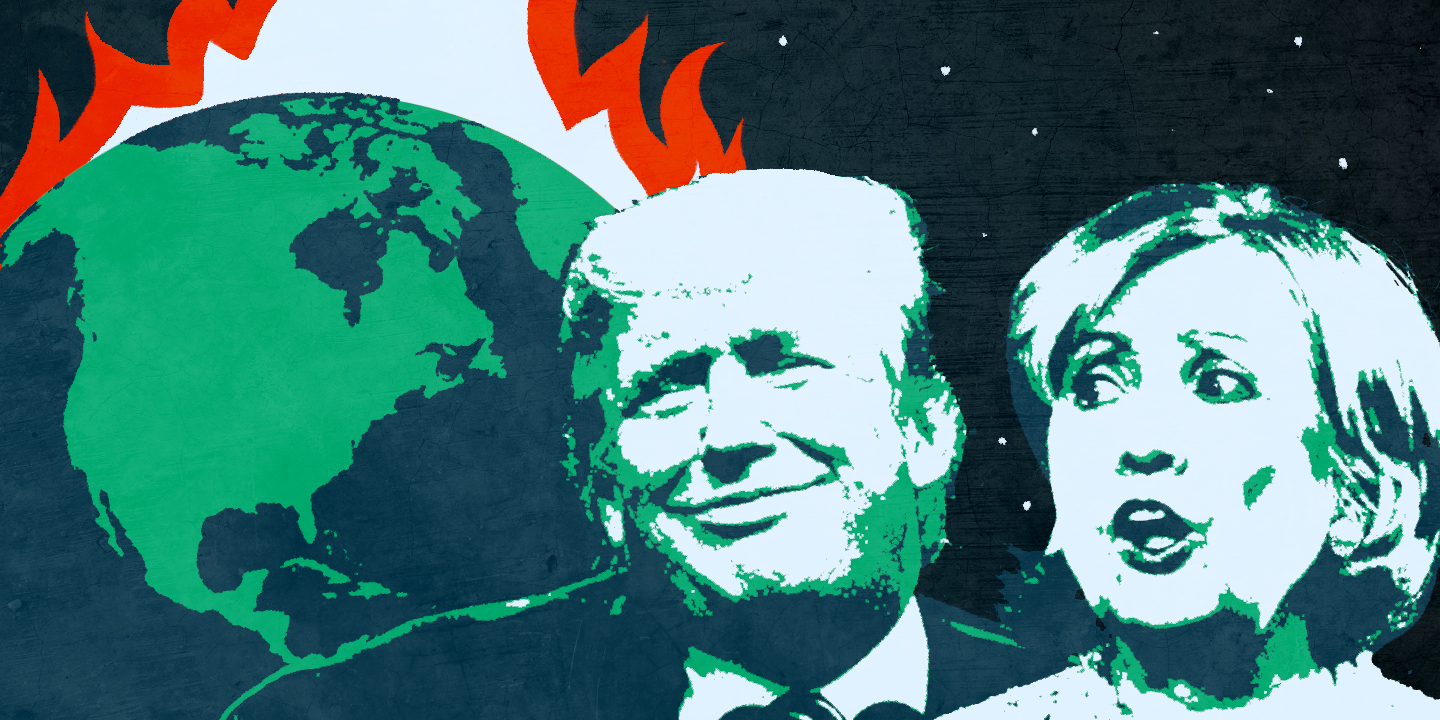
Clinton and Trump. Fear and Fascism. Part two

trump_hillary_globe

Clinton and Trump. Fear and Fascism. Part Two.

Read Part One

Full Frontal Fascism

Trump has returned a deep and frightening bigotry to the public discourse of the so-called center. Hatred has a long history in the US and, while we must be outraged, we should not be surprised that it rears its ugly head in times of crisis. Racism has always been the default division among “we the people.” White supremacy will continue to be embraced — ever more desperately — until not just resisted, but displaced by a compelling and tangible alternative based on solidarity and shared interest.

Trump’s form of bigotry is easy to identify and invites open resistance. The coalition of immigrant, youth and people of color that shut him down in Chicago and the Latino lead protest movement against Trump in California, Texas and elsewhere are the leading edge of a movement with wide appeal and great expectations.

Much more difficult to address than blatant racism and much more subtle and dangerous are the institutionalized forms of violence and repression aimed at people of color, the young and the poor.

Hidden in Plain Sight

How is it that a new system of racial oppression came to be created in a liberal world supposedly blind to race? How did new forms of racial oppression become institutionalized at a time when public statements of racism were considered unacceptable? Read The New Jim Crow for a complete answer. The short answer is that it did. And, it took the form of a vast militarized penal system.

The penal system relies on mass incarceration, slave-like prison labor, extrajudicial killings, and the militarization of the police forces. Are these racist? Are these fascist? If not, they are the closest thing to fascism we have in the US today. Did the Clinton machine help construct this system? Yes, they were among the architects of the system. Obama simply managed it. This is not something you can just apologize for or easily dismantle. It is an institution hard and fast, legal, well-funded and a centerpiece of the social order.

If we cannot see it for what it is, its because institutionalized racism and the vast militarized penal system has become the new normal in labor relations for many corporations. When you eat at McDonalds, Wendy’s or Starbucks, shop at Walmart or JC Penny; make a call on Sprint or Version wireless; book a reservation on Avis or American Airlines; enjoy Victorias’s Secrets lingerie or invest with Fidelity you are consuming slave labor. And that is just the start of it.

We miss this fascism, hidden in plain sight, because it is legal and accepted. Hannah Arendt, Jewish-German immigrant and great American thinker, went face to face with the fascist nightmare as a reporter at the trial of notorious Nazi war criminal Adolf Eichmann. To the world’s surprise, Arendt found not a monster but a colorless machine operative, a bureaucrat, a climber with an eye toward his own career. He was just doing his job and following the law. The mass face of fascism is deceptive, its banality and routine masks grave danger. One the other hand fascism demands a flamboyant, demagogue like Trump to brashly articulate the fear and anxiety that both compensates and distracts people from the dumb obedience and despair of life in the machine.

If this is fascism, it is also just good business. Maximizing profit is standard operating procedure, isn’t it?  After all, Trump did not come to power on the shoulders of streets toughs or the KKK. Trump is the “made man” of the corporate media. Giant media corporations gave one of their very own millions of dollars of free publicity. Harvard’s Shorenstein Center on Media, Poltics and Public Policy have documented the media’s positive treatment of Trump during the decisive “invisible primary” during which big media shapes public opinion and expectations before a single vote is cast.

Trump’s candidacy was made by the very same corporations that made Clinton the frontrunner and “presumptive” nominee, marginalized Sanders for ten months only to finally recognize his campaign as a doomed and senseless spoiler harming Clinton. And who is Jill Stein anyway? Trump is very much the corporate media’s boy, and yes, its the same media that launched the preemptive strike on the California primary.

We live in an age of consequences and Trump is the consequence of three decades of dragging the Democratic party to the right that redefined the so-called center around the extremism of mass incarceration, endless war, corporate media and corporate power. At first triangulation was a cunning play for the Clintons. If they could steal conservative issues, the logic went, the Republican would have nothing left to peddle. But the Republicans simply resorted to ever more explicitly rightwing and fanatical politics and in the US that means racism and bigotry.

The great recession of 2008 and failure to do much of anything beside secure the interests of the corporations finally pushed millions of Americans away from the extreme center triangulation created. The game could go on forever as long as no challengers appeared to state the obvious: the machines no longer represented the American people.

The Movement Can Stop Trump

There are answers to Trump far better than Clinton. The super delegates have but one redeeming possibility: they are supposed to pick the best candidate not simply perpetuate the machine. If they do so Sanders is the only choice. If not the options get tricky. Write in Sanders? Perhaps the best long term choice is to build the Green Party, get our 5% of the vote for Jill Stein and move forward. Stein is currently polling at 7% and is likely to finish much, much stronger. But the threat cannot be beat back at the ballot box alone. We need to push our unions toward social movement unionism, and expand the pro-democracy movement.

The Chicago anti-Trump demonstrations have already inspired other protest movements in California and Texas. They are only the beginning of a next phase of new civil rights movement. The movement can stop Trump or at least has a far better chance of doing so than voting for Clinton.

And the progressive white-working class, reawakened by Sanders, is in a pivotal position to help fight Trump. The work and vision of Showing Up For Racial Justice needs to be taken national. Their face-to-face organizing approach and focus on bringing white people into anti-racist activism is just what we need. A multiracial organizing conference focused on “Organizing Poor and Working Class Whites,” in Greensboro, NC is also setting plans in motion. The ground-breaking scholarship of Theodore W. Allen, a white working-class intellectual that pioneered the concept of white skin privilege is gaining wider acceptance.

Maybe Trump is our rendezvous with our own roots. It means so much more than debating fine points in a room full of radicals. Any social movement worth a damn was built through millions of conversations with the people that helped motivate organizing and action. Consciousness raising, organizing into units of power and acting peacefully but disruptively. These are our roots and must be our future.

Fear This

For as bad as Trump is, there are fears far worse: environmental destruction. Lead by Exxon and the Koch brothers, the corporate power is wrecking the planet. Even under pressure from Sanders and the science community the Clinton machine can not bring itself to even symbolically support modest measures such as a ban of fracking or keeping fossil fuels on public lands in the ground. The defense of the fossil fuel industry allows Trump the political space to indulge in equally dangerous climate denial.

Perhaps the most subsidized industry in the world, fossil fuel giants exemplify the corporate power.  Fossil fuel companies recycle vast sums of money to Clinton and almost every other important political figure in the US government. Untold trillions in environmental costs are paid by the public. No free market here.

A mass environmental movement would obstruct the exchanges between government and capital and disrupt the inner workings of the corporate power while exposing it as a threat to every nation, culture and life form. What should be our greatest fear, points us right toward the movement and issue with the potential to mobilize millions and upset the existing order.

Martin Luther King’s intersecting “giant triplets” of racism, militarism and economic exploitation have morphed into the new “Four Horseman of the Apocalypse:” ecocide, racism, empire and the corporate power. We are fighting for our future and we must not fail.

We have to start by knowing what time it is and what battles lie ahead. Strategies, like the lesser of two evils, have failed.  We should not be deceived into using outmoded weapons that not only lost the last war but backfired because we surrendered our power and lowered our expectations. Movements that win the day innovate strategies to fight the war they are actually in. The inside/outside strategy is a starting point. We must move millions into action.

Will movement-building triumph over fear and fascism? Will Sanders or Stein prevail? Can we unseat the Four Horseman? How much more will the people tolerate?

Posted in American Culture, Electoral Strategy for 2016, Movement Culture, Strategy, Uncategorized | Tagged , , | 3 Comments

Clinton and Trump. Fear and Fascism. Part One

FEAR-QUOTES-GHANDI

This article also appeared in Counterpunch.

Clinton and Trump. Fear and Fascism.

We live in an age of consequences; intended and unintended. If we are to avoid, or at least blunt, the worst of what is to come, then we must look to the root of our problems and to our own roots for solutions.

Fear is the main enemy. Fear will paralyze us and perpetuate the system. That is why fear is the machines’ strongest weapon. Given the unprecedented disgrace of the primary election and the pitiful weakness of both Trump and Clinton as candidates, we are likely to experience a fear-mongering crusade without parallel in American electoral history. Get ready people because fear is all they have left.

But take heart. History has not come to an end. Its almost as if there is a moral order to the universe: as if karmic forces are putting us hard to our lessons; as if “for whatsoever a man soweth, that shall he also reap,” is the new and true law of life.

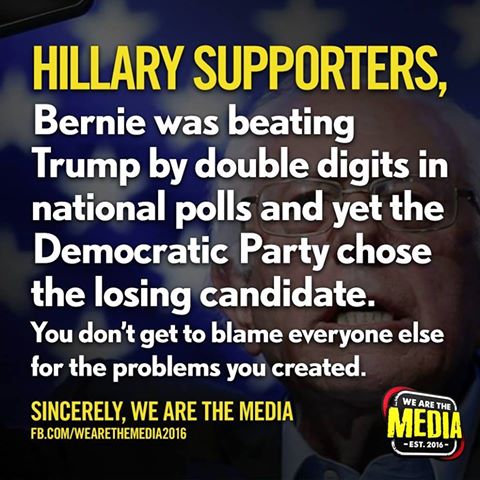
Those who vote Clinton to fight Trump (or even Fascism) cannot escape the consequences of American politics by traveling down the same road we have taken every four years. We are already way past the bend. Setting aside consistent polling data that has for months shown Sanders far and away the best candidate to defeat Trump, a vote for Clinton is a vote for “more of the same.” And this “more of the same” is precisely the existing order of things from which Trump sprang.

Support for Clinton may, or may not, defeat Trump this time, but, as Green Party candidate Jill Stein has pointed out, Trumps has deep roots in the existing system, a system the Clinton machine has helped to create and will fight to maintain. Trump grows right out of American political soil, he is an expression of our political system and political culture, not an exception to it.

The two party system is a system. For three decades at least, the “mainstream” or official American discourse has drifted steadily to the right preparing the way for the rise of Trump. The lesser evil has paved the way to the greater evil, not prevented it. But, lets keep our heads. The same two party system is showing unmistakable signs of decline. It is up to us to create a democratic resistance with the capacity and vision to defeat Trump.

We cannot afford to adopt the simplistic idea that fascism is a plague, a virus, a disease of the mind and spirit more mysterious or irrational that other political beliefs. It can be understood well enough to combat it. Like all the great “isms” and ideologies, fascism defies easy or precise definition. Let’s leave the ultimate question of what Trump is, and what fascism is, open to debate.

But strategy demands a working definition if not an ultimate one. Trump is without doubt the boogeyman and the biggest baddest boogeymen in modern memory are fascists. But boogeymen do not just appear out of nowhere. Fascism can be understood as a set of institutional relationships.

In an era of rising fascism, President Franklin Delanor Roosevelt wrote to Congress:

The first truth is that the liberty of a democracy is not safe if the people tolerate the growth of private power to a point where it becomes stronger than their democratic state itself.  That, in its essence, is fascism — ownership of government by an individual, by a group, or by any other controlling private power.[emphasis added]

The second truth is that the liberty of a democracy is not safe, if its business system does not provide employment and produce and distribute goods in such a way as to sustain an acceptable standard of living.

Both lessons hit home.

Among us today a concentration of private power without equal in history is growing.  This concentration is seriously impairing the economic effectiveness of private enterprise as a way of providing employment for labor and capital and as a way of assuring a more equitable distribution of income and earnings among the people of the nation as a whole.

Since 1938, when FDR warned us, the corporate power has grown dramatically. It is not just “stronger than their democratic state itself,” it has merged with the state. The failure of “assuring a more equitable distribution of income” is part of the on-going crisis that set the stage for Trump and the threat of fascism. In the end however, its all up to what “the people tolerate.”

Who can deny that the merger between the immense wealth of the corporations and the political power of the government is one of the distinguishing characteristics of the US politics since the Sixties? The corporations rule and share sovereignty with the state.  How else can “Citizens United” be interpreted, except as a recognition of this fact, many decades in the making.

Power is the new profit and like prior forms of capital accumulation it knows no bounds even unto ecocide.

The corporatization of our institutions have drained away any democratic content they once contained. More than the direct control of institutions by some corporate board members, corporatization occurs when institutions internalize the corporate model, adopt the managerial mindset, and run some essentially public service like a business. The military has become big business. Generals manage wars not win them. Prisons, schools and universities, political parties, media, hospitals, even some of our labor unions operate on managerial models.

The Clinton machine played a pivotal role in creating the corporate power particularly in the key financial sector.  By abandoning its New Deal voter base, becoming the party of Wall Street, and accomplishing core Republicans goals, the “third way” Democrats embodied triangulation. The Clinton machine took the merger of power and money to its logical conclusion by innovating a new form of global political corporation known as the Clinton Foundation. Profit is power, power is profit.

While the Clintons had to engineer this merger Trump was simply born to it. Trump is wealth inequality, entitlement to unearned riches, and its fusion with political power personified. Trump and Clinton are both, we hope, the final episodes of the so-called “Reagan Revolution. “ A revolution no president since has even tried to reverse. Not Clinton. Not Obama. Since Reagan only one major party candidate has even promised to return government to the vision and policies of the New Deal, and that, of course, is Bernie Sanders.

The consequences of this unchallenged corporate power — economic misery, distress, despair and death — have been pushing the white working class left toward Sanders and Stein and right toward Trump. The hollowing out of institutions like the labor movement, that once achieved some measure of political and economic democracy, are preconditions for fascism. The weakness of labor and the social movements leaves millions with nothing much more than resentment, sexism, racism, homophobia and the glory of our military might to assuage their wounded pride.

If the present trends continue to deliver “more of the same”— and we have no reason to expect Clinton to change course — then the broad economic and social conditions that gave rise to Trump will simply intensify. It is likely that far worse than Trump will arise unless the people make history. Remember, the boogymen of the past, the Bush dynasty, are now allies with Clinton providing political support and funding against this new and seemingly more dangerous threat.

Will Trump reap what the Clinton machine has sown?

Not if we break the cycle and support candidates and parties that actually represent our interests. Not if we build pro-democracy movements of all kinds. That means Sanders or Green Party in 2016 and the kind and scale of demonstrations planned for the Democratic Convention in Philly.

Be there or be triangulated.


Posted in Uncategorized | 6 Comments

Transformation and Reconstruction: The Means and Measure of Revolutionary Change


337ff8469029ad0c869361889ae60a06

The fourth and final post in the series:

How Do We Organize a Hundred Million?  

Click to read One, Two, Three.

Transformation and Reconstruction: the Means and Measure of Revolutionary Change

To organize millions, the revolution has to create, not destroy.   Truly massive movements take shape around affirmations of goodness most powerfully represented by the promise of universal values.  Our task is to fulfill this promise, recognizing that we doom our efforts to win people’s support and allegiance if we too often rely solely on criticism, resistance, and opposition.

It is far, far better thing that we be authors of a new world rather than critics of the old one.

If we envision revolution as radical departure or complete discontinuity from the existing world we are likely to both overlook real change and leave the millions behind. A transformative movement works on culture and works with history. Transformative movements recast and reconstruct cultural materials from the past and present to create a new world out of the world we have inherited.

To be a transformative organizer is to be a worker. As King suggested, “There is nothing to keep us from remolding a recalcitrant status quo with bruised hands until we have fashioned it into a brotherhood.”[ 1 ] With our hands and minds, we labor upon the existing world, making it into something new, while allowing the value of  the raw materials to shine through.   Transformation and reconstruction makes another world possible starting from the world we are in.

Expectations for total change actually diminish the chances for real revolution by proposing changes without taking transition into account. Dreams of total change cannot be easily imagined or acted upon.  In their collective wisdom, the millions know you cannot tear one thing down without creating something else to put in it place.

Revolutions do not reject the past. Revolutionary organizers embrace the world because there is simply no other way of reworking culture. Conventional ideas of linear, mechanical, discontinuous change will not serve us well in times of revolutionary ferment. Static binaries such as past and present, old and new, or tradition and revolution reinforce the existing order while transformation and reconstruction of the past, the old, the traditional, is the signature of revolution.

While Karl Marx dreamed that future revolutions would make a clean break with the past, the actual revolutions he observed and interpreted in his life demanded the dialectical approach at the core of his philosophy. Consider Marx wrestling with history and revolution.

Men make their own history, but they do not make it as they please; they do not make it under self-selected circumstances, but under circumstances existing already, given and transmitted from the past. The tradition of all dead generations weighs like a nightmare on the brains of the living. And just as they seem to be occupied with revolutionizing themselves and things, creating something that did not exist before, precisely in such epochs of revolutionary crisis they anxiously conjure up the spirits of the past to their service, borrowing from them names, battle slogans, and costumes in order to present this new scene in world history in time-honored disguise and borrowed language….Thus the awakening of the dead in those revolutions served the purpose of glorifying the new struggles, not of parodying the old; of magnifying the given task in the imagination, not recoiling from its solution in reality; of finding once more the spirit of revolution, not making its ghost walk again.[2]

There is simply no escape from “circumstances existing already, given and transmitted from the past.” As Americans, deep down underneath, we dream of escape to a new frontier where we can begin all over again, or that we were by some means “chosen,” and so feel ourselves outside of the contours of history. Escape, departure, specialness, uniqueness and the rejection of history are essential to American Exceptionalism.  Instead we should use our “given and transmitted” history and culture to, “conjure up the spirits of the past,” for a purpose: “of magnifying the given task in the imagination,” “of finding once more the spirit of revolution.”

In order to achieve a true “revolution of values,” Martin Luther King counseled that Americans would have to build upon the spirit and promise of our revolutionary forbearers “to make democracy real and to follow through on the revolutions that we initiated.”[3]  King recognized that we don’t need to invent this revolutionary spirit from scratch, we only need to recapture something once lost:

“The Western nations that initiated so much of the revolutionary spirit of the modern world have now become the arch anti-revolutionaries…..Our only hope today lies in our ability to recapture the revolutionary spirit and go out into a sometimes hostile world declaring eternal opposition to poverty, racism and militarism. With this powerful commitment we shall boldly challenge the status quo and unjust mores and thereby speed the day when “every valley shall be exalted, and every mountain and hill shall be made low: and the crooked shall be made straight and the rough places plain.[ 4 ]

By using the ideas of transformation and reconstruction we can better envision the process of historical change as the play between continuity and discontinuity or between tradition and innovation.

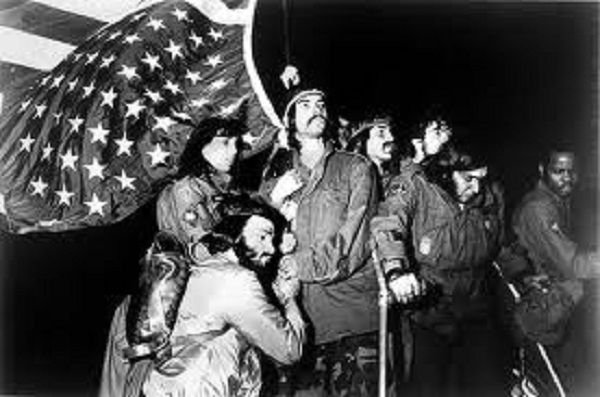
At the heart of the last American revolution, a movement of Vietnam era soldiers and veterans opposed war and empire. Lead by patriotic volunteers they became “new winter soldiers” that remade and transformed the citizen-solder ideal. The anti-war soldier became the authentic reenactment of a related revolutionary figure created in the American Revolution and Civil War. The transformation ran so deep, it founded a permanent movement of military dissent. Vietnam Veterans Against the War, Iraq Veterans Against the War, Veterans for Peace, GI Rights Network, Military Families Speak Out, Votevets, the heroic stand of Chelsea Manning, and the insightful anti-imperialism of intellectuals like Andrew Bacevich still continue the revolution of the Sixties.

We should set our sights so high.

Not some nagging residue that must be overcome, cultural and historical traditions instead represent the inevitable grounds on which social change occurs and the raw materials from which new consciousness is constructed. Revolutions succeed when new, more inclusive and compelling versions of worn-out traditions take root by assuming the latent power and liberating vision of some frayed but classic ideal. [ 5 ]

How will we know revolution when we see it? When old things are made new again revolution is in the air. It’s the “re-” in “revolution.”

The experimental approach of the inside/outside strategy, altertness to transformation/reconstruction as the mode of revolutionary change,  universal values as rhetorical framework and political ideal, and the recognition that our ideals and strategies must, of necessity, speak to a hundred million people and more, are four parts of a work in progress.

To make the changes we must make, we need to create a working theory of revolution. Perhaps “How Do We Organize a Hundred Million” is a beginning. You be the judge.


[ 1 ] Martin Luther King, Where do We go From Here?

[ 2 ] Karl Marx, The Eighteenth Brumaire of Louis Napoleon, 1852.

[ 3 ] Martin Luther King, Where Do We Go From Here?

[ 4 ] Martin Luther King, Where Do We Go From Here?

[ 5 ] Richard Moser, The World the Sixties Made p.44.

Posted in American Culture, Martin Luther King, Movement Culture, Organizing Strategy, revolutionary strategy, Strategy, Uncategorized | Tagged , , , , | Leave a comment

Fire a shot across the bow of the USS Superdelegate for Bernie

Posted in Uncategorized | 1 Comment

Universal Values are Revolutionary Values

images-24

Third in the Series: How Do We Organize a Hundred Million? Also find this at PopularResistance and CounterPunch.

Universal Values Are Revolutionary Values

If we want to organize a hundred million, we must not only go where people live and work, but we must also engage what they think and believe. And people believe in universal values.

In moments of revolutionary flux, the chaos and confusion of on-the-ground politics outrun the far too orderly confines of ideology. Perhaps this is why revolutionary movements cannot win the hearts and minds of millions of people without struggling toward Equality, Ecology, Peace, Love, Freedom and Democracy.

It was Karl Marx who first grasped the necessary and practical role of universal ideals as a theory of revolution:

“For each new class which puts itself in the place of one ruling before it, is compelled, merely in order to carry through its aim, to represent its interest as the common interest of all the members of society, that is, expressed in ideal form: it has to give its ideas the form of universality, and represent them as the only rational, universally valid ones. The class making a revolution appears from the very start…not as a class but as the representative of the whole of society; it appears as the whole mass of society confronting the one ruling class.”   The German Ideology 1845

We have heard such “universally valid” ideas before and will likely hear their echoes:

Liberty, Equality, Fraternity

Peace, Bread and Land

Life, Liberty and the Pursuit of Happiness

We the People

Land and Liberty

All Men Are Created Equal

Workers of the World Unite

The revolutionary declarations of independence, from Ireland to Vietnam, are classic calls to freedom that mix universal values with patriotism. The Vietnamese leader Ho Chi Minh quoted the American Declaration of Independence’s assertion of inalienable human rights, which he interpreted to mean: “All the peoples on the earth are equal from birth, all the peoples have a right to live, to be happy and free.”

“…The true revolutionary is guided by great feelings of love.” — Che Guevara.

Revolutionary Ghana‘s most popular slogan was “Freedom: Forward Ever, Backward Never.” Patrice Lumumba linked anti-imperialism and new forms of political identity together as “Independence and African Unity.”

And now, from the heart of America, come new calls for universal values that reinvent and reinterpret classic revolutionary ideals.  It’s not too hard to see that Mni Wiconi\Water is Life means Life, that Treaty Rights and Sovereignty are a claim for land and liberty, that defense of the sacred is the pursuit of happiness.  Let this sink in: the values of Life, Liberty, and the Pursuit of Happiness from our first great revolution are the same values at stake now, in the struggle to defend Mother Nature, native rights, and the powerful fusion of the sacred, scientific, and political invented at Standing Rock.  And Water, Water, Water: the one thing that is everything to every living thing.  There is no value more universal than that.

Power to the People

Independence is more than freedom from empire or oppression. Independence is the power to achieve self-governance.  In its Constitution, the United States asserts that power as belonging to “We the People.” For the Irish, it’s “Sinn Féin” (“We  Ourselves.”) In Xhosa, South Africans chanted “Amanda Awethu!” (“Power is Ours!”) The Black Panthers “All Power to the People” became “Power to the People,” perhaps the most widely loved ideal in the movements of the Sixties and Seventies. Listen to John Lennon or Rootz Underground sing it.

All these revolutions — and many more — aspired to universal values and moved millions. We need millions because the challenge is steep. Surely, we have lost our democracy.

It is… for us to be here dedicated to the great task remaining before us….that this nation…shall have a new birth of freedom—and that government of the people, by the people, for the people, shall not perish from the earth. – Lincoln

Whether we look to the past or peer into the future, universal values will help us to find our way.

Today, the Green Party wisely advocates not ideology but universal values. The Green Party program is peace, ecology, social justice, democracy. It is this focus rather than ideological precision that gives the Green party its promise as a new mass political force.

Personally, I like Peace, Power and Whole Earth.[1]

The Right to Revolution

Today, we need to reclaim an often overlooked universal value from the American revolutionary tradition. The right to revolution itself.

The Declaration of Independence insisted on revolution as both right and duty.

[W]henever any Form of Government becomes destructive of these ends [securing the people’s rights to life, liberty, and the pursuit of happiness], it is the Right of the People to alter or to abolish it, and to institute new Government . . . .[W]hen a long train of abuses and usurpations, pursuing invariably the same Object evinces a design to reduce them under absolute Despotism, it is their right, it is their duty, to throw off such Government, and to provide new Guards for their future security.

James Madison, the principal author of the US Constitution, laid it out like this:

If there be a principle that ought not to be questioned within the United States, it is, that every nation has a right to abolish an old government and establish a new one. This principle is not only recorded in every public archive, written in every American heart, and sealed with the blood of a host of American martyrs; but is the only lawful tenure by which the United States hold their existence as a nation.[2]

On the verge of Civil War, Abraham Lincoln looked straight at the right to revolution:

This country, with its institutions, belongs to the people who inhabit it. Whenever they shall grow weary of the existing government, they can exercise their Constitutional right of amending it, or their revolutionary right to dismember it or overthrow it.” [3]

I rely on these flawed giants, sullied by slavery and white supremacy as they were, because we can see further if we stand on their shoulders. From that vantage point, maybe our own terrible flaws can come more clearly into view: war, empire,  corporate power, ecocide, the new Jim Crow, and slave-like prison labor in our vast militarized penal system. Despite many shortcomings, great Americans have always aspired to revolution, as we still must now.

Mahatma Gandhi and Martin Luther King innovated universal values of immediate strategic use: non-violence and peace. Massive nonviolent civil disobedience emerged as a transformative revolutionary strategy not simply because it was morally superior to war but because nonviolence promises a struggle that millions of people might risk participating in.

And only a revolution, made by millions, will affect the sweeping transformations in consciousness necessary to change the world.  It will take the power of millions to reconstruct government, transform corporations into public utilities, build a new cooperative economy, and dismember the empire.  A hundred million activists are also necessary to safeguard against the reemergence of the hierarchies and political machines that have plagued history’s prior revolutions.  Massive, non-violent civil disobedience is inherently democratic.

E Pluribus Unum

Universal values are the best instruments for the solidarity and coordination of the “movement of movements” that is our future lest disaster come. Universal values increase our capacity to win the struggle for hearts and minds of people from all walks of life.

Yes, universal values are capacious and open-ended but that’s exactly why they work.  People are walking, talking contradictions without transparent perspectives or untroubled minds.

One hundred and thirteen years ago, in The Souls of Black Folk, W.E.B. Du Bois identified the human experience of double-consciousness.

It is a peculiar sensation, this double-consciousness….One ever feels his two-ness, an American, a Negro; two souls, two thoughts, two unreconciled strivings; two warring ideals in one dark body…

In the century since Dubois’s time of “two-ness,” political consciousness has done nothing but further multiply, complicate, and fragment. For evidence, look no further than the social movements that have emerged since the Sixties.  Struggles over race, class, gender, sexuality, age, war and empire have merged with Occupy,  the new civil rights, environmental, student and veteran movements to weave a crazy quilt of democratic opposition and alternatives.  We are polycentered, diverse, conflicted, variegated, fluid, and rapidly shifting. This is reality. It is a good thing.

Universal values accommodate the ambivalent nature of social identity through multivalent relevance across a broad range of social movements, identities, and communities.

Different people see freedom and live freedom differently. Let it be and build on it.

With universal values as our revolutionary ideals —rather than an ideology—we may steer clear of, or at least minimize, endless polemics and needless schism. Universal values bring us closer to the minds of the millions and closer to transformative change. The world presses in. We cannot wait.

If revolution means freedom or equality or peace or a whole and healthy earth, then the path forward passes through every single community, identity,  movement, and history. We need to pursue each and every path. The history of the last half-century strongly suggests that political movements cannot be reduced to a singular perspective.

Both agreement and disagreement are the inescapable conditions of political life. We must embrace this.  Revolutionary strategy must account for “both/and.” Universal values allow us to agree and disagree simultaneously as we work together in a rough and ragged harmony.

Let us fight on — rough and raggedy as we might be — for Freedom, Democracy, Ecology, and Equality.


[1] Richard Moser, New Winter Soldiers, p. 157-158.

[2] James Madison, Letters of Helvidius, no. 3, 1793.

[3]. Abraham Lincoln, First Inaugural Address 1861.


Next: Transformation and Reconstruction

Posted in American Culture, Electoral Strategy for 2016, Martin Luther King, Movement Culture, Organizing Method, Organizing Strategy, revolutionary strategy, Strategy, Uncategorized | 2 Comments

There is No Spoiler

nospoon

Also find this article at Counterpunch

There is no spoiler.  Its just the machine’s fear of democracy.

Spoiler arguments are part of an interlocking set of social control discourses that too-often govern our thoughts and actions regarding elections and representational democracy.

While “the spoiler” is deployed on the wings of the “lesser of two evils” and “electability/inevitability,” it most resembles corporate-inspired arguments about austerity.

Spoiler arguments are the political analog to the “austerity” claims enforced so ruthlessly by corporate elites. Under austerity “we are broke.” But, we must add: except for the trillions of dollars in cash that the big corporations and billionaires are sitting on — at the peak of their wealth — in the richest country in the history of the world. This artificial scarcity is then imposed on the people who, the 1% insists, will have to sacrifice their jobs, incomes, pensions, social services, and security.

In spoiler arguments, the elites insist — and far too many progressives  concede — that there is a scarcity of votes. But, we must add: except for the 70-90 million non-voters that the dismal performance of government, triangulation, and our failure to organize have left disempowered and driven to the sidelines. This artificial scarcity of voters is then imposed on the people who are told by the corporate media to sacrifice their freedom, democracy, and political judgments by yielding to the parties and candidates they no longer believe in.

The spoiler trains us to think that sacrificing democracy to fear is a clever tactic. That is exactly why the spoiler is one of the most powerful rhetorical weapons the machines have. It functions to scapegoat dissenters and limit political engagement and competition when we really need more democracy, more choices, more voices.

Elections are truly spoiled because the existing parties either do not want the American people to participate or make no attempt to register and mobilize the 40% non-voting public or to engage the millions of independent voters.

Perhaps the most remarkable thing about social control discourse — given the wide acceptance of such ideas by seemingly rational people — is the degree to which these arguments are counterfactual. Speculation and ideology must masquerade as facts when facts threaten to undermine social control. So it is with “the spoiler.”

2000 Revisited

Since the election of 2000 is the most powerful reference for spoiler argument let’s unpack it.

The horse-race framing for elections has been incredibly effective in shaping the political outlooks of people who consider themselves liberal or progressive. Bush beats Gore “by a nose” in 2000 and we were told is the nose and not the horse that won or lost.

We were told, a million times over, that the 2000 election came down to 560 Florida voters that cast ballots for the Green Party candidate Ralph Nader. “A vote for the Green Party is a vote for Republicans,” goes the old saw.

It was not that Gore lost the votes of tens of thousands of white women who voted Republican by a huge margin of 53 % Bush to 44% Gore. Oh no, it was the 600 or so Nader voters.

It wasn’t that 12-13% of registered Democrats voted for Bush. It wasn’t that the Democratic base deserted the party and gave about 300,000 votes to Bush in Florida. That’s right, 12 times more Democrats votes for Bush than Nader. But no, no, no it was the 600 Green voters that elected Bush.

It wasn’t the 30-35%  of union members that vote Republican year after year. Nope.

It wasn’t that 40% of eligible voters stayed home nationwide. Forget the 70 to 90 million voters that decide voting isn’t worth the trouble. Forget, forget.

It wasn’t that Gore could not win Tennessee, his home state where he served as a Congress-member and Senator for 16 years and where his father Al Gore Sr. had a long and distinguished record. Or that he could not win Arkansas the home state of his mentors the Clintons. Nah.

It wasn’t that we use an antiquated and anti-democratic electoral college system that Democrats and Republicans refuse to reform. It was the Green 600 for sure.

Or, as Michael Parenti so well demonstrates, that the Republicans stole the election.  And did again in 2004.

Or that Florida has the most draconian laws in the nation permanently disenfranchising people once convicted of a felony. Or that many eligible voters were wrongly purged from the rolls as ex-felons while they were not. Not our concern, no.

And, the list goes on and on.

The Supreme Court handed the election to Bush in one of the most politicized and nonsensical rulings in American history.

It wasn’t that the strategy of triangulation is a failure. That “third way” Democrats, led by the Clintons, abandoned, even attacked, their New Deal voter base and courted Wall Street. It’s not that Gore was a loser and triangulation a danger to democracy. No, that cannot be it.

Spoiler is scapegoating. So when someone raises the spoiler argument here is what I hear them really saying.

“Given our failure to organize the unorganized and motivate non-voters, we blame the opposition party to cover our shameful disregard for the working and poor.”

“Given my failure to contest power, I will blame whoever I have been told to blame so I blame the opposition.”

Pathetic.  The liberals doth protest too much, methinks.

What the Clinton Machine learned from 2000.

The Clinton machine learned that Jeb Bush is a visionary. Election fraud is easier than building your base. Steal an election and even the Supreme Court will endorse it and the people will accept it. So steal it. And when your game falters and triangulation comes tumbling down blame your opponent for your poor showing. They learned that control over the party machine is more important than the future of the country. Control over media helps to spin the blame.

What We Should Learn

The real lesson of 2000 is that triangulation, the strategy of the Clinton machine, is politically and practically bankrupt. Decades of moving the Democratic party to the right has left a huge political field up for grabs. This political field is otherwise known as the American working class or we the people: so Sanders, so Green Party, so Trump.

As far back as 2000, Jim Hightower documented the decline in the working-class Democratic voting base.

These mostly are middle- and low-income folks, people making less than $50,000 a year. While they make up some 80 percent of the U.S. population, exit polls on Nov. 7 found that for the first time they’ve fallen to less than half of the voting population. As the Clinton-Gore-Lieberman Democrats have jerked the party out from under this core populist constituency, pursuing the money and adopting the policies of the corporate and investor elite, the core constituency of the party has — big surprise — steadily dropped away. In 1992, the under-$50,000 crowd made up 63 percent of voters. In 1996, after Clinton and Gore had relentlessly and very publicly pushed NAFTA, the WTO and other Wall Street policies for four years, the under-$50,000 crowd dropped to 52 percent of voters. After four more years of income stagnation and decline for these families under the regime of the Clinton-Gore “New Democrats,” the under-$50,000 crowd dropped this year to only 47 percent of voters.

And it has only gotten worse since the financial crisis of 2008.

Obviously, the main function of spoiler arguments is to keep people from voting for opposition candidates. But, a real opposition party is essential to changing the system.  And, while there are important differences between the Democrats and Republicans, under no conditions can either party be considered an opposition party.

That honor belongs to the Green Party.

The current two-party system will maintain a monopoly until the logic and power of that system is fundamentally altered or abolished. I have heard the collapse of the Republican party predicted over and over but always they return. We will never rid ourselves of this power-sharing arrangement between Democrats and Republicans until the balance is disrupted. For that, we need real opposition parties and real opposition candidates.

Kudos to Sanders and the Greens for leading a real opposition. And, for raising expectations. As the people come back into the electoral process the social control discourses lose their power.

There is no spoiler no matter how many times the corporate media trumpets these claims. There is nothing but our failure to contest power and the corporate machine’s fear of democracy.

Posted in Uncategorized | 3 Comments