The Union Triad: Community Activism

full_latham

The last post in the Union Triad Series.

The Union Triad: Community Activism


Local communities are important venues for consciousness raising and for leadership development. The key, it seems, is finding members well suited and willing to devote time and energy to cultural work and community activism.

Community builders use methods much like organizers but instead of the politically charged manner of the organizer, the community builder emphasizes symbolic appeals aimed at including the broadest possible number of people regardless of their involvement with unions. Community builders emphasize universal values and articulate lofty aspirations because communities are the social form through which shared understandings and identities take on tangible life as human activity.

Enduring attachments and deep-seated affinities between people cluster around affirmations of goodness that usually take the form of positive ideals, images, relationships, and values. We fail to win people’s support and allegiance because we too often rely solely on criticism, resistance, and opposition to the negative.

In human imagination, the greatest good usually resides not in critical discourse but in symbol or the narratives of tradition, myth or history. Activists should engage the cultural vehicles that carry shared meanings and identities if they aim to build community.

The hard-boiled union leader or macho organizer may snicker at such talk and the labor movement has largely retreated from symbolic work surrendering the field to the military, state, church, family, and mass media. The scholarly community too largely avoids the study of how meaning is constructed preferring instead the easier work of social criticism and critical theory. But without a sense of connectedness between individuals that share a common sense of history, interests, ideals, and values our movement will be unable to mobilize millions.

Community lifts people beyond the enervating internal politics and grueling struggles of unions so they may reconnect with the deep reasons that motivated their activism in the first place. At their best communities prefigure a better world even if that sense of belonging and transcendence proves fleeting.

It is no coincidence that the civil rights movement, one of the most successful and enduring social struggles in modern history, was animated by a powerful, capacious sense of community. Martin Luther King viewed the creation of the “beloved community” as the ultimate goal of the movement and drew on the teachings of Jesus, Thoreau, Gandhi, and the style and sensibility of African-American Christianity to craft a powerful sense of belonging that proved to have global appeal.

The appeal was not to belonging for the simple sake of belonging. The community aspired to universal values that prepared its members for the long haul. “How long?” Recalling the words of 19th century abolitionist, and theologian Theodore Parker, Dr. King answered, “Not long, because the arc of the moral universe is long, but it bends toward justice.”

Similarly, the labor movement must look creatively at its own traditions and find universal values that will both draw on and transcend existing worker identities.

If community builders focus too closely on prefigurative politics and distance themselves from day-to-day struggles they can often begin to presume the movement to be more powerful, the world more easily changed, or people more easily perfected than is actually the case and so are tempted to raise barriers to participation. Communities lose their power by becoming too exclusive, drawing a firm boundary between the purified and the fallen.

Community builders can sometimes forget that all values are aspirational and lapse into holier or more-radical-than-thou moralism. Successful community builders err on the side of inclusion and address problems with compassion and engagement, not condemnation, instant analysis or moral self-righteousness. In the end however community alone always falls short. Since dominant culture and the political power of governmental and corporate elites are institutionalized and reproduced daily, the community efforts alone can envision the ideal but never realize it.

 Conclusion

This essay suggests that the labor movement has three interrelated and contradictory projects. Representation, organizing and community building are all necessary, conflicting and complementary. In the same way we should accept and draw strength from cultural diversity, so this type of political diversity can also be a source of insight and power. We all need to locate ourselves within these different trends, and to see these diverse tendencies within ourselves.

The balance between the three is dynamic and shifts over time. The ability of unions and other social movement organizations to effectively represent people was originally a product of extensive self-organization and struggle, the recasting of community allegiances, and dramatic transformations in consciousness. On that foundation the movement constructed a professionalized bureaucracy dedicated to representing and servicing its constituency.

Despite the dedication of vast resources to representation those efforts slowly lost power and momentum. The focus of labor activism became the maintenance of organizations and institutions rather than the more risky work of movement building or the more creative work of prefigurative politics.

The time is way overdue for us to adopt organizing and community building activities more akin to the kinds of activism associated with democratic upsurges of the past.  Let us not be rightly accused of “not having the sense we were born with.”

Posted in Movement Culture, Organizing Method | Tagged , | 2 Comments

The Union Triad: Community Building

images-10

This is the third in a series of four posts on the “union triad.”

Community Building


Community building has much in common with organizing.  Successful organizers are usually embedded in communities. Of all activity in the labor movement community building is most ignored and least understood. Very few unions hire staff or designate leaders that dedicate a portion of their efforts to coalitional work or community outreach.

Fewer still dedicate significant resources to the activities that form the foundation of community. An array of community-labor organizations outside of, but linked to unions, as taken the lead.

Before the 1940’s however, the labor movement’s power grew from local, usually urban and ethnic communities. Organizers did not restrict their activities to the shop floor. Local merchants, families, religious groups, ethnic associations, community organizations and intellectuals all participated in the labor movement. Community networks existed in neighborhoods or ethnic groups and the daily activity of working class people in sports, taverns, clubs, and local government.

Unions were part and parcel of these networks and carried on outside the workplace in sport leagues, theater troupes, vacation resorts, mutual-aid networks and local political parties — all to the tune of a rich body of labor music. The music displayed labor’s cultural sources by borrowing liberally from folk, gospel, and blues traditions. Historians called this social unionism but it suffered the same fate as organizing when US labor came of age in the post-WWII world.

At the same time that unions turned away from social unionism and community building as no longer necessary, the upheavals of the mid-20th century transformed and revitalized identities and traditions, reshaping community among people of color, youth, women and sexual minorities. These communities continue to be labor’s allies and underappreciated sources of strength.

The revolution that occurred in consciousness and identity that we associate with the new social movements provides one of labor’s richest resources. Movement culture of the 60’s helped to recast and broaden the range of oppositional social positions and alternative identities available to activists.  These activists then seeded the labor movement.  This new wave of activists  were a part of, and could relate to, the increasingly female, ethnic, and immigrant workers that have been among the greatest sources of new union members and leaders. Even so, these communities are not stable resources waiting to be tapped. Communities, like many workers, are contingent — sometimes they are there — sometimes not.

The global economic restructuring that began in a big way after 1975 weakened labor and eroded popular involvement in community. Stagnant compensation and increased work hours drained away our ability to participate in civic life beyond that necessary for the short-term survival of our families.  Communities can recreate themselves but it takes intentional work. As community organizers will tell you, “The community you get is the community you make”.

Today, community building in Labor’s neighborhood commonly takes two related forms. The first and most successful have been the multi-sector or cross-class communities that have emerged from coalition work. Jobs With Justice, Students Against Sweatshops, Central Labor Councils, and the Living Wage Campaigns, have not just demonstrated that there is a labor community beyond unions but provided the movement with some of the most innovative and inspirational organizing in recent history. The Fight for $15 relies heavily on a mobilized community.

Community building and coalitional work also promises a grassroots alternative for national and international labor issues. The Coalition of Contingent Academic Labor, and the New Faculty Majority for example, has helped to build community among part-time and non-tenure-track faculty members in Canada, the US, and Mexico. Similarly the coalitions working for justice in the Maquiladoras coordinate the activities of religious, labor, environmental, community and women’s groups throughout North America to address the catastrophic consequences of so-called free trade.

Local communities based on racial, gender, sexual, geographic, or political identity may resemble the older, seemingly more stable traditional forms of community but community has always proven difficult to create and sustain. Unions often see this work as a luxury they cannot afford yet it was once a pillar of union power.

A minimal investment in parties, receptions, happy hours, film series, book clubs, lectures, and other cultural events can promote a greater appreciation for unions activists as well-rounded people, and create real bonds of trust and friendship. The creative communities of poets, artists and musicians are particularly fertile fields. The college campus offers an excellent opportunity for the development of community in which the union will be an important participant.

A more community focused unionism would encourage workers to articulate their views as women, or citizens, or gays, or professionals, or people of color, or immigrants.  Community building could help labor grow as a social movement by tapping into the creative energies unleashed by other identities and other movements for justice. Speaking as part of the community encourages social movement unionism.  Community organizing enables labor’s issues to become matters of the public interest and public issues to find a prominent place on labor’s agenda.


Next: Conclusion to the Union Triad


Posted in Movement Culture, Organizing Method | Leave a comment

The Union Triad: Organize!

tumblr_lv50cvWLZu1r2q56co1_500

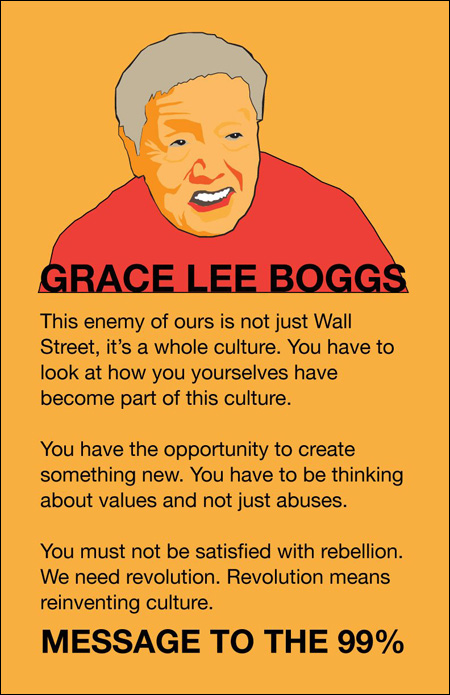
Many Americans, including many radicals, think that the US has no revolutionary tradition to call its own.  To them I say: Grace Lee Boggs!

Second in the series on the Union Triad

Organize!


Since the 19th century unionists have been exhorted to “Organize the Unorganized!”  Organizing has been a distinctive and essential element of union culture. Despite the advent and usefulness of modern communications technology the core activity of organizers remains largely unchanged. Organizers build relationships to help people unionize new shops or increase membership where unions already exist. Organizers put people in touch with each other and work with new members to encourage their involvement and exercise their leadership skills.

With desire and a little training nearly everyone can become an effective organizer since it depends primarily on existing relationships and listening skills. A good member-organizer does not have to sign-up hundreds just handfuls. Organizing tends to promote union democracy, group solidarity, and participation in the life of the union.

The primary work of organizing is face-to-face.  Personal outreach raises consciousness and empowers individuals by creating effective local organization. The many forms of outreach — recognition campaigns, tabling, one-on-one visits, small group meetings, phone banking, educational events, petition drives — are based on personal contact and encourage personal relationships. Organizing uses existing friendship groups, social networks and neighborhood ties as conduits for political consciousness and activism.

Organizing works to undermine the persistent “othering” that makes unions appear as strange or threatening and distances them from members and would-be members. Keep in mind that the vast majority of people in the US have had no direct contact with unions and draw their impressions from media and mythology. When organizers initiate face-to-face contact, act with compassion, and willingly accept criticism as necessary for the union’s development, they help to overcome these barriers by putting a human face on the union.

Organizing is also an educational process through which union leaders and staff learn from members and prospective members. It’s a productive way of discovering new perspectives, new issues, and getting a better grasp on the state of everyday popular consciousness. Organizing works as a regular reality check that tempers wild idealism, curbs disembodied radicalism, or may push a lethargic and conservative leadership to catch up with its members.

Unlike the executive, organizers tend to assume not power but powerlessness on the part of the individuals and organization. Power emanates not from existing institutional arrangements but in upsetting those relations by bringing large numbers of new actors, bearing new ideas, on the scene. Organizers tend to discount the power of individuals acting alone, or of logic, facts, or reasoned argument alone. Empowerment is a product of a growing and engaged membership acting collectively around issues that members define as important in ways they choose as useful.

While organizers are certainly drawn toward conflict and confrontation to solve problems, organizers can adopt collegial, cooperative or partnership approaches when those are demanded by the experience and temperament of the members or when the rare enlightened employer allow.

Organizers tend to see those in power as resistant to any demand for improvement or justice that would undermine their power regardless of how reasonable or productive such changes might be. Organizers often assume that partnerships can only be authentic where a rough parity in power exists between the unions and employers. If the asymmetries in power between union and employer are too great partnership becomes paternalism or just another command-and-control technique.

Another distinctive feature of organizing culture can be seen in the emphasis organizers place on members and potential members in the arena of political action. It is the organizers first priority to promote and nurture leadership and cement the solidarity of members and others. That means the community is the primary audience for tactics and programs and only secondarily the employers or holders of power.  First raise the army, then go on the offensive.

It also means organizers must yield, at least provisionally, their own goals, vision and understanding of politics to that of their constituency. Still, organizers aim to raise consciousness. But they do it best, as a good teacher might, from a position just ahead of their constituency’s current understanding. A good organizer is always one step ahead of the members — always one but only one.

Organizing can ring hollow if it is devoid of political principles or a vision of community and democracy. Conventional organizing all too often devolves into simple-minded salesmanship that is concerned only with head counts and dues income. Organizers can easily become crudely pragmatic by using whatever pitch work for the moment, cutting deals with employers, or promising unrealistic results to show short-term progress on the numbers.

At worst, organizing can slip into manipulation by the organizer that shortcuts worker activism and encourages cynicism and withdrawal by the members. More typically, organizers simply burn out, get promoted to managerial positions in the union, or get distracted. In an environment driven by service needs, organizers have a hard time resisting the continual demands that they abandon their slow, long-term projects and take on the seemingly more urgent servicing of existing members.

Given the current state of the labor movement, organizing is unquestionably the most pressing task for the foreseeable future. At present, too few organizers face a large demobilized and demoralized work force to make large-scale organizing successful. Despite the passive appearance of the unorganized, the need runs deep for freedom and democracy in the workplace and for working conditions that lead to decent lives and quality work.

It is important to remember that organizing is not a subculture unto itself but part of a larger body of knowledge and action that includes representation and community building. If unions can represent a growing and engaged membership, show victories or conduct praiseworthy struggles, then a new sense of community may emerge.


Next: Community Building


Posted in Movement Culture, Organizing Method | Tagged , | 1 Comment

The Union Triad: Representation, Organizing, and Community Building

images-2The first of four posts on the Union Triad

The Union Triad: Representation, Organizing and Community Building*


Organizers need to understand the different components labor activism and their linkage to the culture and character of our movement. We are accustomed to finding the source of cultural differences in the ethnic, racial, gender, sexual, regional or class origin of people, organizations and institutions.

With unions, we also attribute much to the specific occupations, workplaces and communities from which unions arise. More recently “service unionism” and the “organizing model” have been discussed as ideal types to explain how the historic decline in union membership is linked to organizational priorities. While all this remains true, much of the labor movement’s culture and character flows from the actual work done by unions.

Like other social movement organizations, unions pursue multiple agendas and employ various means to reach their goals. Successful unions represent their members and non-member constituencies, organize to engage new members, develop new leaders and build  social networks both inside and beyond the workplace. These three domains of activity–representation, organizing, and community building–produce a wide cast of characters, various work methods and styles, and a complicated, contradictory and conflicted organizational culture.

Representation

Representation is the most visible and prominent type of union work. Representation covers a range of activities that confronts or engages employers and legislators in an attempt to gain concessions and victories.

Representation gets the lion’s share of resources and is what most people have come to understand as the totality of union activity: negotiating and enforcing contracts, settling grievances, influencing electoral campaigns, filing lawsuits, enforcing legal and safety regulations and, more rarely but more notoriously, leading demonstrations, strikes and job actions.

Representation often demands and certainly encourages command or executive leadership. The executive — usually an elected official or staff director — maps out directions carried out by a structured and efficient political machine consisting of members and staff. Exemplary political leaders are ambitious, articulate and decisive, even charismatic, and have wide contacts and connections. Ideally, these leaders pay close attention to balancing union democracy with expediency and flexibility. At their best, executive-style leaders articulate a vision or plan for the organization, resolve internal conflicts, and clarify and recommend priorities for actions or tactics to members and representative bodies within the union.

Leaders in the executive mode usually prefer to achieve goals using an advocacy method and in practice lead unions to act much like other interest groups. Unions customarily identify specific issues that they wish to change in their contract or in law and bring pressure to bear by changing the terms of the debate with new research and analysis and through member or public education using newsletters, websites or other media.  Lobbyists, lawyers, or leaders carry the message to the negotiating table, before the appropriate government body, or to the courts. Members and constituents are called on to sign petitions or send targeted letters, emails, or faxes.

The executive or command model assumes the union is an established institution vested with political power and a legitimate part of the existing system society has created to address inequities. The executive is committed to “getting the job done” or “bring home the bacon” and the concern with timely results tends to trump all other issues including organizing, consciousness raising or community building.

Command leaders are prone to certain shortcomings, primarily tending to act with excessive expediency and failing to delegate. When each contract, crisis or issue is seen as crucial or a test of a leader’s ability, then a reasonable response is to rely on the experienced and trusted old guard and put off incorporating new leaders into important committees or work. There is frequently tension between established and emergent leaders, and the competitive nature common to executive-style leaders can inhibit the participation of new members and damage the organization’s long-term health.

When unions operate like this for long, a few people typically become identified as the union itself, and staff or member leaders become a cadre of experts — easily perceived as separate and apart from the members.

At times, strong leaders make a weak people.

Members can abdicate their responsibly as activists and good citizens, and staff can compromise their independent judgments to become mere political operatives. Leaders deeply engaged in power politics often forget that real power at the bargaining table or City Hall is the number of people the union can educate and organize for concerted action. Clever negotiating tactics, insider contacts, secret negotiations, or actions by small numbers of activists, no matter how well executed, have proven insufficient to rebuild the movement or win lasting victories.

Closed-door power politics also invites scheming, especially if democratic debate is limited or uninformed, or the membership is uninvolved. Not only is palace intrigue an affront to democratic sensibilities but, as King Lear warns, can lead to myopia–fatally distracting leaders and staff from more pressing issues and external threats.

More typically, though, the executive model devolves into reactive crisis-management or a passive, narrowly focused casework approach. As working conditions have declined over the last half-century, many unions are overwhelmed with resolving short-term crises and addressing individual problems and complaints. This reinforces an expedient and spontaneous approach to union work, as short-term demands displace strategic planning and vital resources are depleted.

Despite the problems with representation it is, in many ways, the culmination of union activity. The political strength of unions is realized in tangible and public struggles and without achievements and victories the union loses its reasons for being. Representation does not, however, stand on its own, for it has become painfully obvious that the failure to organize has diminished labor’s ability to successfully conduct executive functions and political activities.


Next: Organize!


*This essay was originally drafted in 1989-90 during a 10 day building takeover while I was a graduate student at Rutgers University. Initially meant to address the student moment it was revised in summer 2005 to focus more tightly on labor. Later that fall while researching material for an internal organizing campaign, I visited the Communication Workers of America (CWA) website and discovered that the CWA had been using the “Union Triangle” as a conceptual tool to explain their union’s activity to members and to promote activism. While notable difference exist between this essay and the CWA’s approach the affinities are also significant. It is gratifying to know that one of the most vital union in the US labor movement has found this a practical and useful approach and it makes me proud to have been a member of the CWA Local 1032 while a staff member at Rutgers AAUP-AFT.

Posted in Movement Culture | Tagged , , , | Leave a comment

Weaving Our Garment of Destiny

5329871139_03cd4e8dd3_bTenth and final post on MLK.

Weaving Our Garment of Destiny

All life is interrelated. We are all caught in an inescapable network of mutuality, tied into a single garment of destiny…We are made to live together because of the interrelated structure of reality.[1]

Interrelation, interdependence, cooperation, synergy, intersectionality and mutuality are not just moral concepts but the beginning of strategy — a strategy based on the kind of values that one day must prevail — or disaster.

Today our “garment of destiny” is woven of threads far more multicolored than in King’s day.  The innumerable consequences of the women’s movement, the many responses to the environment crisis, the searching struggles for sexual and gender alternatives and identities, and the decades old struggles against war and racism — all these and many more — have produced a richly variegated movement. We have created a new alternative American public.  Our dizzying diversity matches our potential reach and potential power.

King’s method of raising consciousness — finding the connections and interrelations between issues, movements and people — remains a vital vantage point. Simultaneously a civil rights leader, a labor leader and anti-war leader, King was one of the few people with the depth, range of experience, strategy and street cred to speak for “we the people.”

The vast array of movement activities, organizations and ideas is our garment of destiny. Our strategies should proceed from an appreciation of the basic connections between us all and seek out alliances and synergies.

As King suggested, strategies for social change should move toward a “both/and,” rather than an “either/or” approach — toward experimentation, inclusion, learning and diversity and away from polemic, moralistic politics and ideological correctness.

To weave our “garment of destiny,” we need to master the difficult art of “calling in.” Practice calling people in to organizing projects and community activities that confront and address the institutionalized structures of power. “Calling people out” may have its place from time to time. But, denunciation as political practice fortifies borders, reproduces exclusion, focuses on the negative, and imagines that all the deeply internalized thoughts we have about dominion — in all its forms — are simply in our heads.

The movement culture of “calling out” actually disarms us, divides us and minimized the task at hand. Dominion shapes our thinking so powerfully because hierarchical standards are reproduced and displayed daily by the culture of empire, racism and corporate power. Dominion and the blindspots, bribes, and privileges that are its instruments, are nearly impossible to be totally aware of, or resist, outside of a vigorous and truly massive social movement — a moment that can only be built by millions of deeply flawed, actually existing human beings.

Here is some good advise from Kai Cheng Thom on making the movement more humane.

To realize our “inescapable network of mutuality” will require the political skill to find unity without uniformity — coordination and unity in action — without uniformity in ideas, identities or ideologies.  Networks thrive at the intersection.

Go on down to the crossroads.  That’s the place to find a new America.


  1. A Christmas Sermon on Peace, 254. See also 122. A Testament of Hope
Posted in Martin Luther King, Movement Culture, Strategy | Tagged , , | 2 Comments

Where Do We Go From Here? Organize!

weNinth in a series of  ten posts on MLK.

Where Do We Go From Here?


“Our most powerful nonviolent weapon is, as would be expected, also our most demanding, that is organization.  To produce change people must be organized to work together in units of power”[1]

Here is a challenge largely unanswered. The failure of the last revolution remains as our failure — the failure to organize.  For King, the long road to revolution calls for organization.

Yet in candor and self-criticism it is necessary to acknowledge that the torturous job of organizing solidly and simultaneously in thousands of places was not a feature of our work. This is as true for the older civil rights organization as for the new ones. The older organizations have only acquired a mass base recently, and they still retain the flabby structures and policies that a pressureless situation made possible.

Many civil rights organizations were born as specialists in agitation and dramatic projects; they attracted massive sympathy and support; but they did not assemble and unify the support for new stages of struggle. The effect on their allies reflected their basic practices. Support waxed and waned, and people became conditioned to action in crisis but inaction from day to day. We unconsciously patterned a crisis policy and program, and summoned support not for daily commitment but for explosive events alone.

Recognizing that no army can mobilize and demobilize and remain a fighting unit, we will have to build far-flung workmanlike and experienced organizations in the future if the legislation we created and the agreements we forge are to be ably and zealously superintended…..We shall have to have people tied together in a long-term relationship instead of evanescent enthusiasts who lose their experience, spirit and unity because they have no mechanism that directs them to new tasks.[2]

What are our long-term relationships?  What are our units of power?

To produce change, people must be organized to work together in units of power. These units might be political, as in the case of voters’ leagues and political parties; they may be economic units such as groups of tenants who join forces to form a tenant union or to organize a rent strike; or they may be laboring units of persons who are seeking employment and wage increases.[3]

When people come together to engage in sustained struggles over the exercise of power they are building “units of power. ”

Yet, King has helped us to identify one of the major weakness that persists inside the many movements for social change. Where are our worker-like “units of power”? Some leading unions are hard at work and a few social movement groups move beyond protest. But mostly we love to demonstrate and march and respond to crisis, or to post opinion on social media, but shy away from the hard work of organizing and/or rebuilding our communities and workplaces through bottom-up projects to reclaim our food, water, work, power and freedom.

For starters, that means talking with the people that live or work next to us about the issues that directly touch our daily lives. It is the not-so-simple act of talking with people about positive programs, as well as problems, that makes organizing a revolutionary practice.

Nonviolence is essentially a positive concept….On the one hand nonviolence requires noncooperation with evil; on the other hand it requires cooperation with the constructive forces of good. Without this constructive aspect noncooperation ends where it begins. Therefore the Negro must get to work on a program with a broad range of positive goals.[4]

We know what we are against but what are we for?

Protest is important but protest alone is not enough. When we take comfort in kindred spirits too often we forfeit power. Where is the power in protest? Where is the power in love or truth? One place to find that power is in organization.

The practical question then becomes: how do we conduct organizing projects that helps people act on the knowledge that “we the people,” and “we the planet,” — in all our wild diversity and richness — are more important than profit motives, corporate property rights and the war machine.

A lot of great work is already underway. However:

[N]onviolence will be effective, but not until it has achieved the massive dimensions, the disciplined planning, and the intense commitment of a sustained, direct-action movement of civil disobedience on the national scale.[5]

It will take political skill, determination, vision and resources to conduct experiments until we rediscover how to build massive social movements and rebuild shattered communities. Occupy, Ferguson, Idle No More, #BlackLivesMatter, Detroit, the struggles of low wage and contingent workers, and the many-faceted efforts to protect the earth — all these and many more experiments need to be conducted. In time we may see a contemporary version of what King saw:

We are all connected with each other and with nature.


Next: Weaving Our Garment of Destiny.  The Conclusion to the Martin Luther King series.


All citations are from, A Testament of Hope.

[1] Nonviolence, The Only Road to Freedom, 60. check this

[2] Where Do We Go From Here, 612-613

[3] Nonviolence, The Only Road to Freedom, 60.

[4] Stride Toward Freedom, 488

[5] The Trumpet of Conscience, 650

Posted in Martin Luther King, Movement Culture, Organizing Method | Tagged , , | Leave a comment

Up Against the Wall: Corporate Power and Empire

disobeying 01Eight in a series of ten posts on MLK. 

Corporate Power and Empire


[T]he Black revolution is much more than a struggle for the rights of Negroes. It is forcing America to face all its interrelated flaws—racism, poverty, militarism, and materialism. It is exposing evils that are rooted deeply in the whole structure of our society. It reveals systemic rather than superficial flaws and suggest that radical reconstruction of society itself is the real issue to be faced.[1]

King repeatedly identified the “giant triplets:” racism, materialism/exploitation/poverty and militarism. This post suggests a slight revision of two of the triplets I believe still in keeping with King’s vision.

The Corporate Power is immense economic wealth merged with unrivaled political might. Corporations govern.  The Corporate Power is the only form of capitalism worth taking about except that we do need a useful historical understanding of the long-gone free market and how earlier forms of capitalism were based on slavery, class exploitation and many other forms of conquest and domination.  But, there is no system in existence today — save the Corporate Power — responsible for the materialism/exploitation/poverty that King understood as racism’s “kin.”

US Militarism is not simply a body of ideas, or a culture of war, or policy decisions, or economic dominance, although it is at least all four. Militarism in our time is a structure — hard and fast. US elites control a global fortress of approximately 800 military bases. A system such as this —created by any other country, in any other historical period — would have but one name: Empire. And we can see — in how and where this Empire fights wars — an institutionalized racism equaled only by the vast militarized penal system that has finally gotten our attention by the uprisings, protests and disruptions of the new civil rights movement.

Racism, The Corporate Power and Empire — now that’s one mean-spirited brood of triplets.  But, back to our story of King and the Civil Rights Movement.

War, What is it good for? 

After Selma and the passage of the Voting Rights Act the movement turned to ever more challenging tasks but every attempt to root our racism became entangled with other great problems: war and economic exploitation.

King became one of America’s most powerful voices against war. In 1967 his address at Riverside Church in New York City, “A Time to Break the Silence” was one of the most visionary yet effective speeches made on any topic in the 20th century.

“Our only hope today lies in our ability to recapture the revolutionary spirit and go out into a sometimes hostile world declaring eternal opposition to poverty, racism and militarism.”[2]

King’s entire moral, political and intellectual life was inseparable from his opposition to war and empire. His dissent, and those of other Civil Rights and Black Power leaders of the day, broadened the anti-war movement and had a decisive impact on African-American solders and veterans who played important roles in resistance to the Vietnam War.

Part of King’s global appeal was his understanding the so many of the problems of Latin America, Africa and Asia were the result of western colonialism and the continued exploitation by corporate investment.

“Americans in particular must help their nation repent of her modern economic imperialism.”[3]

King took a lot of heat from many in the Civil Rights movement for his anti-war and anti-imperialism but would not retreat.  He knew then what has become increasingly obvious:

[T]hat America would never invest the necessary funds or energies in rehabilitation of its poor so long as adventures like Vietnam continued to draw men and skills and money like some demonic destructive suction tube. So I was increasingly compelled to see the war as an enemy of the poor and to attack it as such.

And do not the wars continue endlessly with the same results?

The Political Economy of The Civil Rights Movement

After 1965 or so King became the truest of  labor leaders, one that advocated for the entire working class, not just his members. And, it can never be forgotten that he was assassinated while supporting a strike of sanitation workers.

What is stunning by today’s standards is the sweeping nature of King’s plans, vision and proposals. He proposed programs for poor people drawn on the grand scale of the Marshall Plan or the GI Bill.

King was killed before the movement could occupy Washington DC with a multi-ethnic encampment called the Poor Peoples March. The Poor Peoples march was the first massive embodiment of how fighting classism had to be part of fighting racism — about how organizing around the shared economic interests of the working class — black, white, native, asian and latino was an essential direction for future movement building.

King was gone but his vision leads us to challange corporate power.

And one day we must ask the question, “ Why are there forty million poor people in America?” And when you begin to ask that question, you are raising questions about the economic system, about the broader distribution of wealth….You begin to ask the question, “Who owns the oil?”. You begin to ask the question, “Who owns the iron ore?” You begin to ask the question, Why is it that people have to pay water bills in a world that is two-thirds water?”[4]

Who owns America? Now we know it’s the 1%. But King dug deeper still.

All men are interdependent. Every nation is an heir of a vast treasury of ideas and labor to which both the living and the dead of all nations have contributed. Whether we realize it or not, each of us lives eternally “in the red.” We are everlasting debtors to known and unknown men and women.[5]

King tried to subvert the common notions of property rights and profit motives that are the cultural and economic foundations of corporate power. The earth — our first and truest commonwealth — should not become the private property of a few. And, who does the past belong to?  It is the labor of human beings — “living and dead,” “known and unknown” that is also commonwealth — a wealth we all should protect and spend wisely.

We must create full employment or we must create incomes….[W]e need to be concerned that the potential of the individual is not wasted. New forms of work that enhance the social good will have to be devised for those for whom traditional jobs are not available. In 1879 Henry George anticipated this state of affairs when he wrote, in Progress and Poverty: “The fact is that the work which improves the condition of mankind, the work which extends knowledge and increases power and enriches literature, and elevates thought, is not done to secure a living. It is not the work of slaves, driven to their task, either by the lash of a master or by animal necessities. It is the work of men who perform it for their own sake, and not that they may get more to eat or drink, or wear, or display. In a state of society were want is abolished, work of this sort could be enormously increased.”[6]

Kings anti-poverty strategy recognized that the relationship between work and reward, and between work and economic necessity, had already been altered.  Mass production had abolished true scarcity.  The corporations themselves had already made political power  — not hard work — the path to wealth.

This is a boon to humanity that  the corporations hoard for their class alone.  Do we have the courage and ability to take it for all of us?

If the billionaires and corporations can lay claim to almost all of the productivity gains of the last half century it is because they have the political power to separate work from reward — but only in their favor. If they can impose austerity upon us while holding trillions of dollars out of circulation — then austerity and poverty is a matter of political power and policy not economic necessity. King saw that, finally free from economic necessity, guaranteed jobs or guaranteed income was an achievable, if monumental, political project.

The Threshold

Not only did King point the way toward the end of wage-slavery but his political and intellectual journey proves that race as a category of analysis and action was not just central to politics but in all respects universal and revolutionary in scope and consequences.  As the movement approached the threshold of the “radical reconstruction of society itself,” the struggles over race, class, and empire began to fuse into a broad revolutionary surge that included all, but was greater than the sum of its parts. 

And, King knew full well that the movement had crossed beyond the liberal consensus and into revolutionary territory.

Exactly one hundred yeas after Abraham Lincoln wrote the Emancipation Proclamation for them, Negroes wrote their own document of freedom in their own way. In 1963, the civil rights moment coalesced around a technique for social change, nonviolent direct action. It elevated jobs and other economic issues to the summit, were earlier it had placed discrimination and suffrage. It thereby forged episodic social protest into the hammer of social revolution.[7]

As we know, that stage of the revolution failed. King, the civil rights movement and other social movements of the day failed to win a lasting peace, let alone transform the empire into a democratic republic. They, and all the movements since, have failed to achieve a decent measure of economic justice let along transform corporate power into economic democracy.

Yet, there is something vitally important to be learned from these failures.  Organize!


Next: Where Do We Go From Here?


All citations are from A Testament of Hope [1] A Testament of Hope, 315. [2] A time to Break the Silence. 242. [3] The Trumpet of Conscience, 652 [4] Where Do We Go From Here? (SCLC Presidential Address) 250 [5] Where Do We Go From Here? 626 [6] Where Do we Go From Here? 615-616. See Also “Face to Face” Television News Interview 409. [7]Hammer On Civil Rights, 169.

Posted in American Culture, Martin Luther King, Strategy | Tagged , | Leave a comment

A New Revolutionary Strategy

Seventh in a series of  ten posts on MLK.

The Revolution in Revolutionary Strategy

“The way of acquiescence leads to moral and spiritual suicide. The way of violence leads to bitterness in the survivors and brutality in the destroyers. But, the way of nonviolence leads to redemption and the creation of the beloved community.”[1]

King succeeded in creating a popular revolutionary vision — where so many others failed — because he was awake to the revolution in revolutionary practice.

For King this came from the fusion of Christian love and Gandhian non-violent struggle. For the southern civil rights movement, “Nonviolent resistance had emerged as the technique of the movement, while love stood as the regulating ideal.”[2]

King considered nonviolence a powerful, just and superior strategy. Almost all activists in the movement, including King, accepted armed self-defense against terrorist attacks. But, as necessary tactic, not as movement-building strategy.

Non-violent struggle transforms people and their relationships with each other, and it transforms individual and group consciousness as only difficult experience can. Organizing projects that win lasting concessions, rebuilds communities, or brings new leaders into play disrupt existing power relations far more effectively that violence.

Only nonviolence has a long and documentable record of success as strategy for recent US social movements. The urban rebellions of the 60s and 70s were historically important and todays rebellions are important too, but the evidence of their lasting economic benefit or movement building capacity is thin, unless considered as one part of the larger  struggle. Piven and Cloward’s classic Poor Peoples Movements comes closest to presenting not just argument but evidence.

Perhaps the greatest example was the powerful impact urban rebellions had on the already emerging resistance movement of black soldiers and veterans of the Vietnam Era.

Rioting is an understandable reaction to extreme economic exploitation and the escalating violence surging out of the many wings of the penal system. The violence in Ferguson and Baltimore involved a very small percentage of protestors.  If anything the demonstrators showed remarkable restraint.

Absent clear statements or demands by those involved in riots we are left to assume that this was either a desperate symbolic attempt to highlight the issues or collective self-defense. Even if we stretch the almost universally accepted right to self-defense to include community defense, this approach is still primarily defensive and episodic.

Does rioting open up opportunities for others to leverage reform? It seem likely but, corporate media frenzy aside, it is difficult to untangle the effect of riots from the general effect of other disruptive if non-violent protest.

And seemingly spontaneous riots are a far cry from armed struggle.  King argued:

[N]o internal revolution has every succeeded in overthrowing a government by violence unless the government had already lost the allegiance and effective control of its armed forces. Anyone in his right mind knows that this will not happen in the US. In a violent racial situation, the power structure has the local police, the state troopers, the National Guard and finally the army to call on—all of which are predominantly white. Furthermore, few if any violent revolutions have been successful unless the violent minority had the sympathy and support of the nonresistant majority.[3]

If there is a coherent strategy about how organized violence is going to lead to social transformation in our time — to the end of mass incarceration, the so-called war on drugs, the militarization of police forces, extra-judicial killings and discriminatory policing — I have yet to hear or read of it.

Nonviolence better fits the poly-centered social movements we actually have today by limiting the reestablishment of gendered, sexual, racial, ageist and military hierarchies that violent revolutions often replicate.

From this point of view, it is those that go beyond understanding riots to advocating violence as a solution that are the conservatives—using the outmoded ways of war and empire—heedless to the dangers that the culture of war contains. Heedless to the fact that fantasies of “redemptive violence” or “regeneration through violence” returns to the repressed evils of frontier and empire.

Violence is the master’s tactic.

Non-violence on the other hand is prefigurative. It is a political practice that calls to consciousness our connections with all people and to live lives of social and political engagement. And, nonviolence produces coherent strategy and practice.

Yet, King was “no doctrinaire pacifist.”[4]

I could imagine nothing more impractical and disastrous than for any of us…to precipitate a violent confrontation in Mississippi. We had neither the resources nor the techniques to win.… Many Mississippi whites, from the government on down, would enjoy nothing more than for us to turn to violence in order to use this as an excuse to wipe out scores of Negroes in and out of the march….The debate over the question of self-defense was unnecessary since few people suggested that Negroes should not defend themselves as individuals when attached. The question was not whether one should use his gun when his home was attacked, but whether it was tactically wise to use a gun while participating in an organized demonstration. If they lowered the banner of nonviolence, I said, Mississippi injustice would not be exposed and the more issues would be obscured.[5]

Once violence is used or advocated the tactic itself becomes the all-consuming issue and it often produces the very fear and demoralization we struggle to overcome. Violence fails because it plays to our opponents strength. And, it’s an overwhelming position of strength. Realizing this, even advocates for violence sooner or later cycle around to tragic and futile ideas of “revolutionary suicide.” Or like Malcolm X, they recognize the limits. At the second rally of the OAAU Malcolm X said:

[I]f you and I don’t use the ballot and get it, we’re going to be forced to use the bullet.  And if you don’t want to use the bullet. I know you don’t want to use the bullet. So let us try the ballot….And the only way we can try the ballot is to organize and put on a campaign that will create a new climate.[6]


Had Malcolm X lived perhaps he would have created an actual strategy to fill out his provocative call: “by any means necessary.” But, all his known preparations were political: meeting with heads of state in Africa and organizing in the movement and electoral arenas.

Not so very different in the end, both King and Malcolm engaged the existing political reality on the ground.  King accepted what he did not support.  He dug down to the deep causes of violence to craft a strategic approach that made the best of what he saw as a bad situation.

A righteous man has no alternative but to resist such an evil system. If he does not have the courage to resist nonviolently, then he runs the risk of a violent emotional explosion. As much as I deplore violence, there is one evil that is worse than violence, and that’s cowardice. It is still my basic article of faith that social justice can be achieved and democracy advanced only to the degree that there is firm adherence to nonviolent action and resistance in pursuit of social justice. But America will be faced with the ever-present threat of violence, rioting and senseless crime as long as Negroes by the hundreds of thousands…remain smothered by poverty in the midst of an affluent society; as long as Negroes see their freedom endlessly delayed and diminished by the head winds of tokenism and small handouts from the white power structure. No nation can suffer any greater tragedy than to cause millions of its citizens to feel that they have no stake in their own society.[7]

While the US has a long history of terror and violence against african-americans, native people, workers and many others, the relatively recent consciousness — thanks to Ferguson and blacklivesmatter — that the  vast militarized penal system is a primary form of social control has given everyone desiring social change a stake — a stake in a new system. The question: how to get there.

King repeatedly pointed out that violent action will never succeed in attracting the millions of people it takes to create social change. Yet, the social causes of desperate action must be revealed, articulated and addressed.

Social justice and progress are the absolute guarantors of riot prevention….constructive social change will bring certain tranquility; evasions will merely encourage turmoil. Negroes hold only one key to the double lock of peaceful change. The other is in the hands of the white community.[8]

By embracing Ghandi’s innovation King avoided the mistake of so many would-be revolutionaries, who — by focusing too narrowly on the conventional politics of violence or their preconceived expectations — missed the actual revolution that was occurring right in front of them.


Next: Corporate Power and Empire


All citations are from, A Testament of Hope unless otherwise noted.

[1] My Trip to The Land of Gandhi, 25

[2] Stride Toward Freedom, 447

[3] Where Do We Go From Here? (SCLS presidential address) 249.

[4] Pilgrimage to Nonviolence, 39

[5] Where Do We Go From Here? 571 See also 589-92, 365.

[6] “The Second Rally of the OAAU” p89 By Any Means Necessary

[7] Playboy interview: Martin Luther King Jr. 360

[8] Where Do We Go From Here?, 568

Posted in American Culture, Martin Luther King, Organizing Method, Strategy | Tagged , , | 5 Comments

The Movement and Elections

This is the last of seven posts on Electoral Strategy.

The Movement and Elections


It’s what we do that matters.

The rank and file of the social and labor movements hold the most important position and bear the heaviest burden of all.  Participatory democracy is the key to reconstructing representative democracy. The labor and social movements have the power to change America.

I am not suggesting that activists shift their work to electoral politics unless they want to.  It may well be that the best thing people can do is to build their movement and community. Make their organizations and neighborhoods more sustainable, more effective, more democratic and more disruptive to the normal course of corporate power.

We are in desperate need of grassroots rebellion and empowerment on many fronts and for many reasons. And, the social moments remain the best source of people with the capacity to undertake electoral work as transformative project.

The Greens have distilled popular oppositional politics into a compelling platform, but they did not invent it — decades of struggle from many social moments did.

In our time, the struggle of low wage and contingent workers is mustering new people and new ideas in the pursuit of economic democracy. Occupy reshaped popular discourse and mass perceptions regarding class realities in America and rediscovered the promise of participatory democracy. Ferguson and #BlackLivesMatter brought racism roaring back into national consciousness and trained our eyes on the penal system and mass incarceration. The environmental movement, from Idle No More, to Food and Water Watch to 350 have found a diverse mass activist base that is trying to wake us up and tell us what time it is.

It is too late for horse trading.  Too late for more of the same.

The power of the social movements to alter elections is largely based on our ability to disturb the peace. Beneath the often reported signs of contest and competition, the major parties enjoy a kind of power-sharing arrangement. Gerrymandering, regional strongholds, machine politics and the many legal limits on political competition have created something akin to a dual one-party system.  Each party is master of its own domain.

Our power originates in our ability to disrupt and threaten triangulation, upsetting the harmony that allows the corporate power, empire, mass media and the penal system to remain untouched. Ramping up our ability to organize and conduct massive non-violent civil disobedience and protest is essential. Without a vigorous outside movement all the inside efforts will weaken or collapse because no there is no alternative, no credible threat of exit, no standard to refer to.

This is not necessarily an endorsement of loosely defined tactics that simply disrupts random motorists, although that seems a popular choice. Aim at a constituency with movement building in mind — not just some vague public. Do not surrender your communications to be carried — one way only— by the corporate media. We need to upset the system in ways that brings us into direct contact with the people we want to organize and mobilize. How else can we learn from them?

If you are not part of the solution you are part of the problem.

We do need to stare straight at the most glaring contradiction of the social and labor movements. While the movement has the potential to provide the spark, most established organizations representing workers, women, GLTBQ, students, people of color and the peace and environmental movement are often the most wedded to the Democrats and conventional political wisdom of “get in early” or lesser of two evils. And, much of the urgency and innovation of recent unrest has fallen on deaf ears of those in command of social and labor organizations.

The AFT’s premature endorsement of Clinton is a case in point. Sixteen long months before the election, a small group of union officials repeated the old standard strategy of “get in early.” What did we get in return?  Does getting in early increase leverage or surrender to triangulation?

Thirty years of the corporatization of education should have taught us a few things.  First, that the assault has come from mainstream Democrats as well as from Republicans.  Both parties have slashed education budgets and undermined the status and compensation for teachers.  This  bi-partisan consensus hides the deep structural consequences of corporate domination while shifting blame to teachers and students.

“Running it like a business” demands lower wages and contingent work, unprecedented student debt levels for higher education,  high stakes and standardized testing, greater centralization and routinization of curriculum, and the punitive discipline of entire school systems just to name just a few corporate reforms.  Meanwhile the real culprits of childhood poverty, institutionalized racism, the school to prison pipeline, the disruption to family life caused by falling labor standards, chronic unemployment and low wages are invisible to corporate “reformers.”

In other words, the problems of education are the same problems we all face when our economy and government serve the corporate power and not the people.

Can this be reversed by the early and uncritical endorsement of one of the architects of the system?  The AFT’s endorsement signals either that the union is an “easy mark” and/or consider itself to be part of the system.

An effective inside/outside strategy would have at very least included a national discussion and voting by the members of the AFT. But union managers too often fear disruptive politics even though it’s the only real leverage unions have ever had or ever will have.  At its very best, getting in early is a receipt for limited concessions at the price of the ongoing corporatization of education.

The Fight for 15 has had more impact on electoral politics than any deal made at the top.

The real leaders.

There is a real saving grace here: we the people and the many thousands of solid union members of the AFT will have their say.  Many will vote for Sanders or the Greens or offer critical support to Clinton contingent on some real agreements.  Remember that in October 2007 the AFT endorsed Clinton early too. After the people and members had their say the national officers relented but apparently learned little from the experience.

How can this unresponsiveness to “we the people” be seen outside of the long slow decline of labor or the defensive posture of the official social and student movement organizations? And, what is the remedy outside of the challenging work of grassroots activism, participation, organizing and dissent?

What better example than the case of “Mayor 1%” himself, Rahm Emanuel. Emanuel is a longstanding leader of the Democratic party with deep connections with both the Clinton and Obama administrations. He is an unswerving servant of Wall Street and former financier; a major proponent of expanding the drug war and an architect of mass incarceration under Clinton; he also led the charge to cut welfare for the poor using austerity arguments later aimed at public employees, teachers, students and well, everyone.

Emanuel is one of the strongest proponent of triangulation consistently pushing national politics to the right by supporting pro-war democrats and cheerleading for the war in Iraq. He tips his hat to abortion rights, gay marriage, and gun control giving just enough to win support for his core mission of corporate power. No wonder the corporate media loves this guy praising him, amazingly, as a liberal courageously “not pandering” to special interests.

Even in defeat, the challenge from Jesus ‘Chuy’ Garcia showed how unstable triangulation is becoming.  Garcia was a relative unknown and a working-class immigrant from Mexico. Even without money Garcia was a threat because the campaign stood on years of movement building and organizing.  Amisha Patel captures it perfectly:

What Chicago’s various social movements have built did not materialize over the course of one election cycle and cannot be understood as just a set of electoral strategies, clever tactics or shrewd messaging. For years, Chicago has been an epicenter of militant, grassroots organizing that has come to deeply resonate with working class families.  A long-term transformative vision lies at the heart of this organizing, taking aim at oppressive systems and corporate interests that exploit and divide people along lines of class and race.

Well, there it is. Can we take the Chicago model national?


In sum.

The political system is a human artifact that will respond toward the direction of power. A stronger, larger movement will increase our capacity to pull, push and pivot all along the line — from you local union or community group to the insider working to wean the Clinton machine away from Wall Street.

The point of the proposed strategy is not to find the perfect candidate or political purity but to create a strategic framework to assess and guide our activism.   Instead of endless debate, we should express our “truth” through the political work of building “truth-power.” [1] Speak truth, yes, but in the language of power. Without movement building, without an inside/outside strategy we can not expect the inside work to yield results any different from the past.

It is hard to know how long triangulation and minor concessions will maintain order. It is very likely that the crisis will deepen on every front making the risk of conventional behavior greater than the risk of independent, creative action.

This much we can be assured of: history has not come to an end.

Yes, it is unlikely that electoral work alone will lead to social transformation but it is an important arena —an opportunity we cannot afford to abandon. Transformative politics move us toward “both/and” options not “either/or” choices.

Long ago in a time of sweeping change, social movements and third parties upset and transformed the American electoral system. Then came the Civil War. Given the choice of revolution or disaster, the Party of Lincoln embraced the rebellion of runaway slaves and followed the leadership of freedom fighters, black and white, to destroy slavery. Lincoln’s actions were first and foremost strategic and political but helped make a revolution. With all the failures of emancipation and Reconstruction, there was no going back.

We could do far worse. And maybe far better.


[1] Gandhi’s innovative use of non-violence was to fuse politics to love or moral truth. He called the concept of satyagraha. Satyagraha is love-force or truth-force which the American civil rights movement revised into soul-force. The civil rights movement spoke truth to power but in the language of non-violent force: sit-ins, occupations, marches, strikes, picket-lines, boycotts.

Posted in Electoral Strategy for 2016 | Tagged , | 5 Comments

The Green Party and the 2016 Election

The sixth in a series of seven post on Electoral Strategy.

 The Alternative: The Imperative


We need the Green Party.

An electoral strategy aiming toward social transformation requires a dramatic shift from the routine ways that we view and contest elections.

We need to reconsider the western theological model that, like it or not, is the deep structure behind so much of contemporary US radicalism. Instead of studying and engaging power, the polemical, moral and ideological life of radical politics mimics an ancient theological model. We feel we must have one god and one god only, and that there is but one way to salvation. To defend our beliefs we joust with other radicals through endless polemics that only serve to divide us and substitute opinions for strategy.

Our system of representation is so compromised that we must look beyond the candidates and their stand on the issues to focus on the power relationships we want to contest. We have to ask: What is going to weaken triangulation: the strategy of the two-party system? What is going to strengthen participatory democracy and the social movements?

We know that people become active in many different ways. Let’s keep all the doors open. We need to conduct a vast experiment in democracy and for the best results we need to put as many possibility to work as we can. “Both/And” approaches allow us to evaluate and discover the strategic value of the actual forces on the ground, while “Either/Or” choices narrow our vision and divides the movement.

If we welcome everyone, honor the path they took to activism, and keep experimenting, perhaps  grassroots movements can renew representative democracy. Perhaps we can beat the big money, the corporate media and the masters of war and prison.

This is why we need the Green Party.

The lack of political competition has all too often made two-party system little more than a power sharing system.  Sanders is important for introducing dramatic alternatives to routine politics. Sanders’ surge in the polls shows the widespread knowledge that we cannot afford more of the same.  He is opening a door the Greens can also walk through.

Political alternatives and opposition parties are essential to an effective strategy and those exist most clearly in the platforms and principles of the Green Party and other third parties.  But that is not enough.

Alternative parties need to help us imagine a compelling pathway to power. It’s difficult to commit to a course of action that cannot be imagined. Rhetorical strategy, political strategy and action plans are crucial because visions, plans and projects allow us to imagine alternative futures. People need to see that another world is possible. 

For the sake of argument, lets say the national goals of the Green Party in 2016 are achieving the 5% threshold for public funding and shifting the public discourse.

As a starting point it is vitally important that alternative parties exploit their positions as outsiders — outsiders cast out of public debate. We should struggle to be included in debates and forums sponsored by the labor and social movements and eventually by the media. Exclusion from debate is inexcusable and an organizing issue for third parties: an opportunity for protest, education and civil disobedience.

When Jill Stein and Cheri Honkala were arrested at the Hofstra debate in 2012 they were on the right track. Can we find hundreds of people willing to be arrested with candidates locked out of debate? The right to debate may have the potential for popular support. This could become a 1st Amendment campaign, itself something of educational and political value.  It is a struggle we can wage and even win.

There is no spoiler.

For an inside/outside strategy to show results it will be necessary for alternative parties to address “spoiler” arguments.

Spoiler arguments are the political analogue to the “austerity” claims enforced so ruthlessly by corporate elites. Under austerity “we are broke.” But, we must add: except for the trillions of dollars in cash that the big corporations and billionaires are sitting on — at the peak of their wealth — in the richest country in the history of the world. This artificial scarcity is then imposed on the people who will have to sacrifice their jobs, incomes, pensions, social services, and security.

In spoiler arguments, the elites insist — and far too many “progressives”  concede — there is a scarcity of votes. But, we must add: except for the 70-90 million non-voters that the dismal performance of government, triangulation, and our failure to organize have left disempowered and driven to the sidelines. This artificial scarcity of voters is then imposed on the people who will have to sacrifice their freedom, democracy, and political judgments by yielding to the major parties they no longer believe in.

Since the election of 2000 is the most powerful reference for spoiler argument let’s unpack it.

The horse-race or sports framing for elections and the pro-corporate mission of major media has been incredibly effective in shaping the political outlooks of people who consider themselves progressive or radical. Bush beats Gore “by a nose” in 2000 and we  act as if it is the nose and not the horse that won or lost.

We are told that the 2000 election came down to 560 Florida voters that cast ballots for the Green Party candidate Ralph Nader. “A vote for the Green party was a vote for the Republican party.”

It was not that Gore lost the votes of tens of thousands of white women who voted Republican by a huge margin of 53 % Bush to 44% Gore. Oh no, it was the 600 or so Nader voters.

It wasn’t that 13% of registered Democrats voted for Bush. It wasn’t that the base deserted the party and gave approximately 300,000 votes to Bush in Florida. No, no it was the 600 Green voters that elected Bush.

It wasn’t the 30-35%  of Union members that vote Republican year after year. Nope.

It wasn’t that a near majority of eligible voters stayed home nationwide. Forget the 70 to 90 million voters that decide voting isn’t worth the trouble. Forget, forget.

It was not the failure of the Democrats to commit resources to inspire, register and mobilize non voters and occasional voters. Not that.

It wasn’t the Gore could not win Tennessee, his home state where he served as a Congress-member and Senator for 16 years and where his father Al Gore Sr. had a long and distinguished record. Nah.

It wasn’t that we use an antiquated and antidemocratic electoral college system that Democrats and Republicans refuse to reform. It was the Green 600 for sure.

Or, that the Republicans stole the election.  And did again in 2004.

Or that  Florida has the most draconian laws in the nation permanently disenfranchising people once convicted of a felony. Not our concern, no.

And, the list goes on. Spoiler is scapegoating. So when someone raises the spoiler argument here is what I hear them really saying.

“Given our failure to organize the unorganized and motivate non-voters,  we blame the opposition party to cover our shame.”

“Given my failure to contest power, I will blame whoever I have been told to blame so  I blame the opposition.”

Pathetic.  The liberals doth protest too much, methinks.

Still I expect to continue to hear spoiler arguments even as it passes into absurdity. When Green Party candidate James Lane ran for congress in 2015 in NYC he was attacked as a spoiler.  The voter turnout was only 11%.  89% of the eligible voters stay home and still we are told that a vote for an opposition party is a vote for the reactionary party.

Obviously, the main function of spoiler arguments is to keep people from voting for opposition candidates. But, a real opposition party is essential to changing the system.  And, while there are important differences between the Democrats and Republicans, under no conditions can either party be considered an opposition party.

That honor belongs to the Green Party.

The current two-party system will maintain a monopoly until the logic and power of that system is fundamentally altered or abolished. I have heard the collapse of the Republican party predicted over and over but always they return. We will never rid ourselves of this power sharing arrangement until the balance is upset and for that we need real opposition parties and real opposition candidates.

Kudos to the Greens for giving the opposition a voice. And, for raising expectations.

There is no spoiler no matter how many times the corporate media trumpets these claims. There is nothing but our failure to contest power.

Bring on the Competition. 

In the pursuit of the 5% necessary to gain major party status, the economic strategy articulated by Gar Alperovitz is a helpful tool.  Alperovitz argues that the barriers to appropriating the wealth of the ruling elite are currently so formidable that producing new wealth and is a more winning strategy.  The same holds true with votes to some degree.  And creating new voters weakens triangulation even more forcefully than competing for lesser of two evils voters.

But the Sander’s surge does mean that a lot is up for grabs.  What is the fate of the huge number of real opposition voters supporting Sanders?  If Clinton wins the nomination, the Green Party stands to convert millions of voters.  Let’s start the welcome now by honoring Sanders supporters, not insulting their intelligence, softening polemical attacks, avoiding self-righteousness and pointing out the many, many common concerns and political positions between the Green Party and the Sanders’ surge. Most important,  we need to concentrate on all the positive ideas that makes the Green Party so valuable. The Green Party offers the full-on critique and robust revolutionary program that Sanders introduces.

If Sanders wins the presidency his program will be stalled by the corporate power and the two-party system. Can the Green Party ride the tide of discontent and frustration to elect real revolutionaries to congress and other important positions?  A President Sanders will  need Green members of congress.

If Sanders wins the nomination and loses the general election all hell will break loose. The social and environmental crisis will intensify and the social movements will face desperate  challenges. Green Party leadership could well become indispensable to reigniting resistance and opposition.

The Sanders surge means that something big is changing and that change is opportunity for a principled and skillful opposition.

But in the long run, beyond 2016, the creation of new constituencies out of discouraged voters or independents would be the proof positive that there is no zero-sum game, no spoiler, no wasted vote. Even partial success will draw significant numbers of lesser of two evil voters. New voters are an “outside” force tailor-made to pull the “inside” toward the people.

Can the Green Party become a center for registering new voters? Can third parties become a force for reversing voter suppression? Maximizing vote totals might require focus on some states and not others without regard for how this helps or hurts the Democrats. Similarly it may be productive to focus energy on states that are easier targets for electoral reforms.

The criteria is: how do actions strengthen the standing of the Green Party or third party as an outside actor able to weaken the governing strategy of power. And, since we do not currently have the resources or people to confront power everywhere — the goal is to raise an army of activists and voters — well trained and equipped.

Until that day dawns our first and most important audience is the people, not the government; the social movements, not the two-party system; except inasmuch as demands on power are a means of organizing.

This is so simple to say and so hard to do.

But, If we think that logic, reason, facts, a good argument alone — that principled politics and high moral values alone will lead to power — we are wrong. In any event, the Green Party already has all those resources and while principles are absolutely required they are far, far from sufficient. Strategy and organizing are key to building a vigorous opposition and a credible threat of exit for others.

We need the promise of power.  And we need the  movement.


Next: The Movement and 2016
Posted in Electoral Strategy for 2016, Strategy | Tagged , | 3 Comments